A color commentator is the second voice in a sports broadcast booth, working alongside the play-by-play announcer and talking mainly when the ball is dead. While play is live, the play-by-play announcer narrates the action; when a whistle blows or the ball goes out of bounds, the color commentator steps in to supply analysis, statistics, injury news and player background that a viewer could not get from watching the screen alone.
Most of the time you are hearing two voices trade the microphone without anyone noticing the switch. That handover is the whole job. Everything else — the tactical read, the anecdote about a trade deadline, the joke about a manager’s bullpen usage — sits inside those few seconds between plays.
Table of Contents
- What a Color Commentator Does
- How the Color Commentary Team Works Together
- The Main Duties of a Color Commentator
- What Color Commentators Add That Play-by-Play Does Not
- How a Color Commentator Prepares for a Broadcast
- The Skills Every Color Commentator Needs
- Color Commentator vs. Play-by-Play Announcer
- How Different Sports Change the Job
- Common Mistakes to Avoid
- How to Become a Color Commentator
- Frequently Asked Questions
- Is a color commentator the same as a play-by-play announcer?
- Do color commentators call the score and the action?
- What should a color commentator talk about during a game?
- How much preparation does a color commentator need?
- Can a color commentator work without knowing the sport deeply?
- What makes a color commentator good on live radio?
- A Clearer Broadcast Starts With Good Preparation
What a Color Commentator Does
In short: a color commentator assists the play-by-play announcer by providing expert analysis, background information and context whenever play is not in progress. That single sentence covers the job, the partner and the timing, which is why it is the one most broadcasts describe themselves with.
Three things happen inside that role. First, the commentator explains what just happened in terms the rest of the broadcast has not covered yet. Second, they connect it to something bigger: a season-long trend, a matchup, an injury report. Third, they give the listener something to hold onto during a dead ball, a commercial break or a rain delay.
The word “color” here has nothing to do with race. It comes from the older sense of the word — color as in character, personality and vividness. The commentator adds the flavor the straight play-by-play call leaves out. Nobody missed the pass; what they missed is why the quarterback stopped throwing to that receiver in the second quarter.
It is worth knowing where the term sits in other markets, because the same job wears different names. In the United Kingdom the equivalent is a summariser, with an analyst or pundit alongside. Australia and New Zealand use expert commentator. Across Latin America the word comentarista covers the analyst role while narrador is the play-by-play voice. The work is the same; the label changes with the broadcast culture.
How the Color Commentary Team Works Together
The booth runs on a handoff, and the handoff is the thing fans complain about most when it goes wrong. When action is live, the color commentator’s job is to stay out of the way. He or she listens to the play-by-play call, holds the thought, and waits for the whistle.
Then the lane opens. In a well-run football broadcast the color commentator picks up the line the play-by-play announcer just finished, not repeats it: the pass looked open, the coverage was two-man, and the route was timed wrong because the receiver stopped early. When live action resumes, the color commentator stops mid-sentence rather than being cut off, because a clean stop is a sign of discipline, not a failure.
The same pattern holds elsewhere. In baseball, the color commentator fills the seconds between pitches, which means short, self-contained thoughts rather than long arguments. In basketball, the gap is longer during stoppages, which allows a fuller tactical explanation before the inbound.
Good handoffs also work as a two-way street. A good play-by-play announcer will feed the color commentator the opening — “that was a misread on the coverage” — and turn to them for the explanation. The play-by-play voice owns the moment, the color commentator owns the reason.
The Main Duties of a Color Commentator
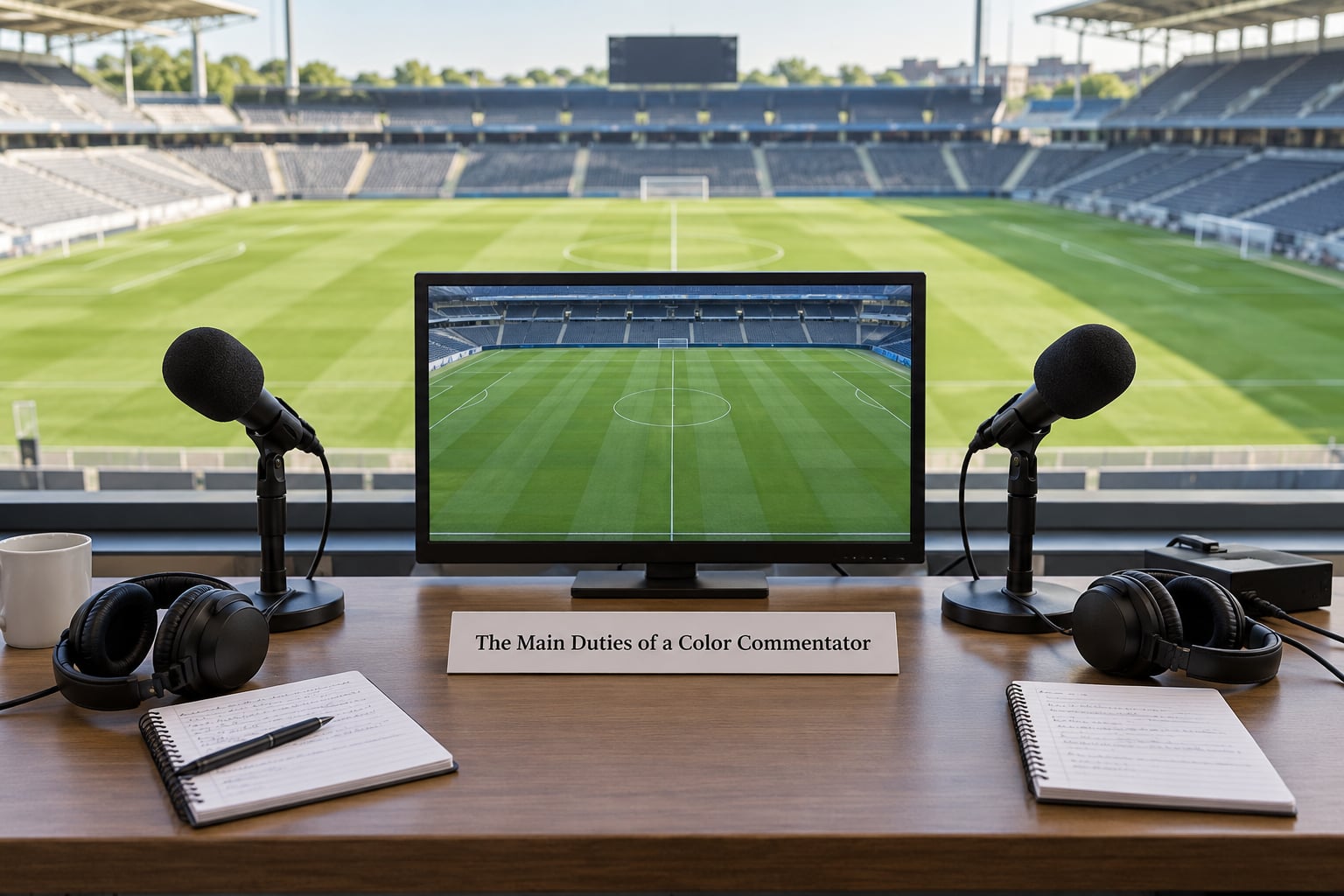
The role breaks down into a handful of practical jobs, and most of them happen in the seconds nobody notices.
- Explaining the action. Saying what just occurred in terms a casual viewer can follow, without re-describing what the eye already caught.
- Adding context. Prior meetings, playoff history, what happened the last time these two teams met, and why the current matchup matters.
- Breaking down strategy. Reading formations, coverages, pitch selection and defensive rotations, then explaining the intent behind them.
- Delivering the numbers. Statistics that fit in a sentence: shooting splits, defensive coverage rates, win probability at the moment it shifts.
- Reporting news. Injury updates, roster moves and anything that happened between the last broadcast and this one.
- Managing dead air. Filling stoppages, replays, commercial breaks and rain delays with something worth hearing.
- Setting tone. Keeping the broadcast watchable, which usually means controlled levity rather than a running joke.
- Staying accurate. Getting player names, roles and numbers right under real time pressure.
The last one sounds obvious and is the most common failure. Fans on r/Thunder threads have called out announcers for mispronouncing or misnaming players, and that complaint comes up more often than any complaint about analysis.
What Color Commentators Add That Play-by-Play Does Not
The play-by-play announcer’s job is to tell you what is happening right now, accurately and fast. The color commentator’s job is everything the play-by-play announcer cannot say while the ball is moving.
In football, the play-by-play voice says the quarterback threw a pass over the middle that was nearly intercepted. The color commentator says why the safety was cheating forward, which route was designed to get the ball outside, and that this offense has gone to the same concept on four of its last five snaps against this coverage. That is a completely different sentence.
In baseball, between pitches the color commentator will note that a reliever has come in with a pitch count that already suggests the platoon switch, or that the hitter has swung at the same pitch eleven times this season with poor results. Baseball gives the role less dead time and rewards brevity, which is why baseball analysts are often clipped tighter than football analysts.
In basketball, where stoppages are frequent and long, the color commentator has genuine room. Screens, pick-and-roll coverage schemes, matchup switches and pace all become explainable in a pause that would otherwise be twenty seconds of crowd noise.
In hockey, the color commentator often handles color of a different kind: pointing out a line change that took ten seconds off the clock, or a matchup the coach is deploying deliberately because of the other team’s penalty kill.
In soccer, the equivalent role explains pressing triggers, why a fullback tucked inside, and what a substitution signals about the scoreline. The role exists everywhere; only the vocabulary changes.
How a Color Commentator Prepares for a Broadcast
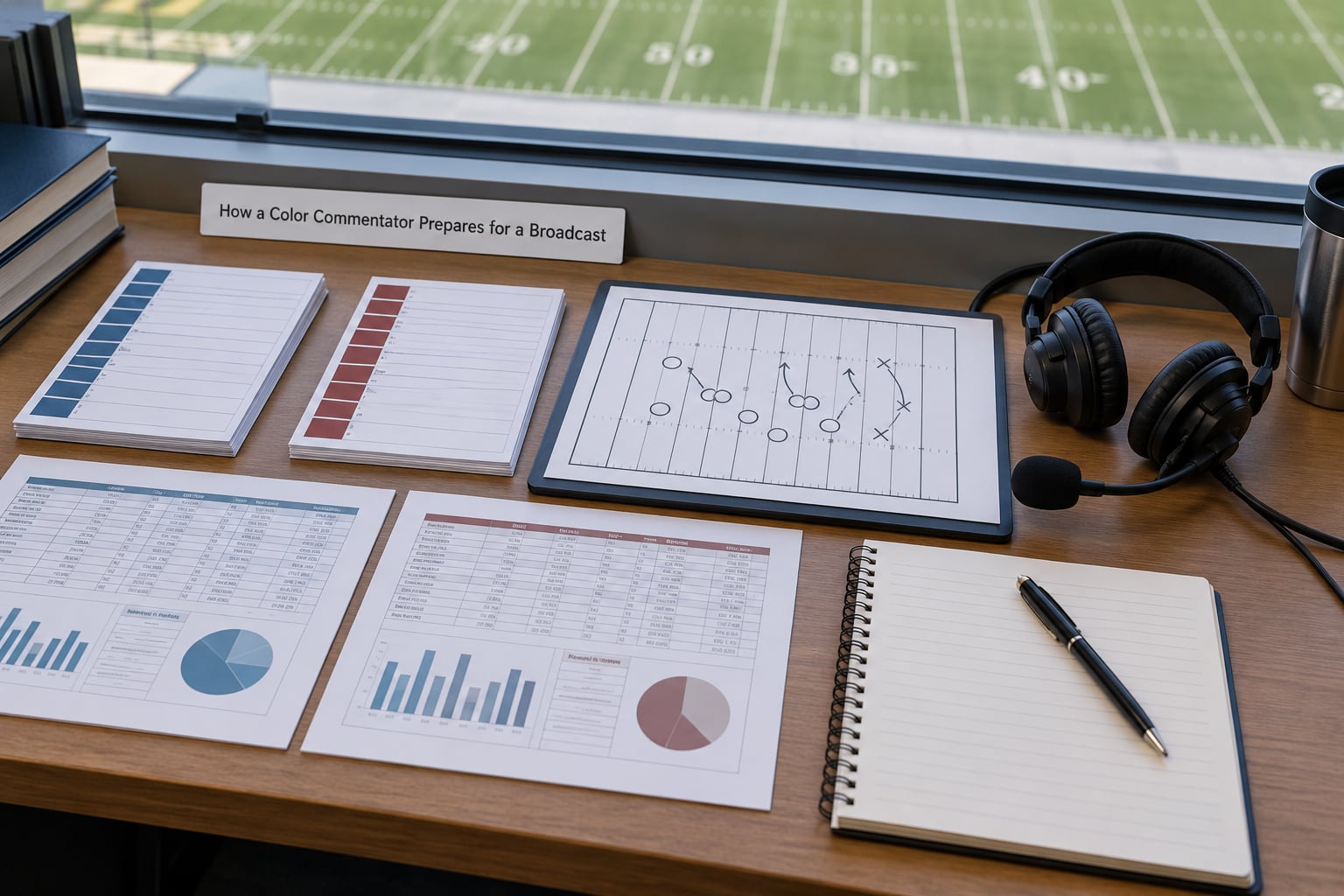
Preparation is where the visible job and the invisible job meet. Off air, a color commentator is doing something closer to a cross between scouting and journalism than anything to do with sound.
Pregame research. Depth charts, injury reports, transactions since the last game and whatever the beat reporter filed that morning. If the second-string quarterback is starting, a viewer should learn that from the color commentator, not from the graphic on screen.
Terminology. Knowing the names of formations, coverage shells, pitch types and stat categories well enough to use them without pausing. This is the mechanical part of the job and the easiest to get wrong live.
Statistical context. Not the raw numbers on the screen, which everyone can read, but the comparison that makes a number land. A figure means something only when the commentator knows the season average and the baseline.
Storytelling. Backstory that will matter later: a rivalry, a slump, a rookie who has never scored in this stadium. Set up in the first quarter, paid off in the fourth.
Technical preparation. Checking the headset, confirming the feed, reviewing the run-down with the producer and agreeing on what the pair will cover before the game and who takes the halftime segment. Booth coordination is at least partly planned, not entirely improvised.
Adapting. The plan changes when the game does. A starter gets hurt, a game becomes a one-score affair, a pitcher is removed. The prepared story that no longer fits gets dropped without ceremony.
The Skills Every Color Commentator Needs
Being able to explain a sport is the entry requirement. It is nowhere near sufficient. The skills that separate a competent booth voice from an exhausting one are mostly about behavior under pressure.
Clarity. Explaining a concept to someone who knows less than the announcer, using words that survive a bad speaker connection and a distracted living room.
Listening. Reacting to the partner, adjusting mid-sentence, and being comfortable stepping aside. On radio, where there is no video to anchor the timing, this matters more.
Subject knowledge. Deep enough to explain why something happened, not just name it. This is why former players, former coaches and former referees make up most of the top tier.
Analysis. The ability to say something in one sentence that a viewer did not know thirty seconds ago.
Judgment. Knowing which of six available observations is the one worth making. Over-explanation is the standard failure mode.
Improvisation. Handling a technical issue, a misunderstanding about a call, or a completely unexpected turn in the game without going silent.
Personality. The delivery is part of the job. Fans routinely praise a commentator for being informative without being annoying, which is a fairly precise brief.
Discipline. Calling the game correctly, protecting the partner’s moments, and never airing an opinion as fact when it is only a hunch.
What a Color Commentator Does With a Developing Play
Every live moment breaks into the same four steps, and the sequence is where the skill shows.
Identify what happened. Not the play itself, which the play-by-play announcer already covered, but the element of it that mattered — the coverage, the route, the pitch selection.
Explain why it mattered. One sentence of reasoning, in plain words: the safety was late, the batter was ahead, the defender went down early.
Connect it to the game. Where does this leave things? A drive, a count, a defensive adjustment, a matchup that is now decided.
Yield the mic. As soon as the action is live again, stop. Color commentators who get cut off mid-sentence are usually being told the handoff has gone wrong, and fans hear it as a failure of control rather than a lack of airtime.
Color Commentator vs. Play-by-Play Announcer
The difference is easiest to see side by side.
| Category | Color commentator | Play-by-play announcer |
|---|---|---|
| Primary focus | Why the play happened and what it means | What is happening right now |
| Speaks when | Play is dead, stoppages, replays, analysis segments | Play is live, essentially without pause |
| Typical language | “That matchup is about to decide this game” | “He’s open over the middle” |
| Information priority | Context, background, news, statistics that add meaning | Accuracy, speed, possession and score |
| Interaction with audience | Explains, frames, occasionally explains a call | Leads the listener through the game |
| Common background | Former player, coach, referee or rules analyst, journalist | Usually a broadcast career or journalism background |
| The question they answer | “Why did that work, and does it change anything?” | “What just happened?” |
One way to remember it: the play-by-play announcer describes the game, and the color commentator interprets it. Neither one is the more important half, and any booth that treats it as a solo job sounds thin within about ten minutes.
How Different Sports Change the Job
The role flexes around the sport’s rhythm. Football and basketball are fast and end-stopped, which favours short bursts of explanation between long stretches of listening. Hockey is quicker still, with frequent shifts, so the color commentator leans on matchup and line-change reads.
Baseball is the hardest case. Between-pitch windows are short, and a commentator who takes too long loses the next pitch. That discipline is why many baseball analysts have a shorter, more technical vocabulary than football counterparts.
Motorsport runs differently again. Because pit stops and safety cars create long windows, some broadcasts carry two analysts in the booth rather than one. Horse racing is its own case: the window between post time and the start of a race is a full half-minute or more, and the commentary is as much about handicapping and pedigree as about what you can see.
Studio work pulls the same skills in a different shape. The pregame show, halftime segment and postgame wrap use the analysis muscle without the pressure of live play, which is where most color commentators cut their teeth before anyone points a live camera at them.
Radio sharpens the job further. With no picture, the color commentator has to carry more visual description, and the play-by-play voice often slows slightly because nobody can see the ball. If you listen to football on the radio and then watch the same broadcast on television, the difference is a genuine part of the craft.
Common Mistakes to Avoid
Every recurring complaint about color commentators traces back to a short list of avoidable errors.
Talking over the partner. The most-cited fault, and the one fans on r/baseball and other forums mention first. The fix is simple discipline: yield the moment action resumes.
Repeating the play-by-play. Saying the same sentence twice in a row wastes the only thing the color commentator owns, which is interpretation.
Overusing jargon. Terms like “x-factor”, “empty” or “analytically sound” mean different things to different listeners. A viewer who nods along without understanding is not an engaged viewer.
Delivering analysis as certainty. An opinion dressed as a fact is the fastest way to lose a technical audience. Fans on r/soccer have been blunt about commentators they feel offer inaccurate tactical criticism and an unprofessional tone.
Getting names wrong. This is not a small slip. It is the most repeated complaint in fan threads, and it undercuts everything else the commentator says.
Sounding rehearsed. Analysis that arrives in identical phrasing every week reads as a script rather than a reaction. Variety comes from listening to what just happened, not from the run-down.
Ignoring clarity. The listener is in a car, on a bus or doing the washing up. If an explanation needs a second listen, it was too complicated.
There is a seventh, quieter one: treating a viewer’s question as an interruption. Announcers who visibly react to being asked something get clipposted for it, and the clip costs more than the segment earned.
How to Become a Color Commentator
The path in is narrower than most people expect, and it starts with the sport rather than the microphone.
Build genuine subject knowledge. Pick a sport and go deeper than a fan. Read the rule book, follow the beat reporters, watch film if the sport has it. Nothing in the broadcast is written or rehearsed enough to hide a hole here.
Practice explaining out loud. Explain the game you are watching to someone who does not follow it. Narrating sport to an unconvinced friend is the closest rehearsal to the real job that you can do alone.
Record and review. Record yourself describing a few minutes of a match, then listen back with headphones. Almost everyone talks too fast and too long. The recording shows it, which is the point.
Learn the equipment. A mixer, a broadcast headset and a basic audio chain are learnable at home, and radio-only work is where most UK and independent broadcasters start.
Get in front of an audience. Student radio, local station coverage, podcast breakdowns of a match, or video analysis clips are all reasonable first steps. A degree helps in sports communication or journalism but is not a requirement for the job itself.
Build a portfolio. Two to three minutes of clean, accurate, well-paced audio matters more than any certificate. That demo reel is the first thing anyone in broadcasting will ask for.
Expect feedback that stings. The criticism you get in your first year of local work is the same criticism you get on television, and learning to hear it early is the fastest route to improving.
Frequently Asked Questions
Is a color commentator the same as a play-by-play announcer?
No, they are two separate jobs that usually share one booth. The play-by-play announcer calls the live action as it happens, and the color commentator covers everything else: analysis, statistics, background, injury news and player context during stoppages. A good booth makes the handoff invisible, so many casual listeners only notice the second voice when it goes wrong.
Do color commentators call the score and the action?
Rarely. The score and the live action belong to the play-by-play announcer, and the color commentator defers as soon as play resumes. In some markets, especially where the calling style is looser, a color commentator will take over the play call entirely for stretches of a game, but that is an exception rather than the standard arrangement.
What should a color commentator talk about during a game?
Whatever the play-by-play announcer did not cover, kept short enough for the gap. Common material includes formations and matchups, season statistics and trends, injury and roster news, previous meetings between the teams, coaching decisions and adjustments, and a light anecdote to keep the tone moving. If a point needs more than about fifteen seconds of dead air, it belongs in the halftime segment instead.
How much preparation does a color commentator need?
More than most listeners assume. Before a broadcast, a commentator typically checks injury reports, roster changes, depth charts and recent form, then prepares context for matchups that are likely to decide the game. Preparation is also what makes live improvisation possible, because a prepared commentator has attention free to react rather than scrambling to find a fact.
Can a color commentator work without knowing the sport deeply?
You can start without deep knowledge, but not stay there. The role is built on explaining why something happened, and that requires more than the surface of the sport. Plenty of working commentators began as enthusiastic fans, but the ones who last are the ones who kept going past the basics into formations, statistics and tactics until the vocabulary became second nature.
What makes a color commentator good on live radio?
On radio there is no picture to lean on, so the commentator carries more visual description and the play-by-play voice tends to slow down to compensate. The radio version rewards the clearest communicators, because listeners cannot look away. It is also the best training ground in the business, since there is nowhere to hide and every habit on the mic shows.
A Clearer Broadcast Starts With Good Preparation
The role is simpler than its critics make it sound. A color commentator describes what the play-by-play announcer left out, explains why it matters, and then gets out of the way before the next play starts. Get that handoff right and most of the usual complaints disappear.
If you want to understand the job better, start by listening to a full game with both voices switched off from your own narration in one ear. Try describing the action in the other, and notice how quickly you repeat yourself. Then listen back to a team you think handles it well. That exercise teaches more about what a color commentator does than any description can.