
If you have ever wondered how Latin radio formats differ, the answer comes down to three things: which genres form the core of the music mix, which era and language of songs they draw on, and which audience the station is built to attract. Two stations serving the same Spanish-speaking city can share a language, a market and even a transmitter site and still have almost no songs in common.
That gap is where most listener confusion sits. A station brands itself as one thing, plays a dozen genres inside a single hour, and switches mood twice before lunch. The label turns out to be a loose summary of a much more specific arrangement.
What follows is the working version of that arrangement: what a radio format actually is, how the major Latin formats are separated from one another, how you can identify one by ear while it plays, and where the labels stop being reliable.
Table of Contents
- What Is Latin Radio?
- How Latin Radio Formats Differ by Music and Audience
- Language, Hosts and Local Personality
- How to Identify the Format While You Listen
- Latin Radio at a Glance
- Frequently Asked Questions
- What is the difference between Latin music and Latin radio?
- Are all Latin radio stations playing the same kind of music?
- How can I tell if a station plays salsa, merengue or bachata?
- Does Latin radio only use Spanish-language programming?
- Can I find niche Latin radio formats online?
- Why does the same genre sound different from one station to another?
- Conclusion
What Is Latin Radio?
Latin radio means Spanish-language commercial music broadcasting. It is an umbrella term covering many distinct formats, not a single station type. Groups that operate several named formats across the same metropolitan market — Univision and the Spanish Broadcasting System are the familiar US names — do it because a station built around salsa in one part of town and a station built around regional Mexican music a few miles away serve different listeners on different terms.
A radio format, in plain terms, is a commitment to a specific mix of music, a specific style of presentation and a specific audience, repeated on a fixed schedule so listeners know in advance what they will hear. US audience measurement and format naming follow Nielsen’s categories, which is where names like Spanish Tropical, Regional Mexican and Spanish Adult Contemporary come from.
Three levels sit underneath that commitment. The station format is the overall identity — Spanish Tropical, say. The program format is what happens inside one part of the day; a morning personality drive show and a midday music sweep can share the same format name and share almost no music. The genre component is the actual style of song: salsa inside tropical, norteño inside regional Mexican.
Two terms explain most of what follows. The music mix is the ratio of genres inside a station’s playlist — how much of the hour is dance styles, how much is ballad, how much is a language other than Spanish. The format clock is the hour-by-hour schedule that places those genres, and a daypart is simply a named block of the day: morning drive, midday, afternoon drive, evening. A good format has a recognisable daypart. A lazy one repeats the same playlist at 7am and 7pm.
Rotation sits underneath both. Core artists get frequent plays; recurrent rotation, usually written as R&R in trade papers, is the pool of songs that return every few hours rather than every few spins. A format that mixes styles on purpose is easier to follow when you know that some of the variety is a designed mix and some of it is just a bridge between eras.
How Latin Radio Formats Differ by Music and Audience
Formats separate along eight practical lines: musical style, language, era, tempo, regional focus, presenter style, listener interaction and the amount of news or entertainment content. Nobody tunes in for all eight consciously, but they decide whether a station feels familiar or strange after about ten minutes.
The four lines that do most of the work are musical style, era, regional origin and language. A salsa-heavy playlist and a regional Mexican playlist can share a beat, a tempo and a Spanish-language vocalist and still belong to different formats, because the instruments, the places the music came from and the decades it draws from are different. Underneath that sits audience: a format built for one diaspora behaves differently from a format built to be broad. Working out how Latin radio formats differ on each of those lines is a matter of knowing which ones a station has actually committed to.
Salsa Format
Salsa radio sits close to one genre, which makes it the easiest format to identify. Look for congas, timbales, a piano montuno, trombones and cowbell, and a lead vocalist who phrases rather than raps. The rotation usually divides into two camps: salsa dura, the harder 1970s New York and Panama City sound, and salsa romántica, the softer romantic ballad that shares most of its instrumentation but slows down and adds strings.
The romantic camp is what makes salsa a format question rather than a purely musical one. A station can run all salsa romantic for morning drive, move to the harder cuts in the afternoon and slot in salsa urbana from Puerto Rico in the evening. Core listeners tend to come from the Cuban, Puerto Rican, Colombian and Venezuelan communities in the diaspora, and they are unusually loyal to a specific era of recordings.
Merengue Format
Merengue is the fastest dance music most US Latin stations play, and it is easy to spot once you know what to listen for. The rhythm is a sharp two-beat, usually carried by the cuatro, guira and tambora, with saxophones and tuba providing the brass colour. The key is tempo rather than volume — a merengue track feels noticeably quicker than the bachata and salsa around it even when the station’s overall level stays the same.
US merengue stations are uncommon as standalone formats; merengue tends to live inside a wider tropical or Spanish Tropical playlist as a defined share of the music mix. Inside that setting the regional differences matter more than the genre label. Merengue típico uses a full band and a brass-heavy arrangement, merengue de salón softens into a slower, smoother swing, and merengue urbano pushes the rhythm toward reggaeton and dembow territory.
Bachata Format
Bachata carries two sounds in one genre, and stations usually lean toward one of them. The dance side leans on the mouth guitar, a small guitar carried at chest height that gives the rhythm its dry, percussive edge, usually at a steady mid tempo. The romantic side takes the same rhythm, slows it and layers on synthesised strings and a large ballad vocal, which is why bachata often sits next to balada programming.
Modern bachata is the version most US stations play, with the traditional instruments thinned out in favour of a four-on-the-floor pop production. Dominican and Puerto Rican listeners tend to have strong views about which version is correct. Expect regional Mexican and Caribbean stations to treat bachata differently even when they play the same recording.
Regional Mexican Format
Regional Mexican is the widest music mix on US Spanish-language radio and the one with the clearest regional identity. A single station can rotate norteño, banda, grupera, ranchera, regional Mexican pop, mariachi and the newer generation of regional Mexican corridos, and it can do so without sounding random, because all of it comes from Mexican traditions with recognisable instrumentation: bajo sexto, accordion, tuba and clarinet, requinto and violin.
Music that arrived from the border — the norteño and Tijuana sound, and the newer corridos tumbados — is usually treated as current rather than recurrent, so it turns up more often in drive hours. Older ranchera and mariachi recordings tend to sit in the recurrent pool. State and regional identity matters enormously here: what counts as core music in Texas is not the same as what counts as core in Southern California or the Great Lakes.
Latin Pop and Contemporary Format
Latin pop programming crosses borders on purpose. It balances established international artists with emerging names from several countries at once, and its era spans far less than other formats — a song two or three years old is usually still considered current. Presentation tends toward a clean, upbeat voice and a low interview load.
This is the format most likely to be bilingual. Some stations run Spanish-language hours with English-language songs and English presenters mixed in, particularly in markets with large Puerto Rican and Mexican-American populations. The result is a playlist where language is a deliberate choice rather than a fixed rule, which is a clear signal when you are trying to identify a format by ear.
Tropical and Caribbean Format
Spanish Tropical is the widest of the Caribbean-leaning formats: salsa, merengue, bachata, cumbia and reggaeton all sit inside it, and the mix is usually majority dance with a defined minority of slower songs. Where cumbia has a local following, or where the station serves a Colombian, Venezuelan or Afro-Caribbean community, those styles get a bigger share than the format name suggests.
Industry naming is inconsistent here, and that inconsistency is a real source of listener confusion. The same reggaeton-heavy playlist may be labelled Spanish Tropical, Latin Rhythmic or Latin Urban depending on the market and the owner. In practice, a Latin Rhythmic lean tends to mean a tighter reggaeton focus, while a Latin Urban lean tends to mean a broader pan-Latino dance mix with more room for alternative and crossover artists.
Latin Rock, Alternative and Urban Formats
A small number of stations run specialist formats built around Latin rock, rock en español, indie and alternative acts, Latin urban and hip-hop, or fusion that borrows from rock and electronic production. These are narrow formats with small but committed audiences, and they are rarely the first thing you find by scrolling a dial.
They are far easier to find online. Streamed channels, app-based stations and playlists built around a single scene do the same job that a terrestrial licence does in bigger markets: keeping a format available when the audience is too small to support a full broadcast day. The practical trade-off is that you get the music mix without the local personality, contests or news that make a broadcast station worth listening to past the song.
Language, Hosts and Local Personality

Two stations can run the same music mix and still feel like different services, because language and personality are part of the format rather than decoration. A Spanish-first station speaks entirely in Spanish and treats English-language songs as an occasional guest. A bilingual station treats both languages as routine, moving between them mid-break without ceremony.
Presenter style is the other half. Some formats lean on high-energy drive personalities who talk over the intro, run contests and take requests. Others run narration-free music sweeps with a short live segment at the top of the hour. Interviews, listener requests and station sweeps are the standard interaction tools, and they are more prominent in formats with a talk component than in music-only ones.
Local cultural content is what listeners react to most strongly. Radio discussion boards keep returning to the same complaint: translated English-language content that reflects American pop culture rather than the listener’s own, slotted into a playlist that otherwise comes from somewhere else entirely. The flip side is that a station which only serves one diaspora can feel out of place in a market that is mostly another. Most stations land somewhere between the two.
Spanish-language talk and news formats sit alongside the music formats rather than inside them. They share the language and often the ownership, but the format is defined by information rather than a music mix, so they behave differently and appeal to a different part of the day.
How to Identify the Format While You Listen
You can place almost any Latin station within a format in a few minutes using six signals. Work through them in order, and stop as soon as the format is clear.
- Listen to the language first. Spanish only, Spanish with English songs, or genuinely bilingual delivery tells you whether you are hearing a Spanish-language music format or a bilingual pop service.
- Note the tempo. The fastest cuts on the station give you the format family. Merengue and perreo sit at one extreme, balada and romantic salsa at the other.
- Identify the instrumentation. Conga and timbale point to salsa. Bajo sexto and accordion point to regional Mexican. Four-on-the-floor pop production with a dembow beat points to reggaeton or Latin urban. Mouth guitar points to bachata.
- Check the era. Four recordings from the 1980s, or a run of music from the last eighteen months, tell you which side of the format clock you are hearing.
- Listen to the presenter. Language, tone and how much talk there is between songs separate a personality-driven drive show from a music-only sweep.
- Track the regional consistency. If the playlist stays inside one country’s traditions for an hour, that is a regional format. If it keeps switching geography, it is a pan-Latino or contemporary format.
Two caveats. The first is the daypart: a single station can move from morning ballad to midday variety to afternoon party music without changing format, so judge on a full rotation rather than on one hour. The second is the label itself. Format names are applied locally, sometimes loosely, and two stations in different markets can carry the same name with completely different music.
Latin Radio at a Glance
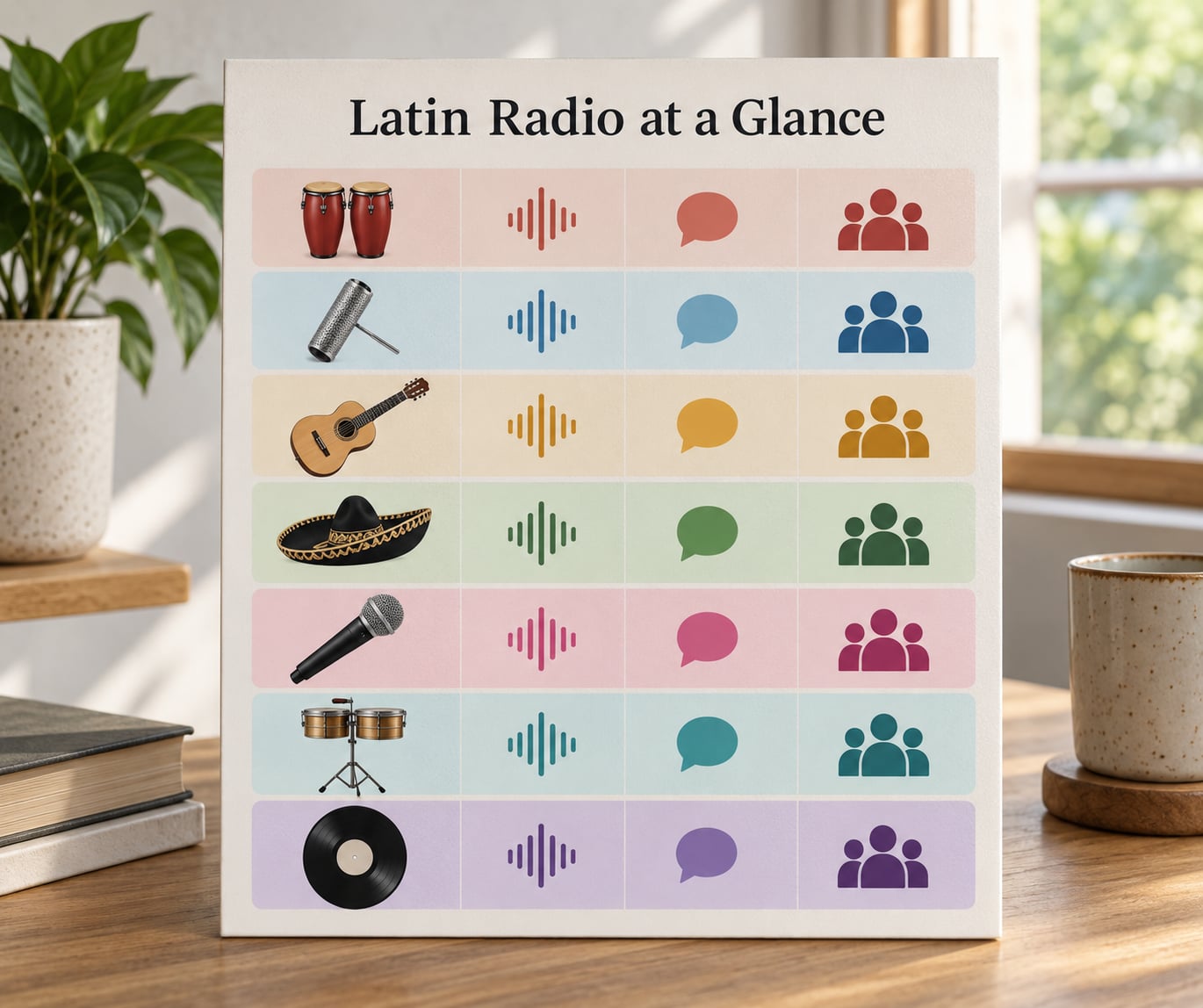
Here is the same comparison in one place. The rows describe the core of each format rather than every song a station might play.
| Format | Musical identity | Typical language | Defining traits | Programming focus | Likely listener |
|---|---|---|---|---|---|
| Salsa | Salsa dura and salsa romantica | Spanish | Congas, timbales, piano montuno, trombones | Genre-led rotation with a strong recurring era | Cuban, Puerto Rican, Colombian and Venezuelan diaspora listeners |
| Merengue | Merengue tipico, de salon and urbano | Spanish | Cuatro, guira, tambora, brass, fast two-beat | Usually a defined share of a tropical music mix | Dominican and Caribbean listeners across US markets |
| Bachata | Traditional bachata and modern pop bachata | Spanish | Mouth guitar, steady mid tempo, ballad arrangements | Dance and romantic halves spun separately | Dominican and Puerto Rican listeners, often alongside salsa fans |
| Regional Mexican | Norteno, banda, grupera, ranchera, corridos, mariachi | Spanish | Bajo sexto, accordion, tuba and clarinet, requinto, violin | Wide mix with strong state and regional identity | Mexican and Mexican-American listeners, plus regional crossover |
| Latin Pop | Contemporary pop from several countries | Spanish, often bilingual | Clean production, low instrumental signature, short era window | Current hits balanced with emerging artists | Broad pan-Latino audience and bilingual listeners |
| Tropical and Caribbean | Salsa, merengue, bachata, cumbia, reggaeton | Spanish | Majority dance styles with a defined minority of slower songs | Dayparted energy, high personality load | Caribbean-origin communities across US markets |
| Specialist Latin | Latin rock, alternative, urban, fusion | Spanish or English | Scene-specific sound, narrow core artists | Music-only or light talk, mostly online | Small, committed, often younger audiences |
Read across a row and the differences are clear. Read down a column and you see why formats drift apart: each column is a separate decision a programmer has to defend to the audience.
Frequently Asked Questions
What is the difference between Latin music and Latin radio?
Latin music is a set of musical styles built from Spanish-speaking traditions, including salsa, merengue, bachata, cumbia, norteño and regional Mexican music. Latin radio is a broadcast format: a station’s promise about which of those styles it plays, in which era, in which language and for which audience. Music is the raw material; the format is the arrangement, the schedule and the presentation built from it.
Are all Latin radio stations playing the same kind of music?
No. A Spanish Tropical station and a regional Mexican station can be ten miles apart and share almost nothing, because one is built on Caribbean dance styles and the other on Mexican traditions. Even inside one format, a daypart change can move the playlist from ballads in the morning to high-tempo dance music in the afternoon. Format overlap exists, especially between salsa and tropical, but it is the exception rather than the rule.
How can I tell if a station plays salsa, merengue or bachata?
Use tempo and instrumentation. Salsa uses congas, timbales, piano montuno and trombones, usually at a mid-to-up tempo with a vocalist who phrases rather than raps. Merengue is noticeably faster, built on a sharp two-beat with cuatro, guira and tambourine and heavy brass. Bachata has a dry, percussive mouth guitar at a steady tempo, and its romantic versions slow down with string layers and a large ballad vocal.
Does Latin radio only use Spanish-language programming?
Mostly, but not exclusively. Spanish-first formats treat English-language songs as occasional guests, while bilingual pop stations mix English and Spanish routinely in both songs and presenter delivery. Some specialist formats, particularly Latin rock, alternative and urban channels, are English-language or fully bilingual by design. Presentation is part of the format, so the language mix is a useful identification signal when you are tuning in cold.
Can I find niche Latin radio formats online?
Yes, and online is often the only place some formats exist. Streamed channels, apps and playlists cover Latin rock, regional Mexican, salsa and oldies formats that no local broadcast licence supports. The trade-off is that a stream usually gives you the music mix without the local personalities, contests or news segments that make a terrestrial station distinctive. Check the format description before you commit to a channel.
Why does the same genre sound different from one station to another?
Because a format is more than a genre. Two salsa stations can share the same style and still differ in era, tempo, how much of the hour is romantic versus hard, how many voiceover breaks sit between songs, and how much commercial content the clock carries. Format names are also applied loosely and locally, so the same label in two markets can mean different music. Judge by the music mix and the clock, not the logo.
Conclusion
Knowing how Latin radio formats differ comes down to four axes: which genres fill the music mix, which era they come from, which country or diaspora they belong to, and which language they are presented in. Salsa is genre-led and Caribbean in lineage. Merengue and bachata sit inside the tropical family with their own tempos and instruments. Regional Mexican is the widest mix and the most strongly regional. Latin pop crosses borders and often crosses languages. Specialist channels cover the scenes that no local licence can support.
Do this first: tune in and judge thirty seconds of music on language, tempo and instrumentation before you believe anything the station calls itself. Then check the regional consistency of the hour, and listen through one daypart change before writing the format off. The label is a useful summary. The music is the evidence.