A gospel radio station runs on a format: a written set of rules that decides what plays, when, how often, and how it is presented to the listener. That format combines music from chosen sub-genres such as Southern Gospel, Adult Black Gospel, Contemporary Gospel, Inspirational, Urban, Traditional and Rock Gospel with host talk, recorded features, imaging and promotions.
Understanding that machinery changes how the station sounds to you. Once you can hear the clock, the rotation and the voiceover, the repetition stops feeling like an accident and starts feeling like a decision.
Last reviewed October 2026. Examples draw on published station schedules, the Gospel Music Association and Southern Gospel Music Association, and broadcaster glossary terms published by Christian Music Broadcasters.
Table of Contents
- What Is the Typical Gospel Radio Format?
- How Gospel Radio Stations Build the Music Rotation
- How Gospel Radio Stations Use Jingles, IDs, and Sweeps
- How the DJ Break Is Structured
- How Gospel Radio Stations Schedule Shows and Specials
- How Commercials and Listener Promotions Fit Into Gospel Radio
- How Gospel Radio Stations Create a Listener-Friendly Sound
- How the Format Varies by Gospel Style and Market
- Frequently Asked Questions
- What is a typical gospel radio station schedule?
- Do gospel radio stations play only gospel music?
- How often do gospel radio stations take commercial breaks?
- Can listeners request songs on gospel radio?
- What is the difference between traditional and contemporary gospel radio?
- How can I find a gospel radio station that matches my taste?
- Conclusion
What Is the Typical Gospel Radio Format?
A gospel format has three working parts: music, words and features. Music is the playlist. Words are the live host and any syndicated talk. Features are everything recorded in advance that wraps around the music, including sweepers, station IDs, birthdays, shout-outs, interviews, promos and contest call-ins.
Most stations also layer a funding model on top. A commercial station runs standard advertising breaks. A non-commercial, listener-supported station runs underwriting spots in place of commercials and adds more community content. A hybrid does both, often with underwriting during certain hours and ad inventory at others.
That mix is what makes two gospel stations playing the same songs sound nothing alike. One leans into teaching and devotional blocks with a warm, low-key voice. Another runs fast sweeps, short breaks and a lot of artist news. Neither is wrong. They are different formats aimed at different listeners.
Format staff usually split into a program director, who owns the sound and the schedule, a music director, who handles song selection and rotation, and a production director, who records imaging and features. Smaller stations fold all three jobs into one or two people.
How Gospel Radio Stations Build the Music Rotation
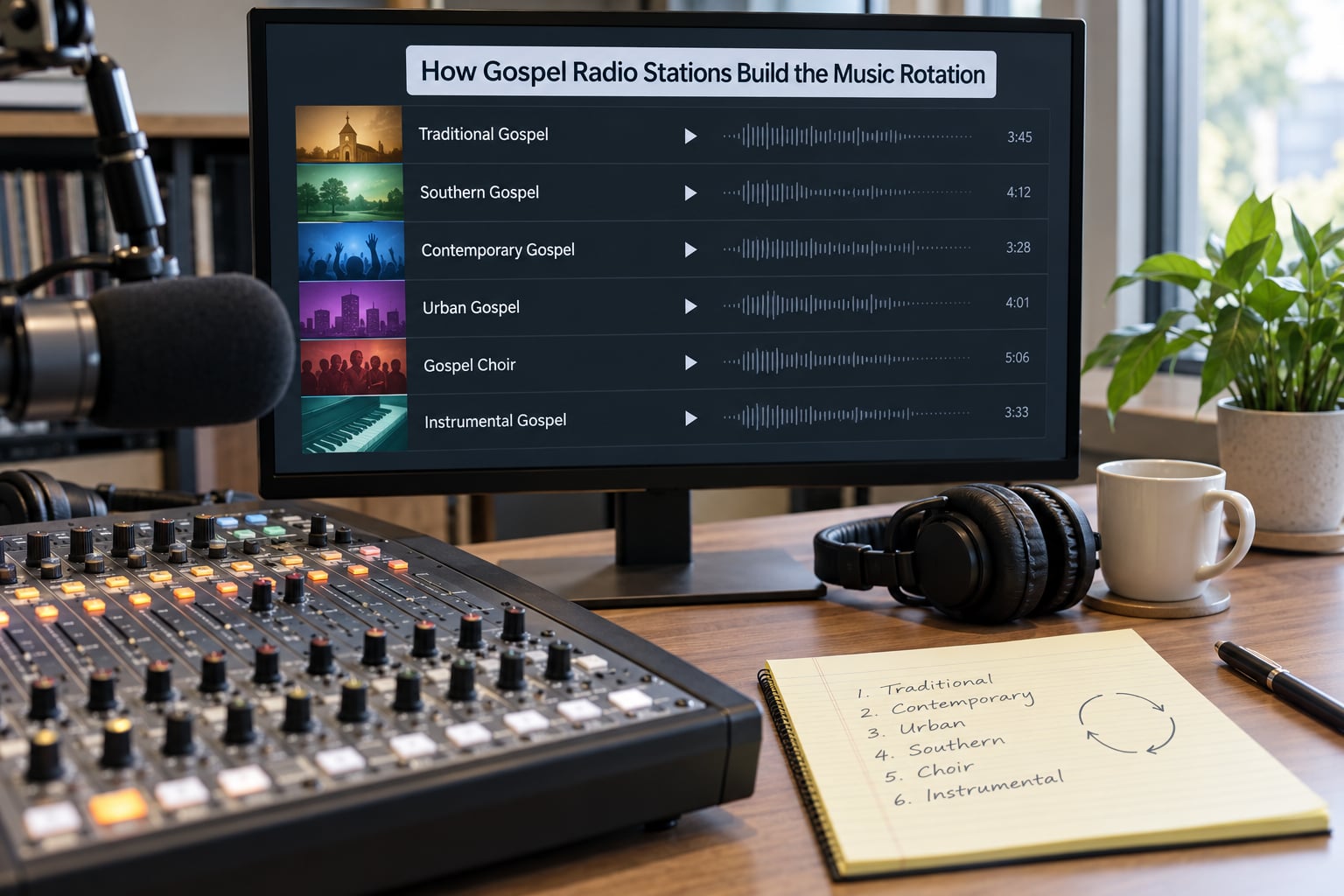
Music directors choose songs by era, sub-genre, tempo, vocal style, lyric theme and how well a record holds up next to what else is in rotation. Familiarity matters more than novelty in most gospel formats, so established artists often stay in the mix longer than pop stations allow.
Songs are then sorted into rotation categories, each with its own rules about how often it may play:
- Feature rotation. New records and songs the station is pushing. High frequency, short life, often given a premiere add and a countdown.
- Current rotation. Recent additions that are holding up. Steady exposure until listeners either take to them or fade out.
- Recurrent rotation. The core of the station. Songs that stay in for months and define the sound.
- Gold rotation. Proven records and classic gospel from earlier decades. Never the same proportion across formats: an Adult Black Gospel or Traditional station may live on gold, while a Contemporary station uses it sparingly.
Those categories are enforced by recurrent rules, which are written limits on repetition. A rule might say a track cannot play twice in one hour, or sets a daily cap for a single record, or requires a minimum gap between two songs by the same group. The rules exist because a small core listener group hears the same station far more than a casual browser does.
This is where the familiar complaint comes from. Broadcaster glossary material measures it as a turnover ratio: cumulative audience, the number of people who tune in over a period, divided by average quarter-hour audience, the number actually listening at any moment. A station with a big turnover ratio can safely play more unfamiliar music. A station with tight cume has to lean on familiar records, and you hear the same three songs in a row.
The music log: how gospel radio stations are formatted hour by hour
The music log is the schedule itself, written hour by hour. A program director uses it to decide how many songs and how many minutes of talk and features each hour gets. Here is a simplified version of a typical weekday:
| Hour | Daypart | Music | Words and features |
|---|---|---|---|
| 5:00–6:00a | Early morning | Slow gospel, mostly gold | Quiet worship hour, minimal talk, short promos |
| 6:00–10:00a | Morning show | Recurrent-heavy mix | Live host, birthdays, call-ins, weather, community board |
| 10:00a–3:00p | Midday | Full mix, most feature rotation | Short breaks, artist news, listener appreciation promos |
| 3:00–6:00p | Drive | Up-tempo emphasis | Light talk, fast breaks, requests taken live |
| 6:00–8:00p | Evening worship hour | Slower, message and praise emphasis | Minimal talk, devotional content |
| 8:00p–12:00a | Overnight | Automated playlist | Recorded features and imaging, few live elements |
Note how the music changes with the listener. Early morning and late evening lean slower and more reflective. Midday carries the widest mix. Drive time gets the energy up because that is when people are in the car.
Not every song plays in every hour. A station will often keep its newest and loudest material out of the overnight slot, and hold the most devotional material for the evening worship hour.
How Gospel Radio Stations Use Jingles, IDs, and Sweeps
Station IDs and jingles are the shortest and most repeated pieces of audio on a gospel station. An ID is the station name and legal call sign at the top of an hour, usually woven over music. A jingle is the short musical signature that plays with it. You have heard both several thousand times without noticing.
A sweeper is the voiceover that bridges two pieces of the hour. Music ends, a recorded voice says something like the station name, a promo or a line about what is coming next, then the next song starts. Sweeps are what make a station sound like a station rather than a shuffled playlist, and they are almost always pre-recorded so the station sounds the same on every daypart.
Stingers are shorter sting versions of the same idea, used to drop into a song without a full break. A station might use one before a contest or before artist news.
Songs are joined either by a segue, where one fades under the first bars of the next, or a crossfade, where both mix together for a second or two. Longer ballads tend to segue; upbeat tracks crossfade so the energy does not sag.
Behind all of it sits audio processing. A compressor evens out the loudness so quiet lines do not disappear on a car speaker. A limiter catches peaks. Processors like those from various vendors tighten the sound and keep it consistent hour to hour, which is why a gospel station sounds denser and louder than the same records played at home.
How the DJ Break Is Structured
A DJ break is the talk segment that gives a station its personality, and gospel breaks tend to follow a recognisable order. The host comes out of the song, gives the time and the station name, welcomes listeners by name, then talks.
What comes next varies by station and by daypart. On a listener-funded station you will hear ministry content: a short devotional, a scripture reading, a prayer, a segment on faith or family. On a commercial station you will hear artist news, upcoming appearances, event promotion and station promotion instead, kept to a few minutes so the music comes back quickly.
Then the hand back to music. Good hosts do it the same way every time, and listeners rely on that. The station name and a tease of what plays next, a final thank you to callers or listeners, then the song.
The length of a break changes across the day, and that length is written into the format. Overnight automation might allow only a few seconds of voice. Midday might run several minutes. Drive time is usually kept tight because listeners are driving.
Requests are where the DJ role gets interesting. Many stations take calls or messages during specific shows, and the host reads a handful. A good host turns a request into a segment: the reason behind the song, a memory attached to it, the listener’s name and town. That is content you cannot get from a playlist.
How Gospel Radio Stations Schedule Shows and Specials
Dayparts are the named blocks of the broadcast day, and each one has its own music mix and amount of talk. The schedule you see on a station’s website is the visible part of it; underneath, the daypart rules govern everything from tempo to talk length.
| Daypart | Typical approach |
|---|---|
| Morning show | Live host, longest talk blocks, birthdays, call-ins, weather, community board |
| Midday | Balanced music and short breaks, artist news, promotions, request segments |
| Drive | Highest energy, shortest breaks, frequent sweeps and requests |
| Evening worship hour | Slower material, message songs, devotional and scripture segments |
| Late evening | Return to music-first, softer talk allowance |
| Overnight | Fully automated playlist with recorded features, no live host |
| Weekend | Longer specialty blocks: live worship services, request marathons, teaching shows, anniversary tributes |
Teaching and preaching programs usually sit in the early morning or late evening, where the audience is listening deliberately rather than in the car. Contemporary stations tend to put them off-peak, where the hours allow them to run without disturbing the core music daypart.
Weekend is where personality shows. A Southern Gospel station might run a four-hour quartet request hour. An Adult Black Gospel station might run a long devotional or tribute block. Contemporary stations often carry live worship services and artist interviews.
Seasonal programming follows the same logic. Expect heavier Christmas rotation from late autumn through December, Easter material in the spring, and celebratory features around artist anniversaries and Gospel Music Association week.
How Commercials and Listener Promotions Fit Into Gospel Radio
Break placement is written into the log, not left to judgement during the show. Commercial stations typically run breaks after every two to four songs, with longer pods at the top and bottom of the hour where audience numbers are highest. Non-commercial stations follow the same rhythm with underwriting spots, which are produced by the station rather than sold as standard advertising, and often read the sponsoring organisation’s name and mission rather than a sales pitch.
Advertisers on commercial gospel stations tend to be businesses that want to reach the same audience: churches, gospel artists and their labels, Christian bookstores, event promoters, local businesses run by church members, and organisations serving the community the station draws from. A station that airs a teaching segment in the morning often sells that segment as a sponsorship.
Listener promotions fill the same slots with audience-facing content instead of revenue: contest call-ins, birthday and anniversary shout-outs, artist interviews by phone, listener appreciation events, station appearances at community events, and reports from church conventions and gospel concerts.
The balance is a constant negotiation. Too much promotion and listeners tune out for the hour. Too little and the station loses community presence, which is the currency a gospel format trades in. Most formats cap promo time and count it against the total word count for the hour, which is why you will rarely hear three promos back to back.
How Gospel Radio Stations Create a Listener-Friendly Sound
The goal is flow: the hour should feel like it is moving even when it stops to talk. Pacing, vocal style and spacing do most of that work, and a few rules of thumb explain how.
Song spacing matters. Stations judge a mix by whether two consecutive songs sound alike in tempo, key feel or production style, and they adjust the next choice to avoid a jarring jump. Singing right after singing, at the same energy level, makes an hour feel repetitive even when every song is different.
Vocal introductions are used sparingly on music-first stations and generously on teaching-oriented ones. A one-sentence intro over the first fifteen seconds of a song tells you why it is playing without breaking the music. A fifteen-second spoken intro stops the music entirely, which is a bigger interruption than most listeners realise.
Local relevance is the other lever. Birthdays, weddings, church news, weather for the station’s own service area, and reports from events in the listener’s own town are cheap to produce and they are what turns a station into a community voice rather than a stream.
Here are the broadcaster terms you will hear in station promos, industry write-ups or interviews, translated:
| Term | Plain meaning |
|---|---|
| Format | The complete set of rules governing what a station plays and how |
| Music log | The hour-by-hour schedule of songs, talk and features |
| Format clock | How a single hour is divided among those elements |
| Daypart | A named block of the broadcast day with its own rules |
| Recurrent rotation | A song given regular scheduled airtime |
| Gold | Established records and classic material |
| Sweep | A recorded voiceover between elements |
| ID | The station name and call sign, legally required at the top of the hour |
| Imaging | All the recorded branding: IDs, jingles, sweeps, promos |
| Voiceover | Pre-recorded station voice used between songs |
| Segue / crossfade | Ways of joining one song to the next |
| Cume | Cumulative audience, everyone who tuned in over a period |
| AQH | Average quarter-hour audience, who is listening at this moment |
| TSL | Time spent listening, usually per day |
| Underwriting | A non-commercial station’s version of an advert |
| Spin | One airing of a song |
| Add | A song newly added to the playlist |
How a song travels onto the playlist follows the same path at most stations. The label or artist submits it, the music director listens to everything that comes in, promising material may go into testing or research, and then it gets added with a rotation category and a recurrent rule attached. Promotion follows it through. Once it is in and working, it drops off and the next add takes its place.
Airplay is tracked by panels of monitored stations, most visibly through the Billboard Gospel Airplay chart, which counts detections from reporting stations. Artists do not get paid per spin. Airplay drives the audience, and the audience is what generates bookings, sales and income for labels and artists. Station sources also need music licences through CCLI.
How the Format Varies by Gospel Style and Market
How gospel radio stations are formatted depends heavily on which gospel the station serves. The sub-genre sets the music weighting, the tempo of the rotation, how much talk there is, and who is hosting. Two stations in the same city serving different sub-formats will have completely different logs.
| Sub-format | Core sound | Rotation and presentation |
|---|---|---|
| Southern Gospel | Quartets, trios, traditional harmony, gospel piano | Fast rotation, tight break structure, requests and dedication features are core to the show |
| Traditional Gospel | Older gospel, quartets, sacred and orchestral | Heavily gold-weighted, slow turnover, long-form uninterrupted music |
| Adult Black Gospel | Testimonies, devotional, choir and quartet recordings | Teaching and testimonial content sit alongside music, fuller devotional features |
| Urban Gospel | R&B-influenced gospel with a younger audience | Music-forward, artist news, contemporary production, shorter talk blocks |
| Contemporary Gospel (CHG) | Polished modern worship and inspirational pop | Highest new-music turnover, energetic sweeps, features and interviews |
| Inspirational | Adult contemporary with Christian lyrics | Played alongside mainstream AC stations, softer praise emphasis |
| Rock Gospel | Gospel rock, punk and metal adjacent | Fast rotation, young audience, weekend specialty blocks often carry the niche |
Market size changes things too. A large metro station can run a live morning show, a midday host and a separate overnight voice. A small-town or rural station may run the entire day on one automation system with two or three live shows patched in.
Signal type matters as well. AM stations in the gospel world lean toward teaching and preaching, with more spoken programming and less music. FM stations lean toward music-first formats. HD sub-channels and streaming apps often carry the specialty formats that would not fit a main channel, such as rock gospel or hard traditional.
Today the same format reaches well past the transmitter. Stations simulcast on apps, and shows are often available as podcasts afterwards. A morning show you missed at 7am is frequently waiting for you on demand, which quietly changes how much repetition a listener actually experiences.
Frequently Asked Questions
What is a typical gospel radio station schedule?
A typical gospel station runs music most of the clock and layers talk around it. A live morning show carries birthdays, weather and call-ins; midday and drive time lean music with short breaks; an evening worship hour goes slower and devotional; overnight is usually fully automated with recorded features. Weekends bring longer specialty blocks like request hours, live worship services and teaching shows.
Do gospel radio stations play only gospel music?
On the main music channel, essentially yes. Every format has a defined music mix built from chosen sub-genres, so a Southern Gospel station plays quartets and traditional harmony while an Adult Black Gospel station leans on testimonies and devotional material. Exceptions are common at the edges: teaching and preaching segments, holiday specials, and HD sub-channels that run a deliberately different style from the main signal.
How often do gospel radio stations take commercial breaks?
Commercial gospel stations usually take a break after every two to four songs, with longer pods at the top and bottom of the hour when more people are listening. Non-commercial and listener-supported stations follow a similar rhythm but run underwriting spots instead of conventional advertising. Either way, the break length is written into the format, which is why break length varies by daypart and why the late-night hours stay tighter.
Can listeners request songs on gospel radio?
Often, yes, though the route depends on the station. Many stations take requests by phone, text or social during specific request shows, usually hosted in drive time or at a set point in the morning. Request-based stations like Southern Gospel formats build the show around dedications. Some stations run primarily on music-director programming with no request window, so the station’s own schedule page is the place to check.
What is the difference between traditional and contemporary gospel radio?
Traditional gospel radio centres on established material: quartets, classic recordings and gold from earlier decades, with slow turnover and long stretches of uninterrupted music. Contemporary gospel radio, often called CHG, centres on new releases and polished modern production, rotating new records quickly and leaning on artist news, features and energetic voiceover. One builds a familiar record collection, the other builds excitement around what just arrived.
How can I find a gospel radio station that matches my taste?
Start by naming the sub-format rather than searching for gospel in general, since stations rarely serve the whole genre at once. Southern Gospel, Adult Black Gospel, Urban, Contemporary, Inspirational, Traditional and Rock Gospel all sound very different. Then listen across dayparts rather than judging a station by fifteen minutes at 9am, and check whether it streams, because sub-channels and apps often carry the niche formats that do not fit a main channel.
Conclusion
A gospel radio format is three things at once: a music mix built from chosen sub-genres, an hourly clock that divides music, talk, features and breaks, and a set of written rules about repetition, imaging and promotion. Change any one of those and the station sounds like a different station, even when the songs overlap.
To work it out for yourself, pick one station and listen to three different hours: mid-morning, drive time and midnight. Note how the music and the talk both change. Then do the same with a station running a different sub-format. That is usually faster than any description, and it tells you which gospel station actually belongs in your listening habits.