A station ident is a very short piece of audio, video, or both that identifies a TV channel or radio station: a sonic logo, a logo reveal, and often a spoken station name, played before or between programmes. Knowing how station idents are produced explains the four seconds of sound between two songs on your local station, which are a deliberate, engineered piece of work rather than filler.
The pipeline runs from a written brief to a mastered file sitting inside the station’s playout system, and every stage has a named job attached to it. On a radio station you hear the audio half of that work; the visual half plays out on television and streaming apps.
Table of Contents
- What Is a Radio Station Ident?
- How Station Idents Are Produced from Brief to Final Master
- What Makes a Station Ident Memorable?
- How Many Ident Versions Does a Radio Station Need?
- How Are Idents Adapted for Streaming and Podcasts?
- Can Anyone Produce a Radio Station Ident?
- Frequently Asked Questions
- Conclusion
What Is a Radio Station Ident?
An ident is a broadcast’s signature sound, and on radio it does three jobs at once. It names the station, it separates one piece of content from the next, and it makes the station recognisable before anything else plays.
The vocabulary around it gets confusing fast, so it helps to separate four terms. An ident is the station’s main signature, usually five to ten seconds. A sting is a shorter fragment of it, three to five seconds, dropped in as a quick signature. A sweeper is the voice element that runs under a DJ clock or promo bed, carrying the station name or a tagline over music. A jingle is a longer musical piece with words, promoting a show, a segment or a contest.
All four usually come from the same session, which is why they sound related. They are separate deliverables inside one station ID package.
How Station Idents Are Produced from Brief to Final Master
Creative direction, sound design, voice recording, music, editing and approval all sit inside one production pathway, and the order matters because each stage constrains the next. Here is how station idents are produced, stage by stage.
1. Start with a Creative Brief and Usage Plan
Before anyone touches a workstation, the station writes down what the sound has to do and what it must never sound like. Practitioners report that briefs are frequently written as exclusions rather than positive direction: not a game console startup, not an operating system chime, not a mobile phone ringtone. That kind of list saves everyone a wasted week.
The brief also settles the practical details. How long is the master, and which shorter cut-downs will be needed? Where does it play, on FM only, or on DAB and online streams as well? Who is the voice, a staff presenter or a hired voice artist? A station that plans the usage up front avoids the common failure of delivering one eight-second master and then needing six variations nobody budgeted for.
2. Develop the Musical and Sonic Identity
Next comes the part that decides whether anyone remembers it: a short motif that belongs to that station and no other. Genres, tempo and instrumentation carry the personality before a single word is spoken, so a heritage stations package usually sits in warm, acoustic territory while a younger service leans on synthesis and a tighter beat.
Two or three notes is the usual working length. Long enough to establish a character, short enough that it can be repeated without wear. Producers commonly keep a hard line between music and sound design here, either composing the music properly or licensing it from a library, then treating any foley or texture as a separate layer rather than a substitute for music.
3. Write and Record the Station Name
The station name is usually the hardest three seconds in the package, particularly if it is a place name or a surname that a voice artist has never said before. Producers send a pronunciation guide and often a reference recording, and the voice artist returns a handful of takes at different energies rather than one take to be polished.
Booth technique matters as much as talent here. A short script read with a little forward energy and a controlled sustain will sit above the music bed far better than a flat read. The most natural take is usually not the most technically polished one, which is why multiple takes get recorded and the choice sits with the producer rather than the engineer.
4. Edit, Mix, and Master the Audio
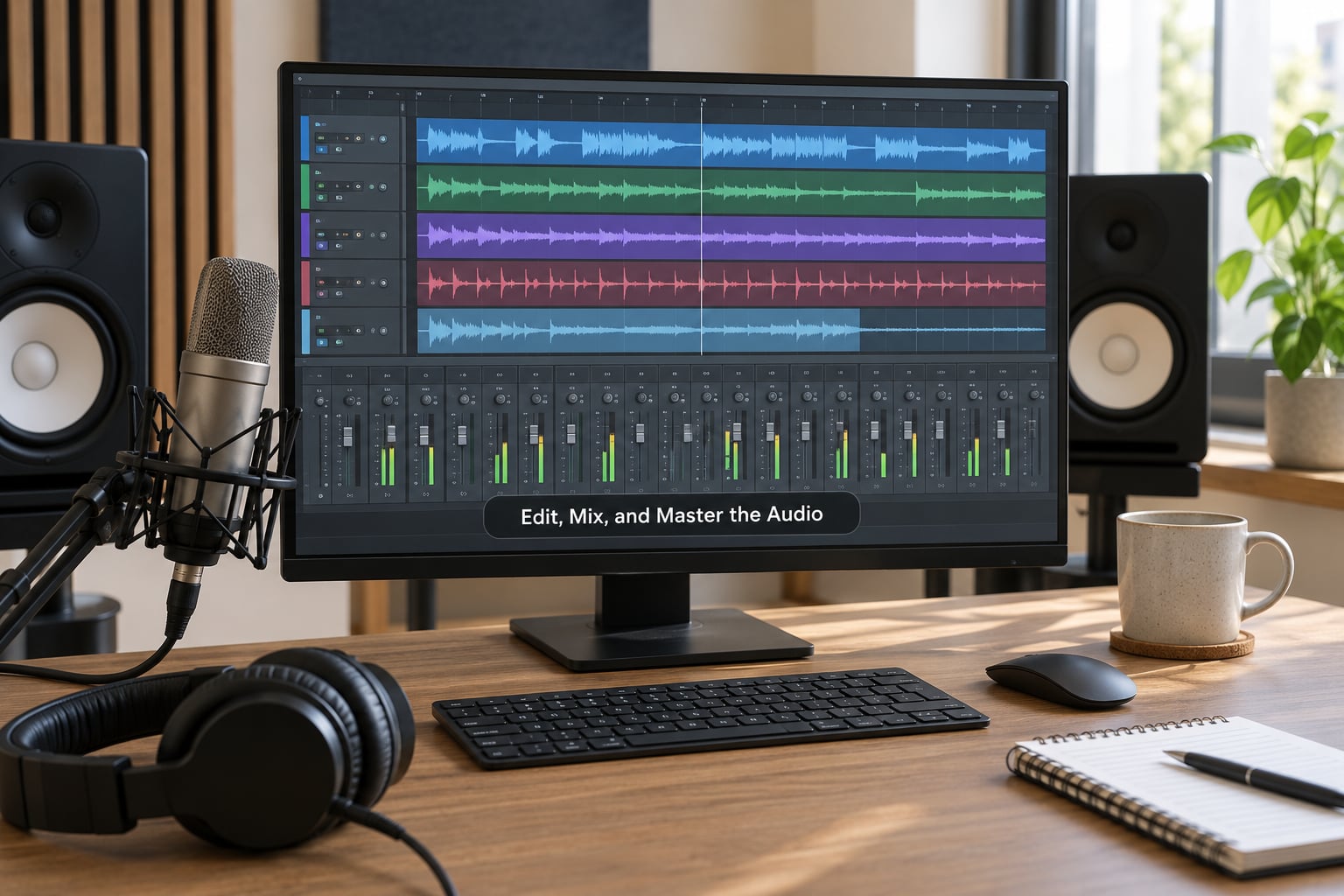
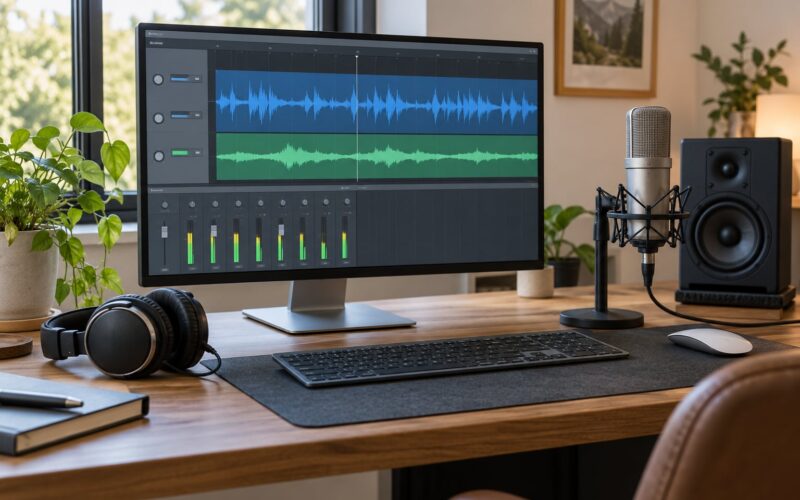
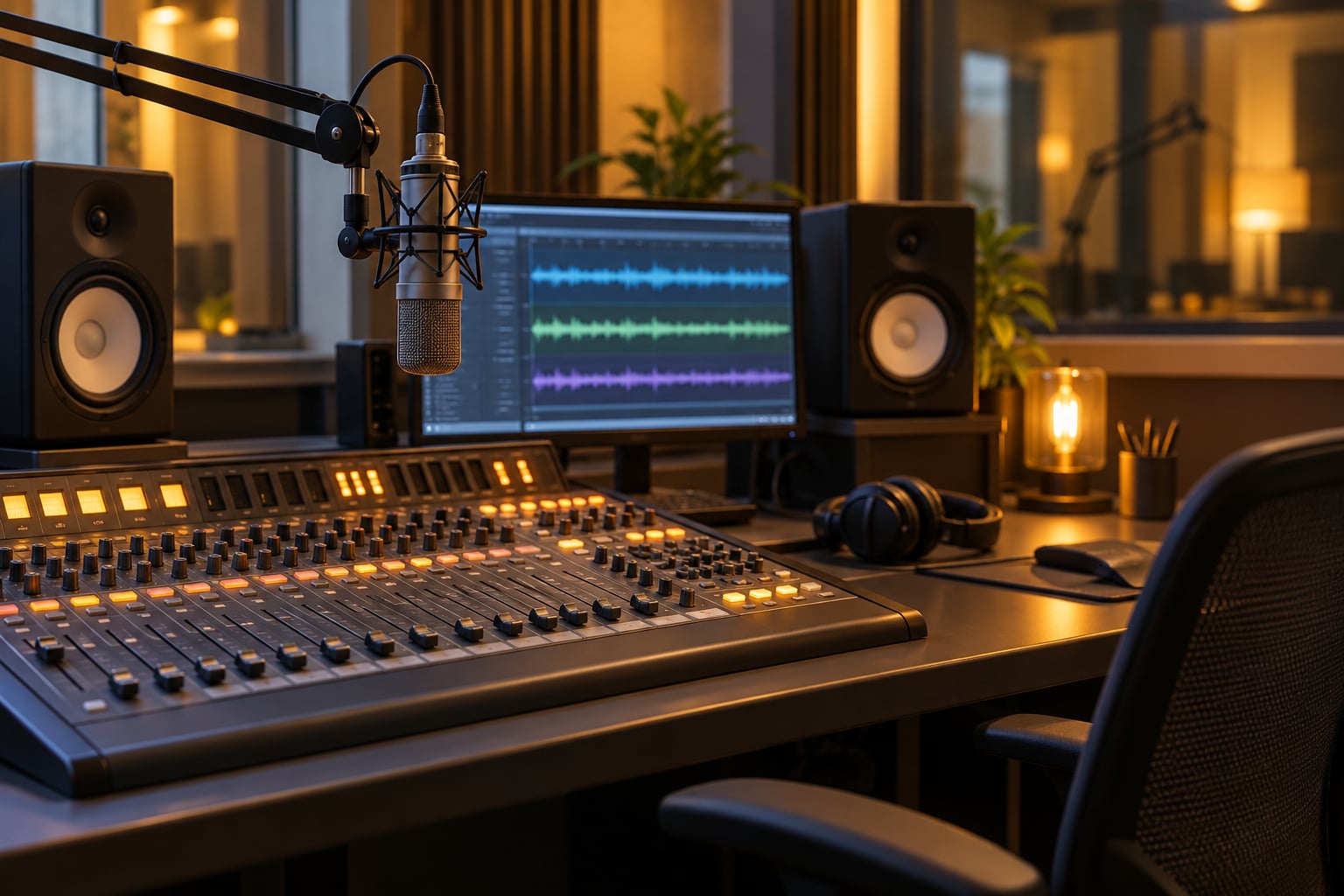
Editing is mostly subtraction. The chosen vocal takes are tightened, breaths trimmed, and the motif is layered until it has weight without turning muddy. Equalisation moves the vocal forward, compression evens out the peaks, and the whole thing is checked for how it sounds on a small speaker and on a phone rather than only on studio monitors.
Loudness is the part stations get wrong most often. A master that sounds powerful in the studio will either shout over the music or disappear under loudness normalisation on a stream, so engineers deliver levels that survive the platform rather than levels that win a solo audition. Separate versions get made for broadcast, for streaming and for anything that plays in a video player.
5. Test, Approve, and Deliver the Ident
Nobody signs off an ident on taste alone. Programmers, presenters, management and whoever owns the brand all hear it, and each hears something different. Specialist recall testing exists because internal opinion is unreliable: the studio that built the sound is the worst possible judge of whether it is memorable.
Technical QC comes last. The name is checked for correct spelling and pronunciation, the file name and metadata follow the station’s own convention, and the final asset is delivered into the playout or automation system alongside every cut-down it needs.
What Makes a Station Ident Memorable?
Recall comes from a small set of practical qualities, not from polish. A distinct sonic signature matters most: if the motif could sit on any other station, it isn’t doing any work.
Clear pronunciation comes next. A name a listener hears correctly once is far more memorable than a clever melody attached to a syllable nobody catches.
Then there is brevity. Two or three seconds of music plus a short vocal is the format that survives heavy repetition. Emotional consistency matters too, in that the same handful of sounds should always mean the same station, and a rebrand is the moment that consistency breaks. Finally, the sound has to be repeatable without becoming irritating, which is a scheduling problem as much as a creative one.
How Many Ident Versions Does a Radio Station Need?
A functioning station runs several, not one. A very short sting of around two seconds handles news and sport breaks. A mid-length version of five to seven seconds gives presenters a signature to talk over. The full master sits at around ten seconds for standalone use.
On top of those sit the variants: seasonal versions, presenter-led versions where the host says the line, promo beds for a specific show, and event specials such as election, festival or sports coverage. Each reuses the same motif, which is why a station can add a version without rebuilding its whole identity.
How Are Idents Adapted for Streaming and Podcasts?
FM gives you the most forgiving environment, because the listener is tuning in and expecting sound. Streaming is different in three ways that matter to a producer.
First, loudness normalisation on streaming and app playback means relative level matters more than absolute level, so masters are delivered with metadata that tells the platform how to treat them. Second, online radio and smart speakers play the same ident far more often than broadcast does, which pushes stations toward shorter versions and wider rotation. Third, podcasts and video drop the station audio identity into an environment where the listener did not choose the station, so the ident has to work in a couple of seconds alongside other sounds.
Episode-level podcast idents follow the same logic at a smaller scale, usually a spoken name over the show’s own music theme rather than the full station package.
Can Anyone Produce a Radio Station Ident?
Yes, and the honest answer is that the ceiling is skill rather than budget. A creator can record a spoken name and a short synthesised motif in Audacity or GarageBand and have something usable in a few hours once the concept and recording setup are ready. That will not compete with a commissioned package, but it will identify a community or online station properly.
Basic digital audio workstations handle the whole job. Professional work happens in Ableton Live, Logic Pro or Pro Tools, with separate handling for voice recording, mixing and mastering. A fully produced ident involving original composition, a professional voice artist, several revision rounds and formal testing is a different scale of job entirely, and the schedule is measured in weeks rather than days.
Rights are the part small producers get wrong. Using a recognisable piece of commercial music in an ident creates a clearance problem, so commissioned work either licenses library material properly or owns the composition outright.
Frequently Asked Questions
How long does it take to produce a radio station ident?
A simple creator-made ident may take a few hours once the concept and recording setup are ready. A fully produced version involving original music, a professional voice artist, revisions, and formal testing usually runs across several weeks, because the schedule is driven by review rounds and stakeholder availability rather than by the editing itself.
What software is used to make radio station idents?
A wide range of software can make an ident, from basic digital audio workstations such as Audacity and GarageBand to professional platforms such as Ableton Live, Logic Pro, and Pro Tools. The essential tools are multi-track editing, EQ and compression, and a loudness meter for checking levels before delivery to the station playout system.
Should a station ident include music and a voice?
Not necessarily. Some stations use a short vocal identification, while others build recognition around music, a synthesized motif, an acoustic sound, or an abstract audio logo. A voice is useful when the station name is hard to recognise on its own, and less useful when the station has a strong existing reputation in its area.
What is the difference between a station ident and a jingle?
A station ident is a short, consistent sonic signature identifying the broadcaster. A jingle is a longer musical composition with words that promotes the station, a show, or an event. In practice the two are made in the same session and share a motif, but they are delivered as separate pieces with different jobs.
Conclusion
Start with four decisions before you pick a producer or open a piece of software: the exact station name and how it is pronounced, the sonic character you want, the durations you need across broadcast and streaming, and where the sound will actually play. Everything after that, from motif to master to delivery, becomes much faster once those four are written down.
The sound between the songs on your local station was built by that same sequence, and it was tested rather than assumed. Our Listening Guides and Online Radio sections cover what different stations and services actually play, and how they present themselves.