
Here is the short version of how a top 40 station is built: a programmer defines who the station is for, research narrows thousands of records down to a few hundred that test well, each song gets a rotation tier that fixes how often it plays, and a scheduler drops the whole lot into an hourly format clock that repeats with small variations so anyone tuning in hears something they know.
The part that surprises listeners most is that the voice on air usually did not choose the music. The playlist is locked days ahead, and the DJ’s job is to talk, time the songs and run the breaks. That is why the same handful of records follows you into the car on Tuesday and again on Thursday.
I have laid out the whole build order below, then gone into detail on each piece: what the format is, how format rules are written, what the rotation tiers mean, what a real hour looks like minute by minute, and where the research actually comes from.
Table of Contents
- What Makes a Top 40 Station Different?
- How a Top 40 Station Is Built From Research to Rotation
- What Goes Into a Top 40 Music Rotation?
- How Are Songs Scheduled and Spun?
- How Do Chart Data and Audience Research Shape the Playlist?
- Who Builds the Station’s On-Air Sound?
- How Do Stations Test and Refine the Format?
- How Do Ratings, Revenue, and Streaming Fit Into the Format?
- Frequently Asked Questions
- How is a Top 40 radio station different from a CHR station?
- Do Top 40 stations play only the most popular songs?
- Why does a radio station play the same song several times a day?
- How do programmers decide whether a new song gets added to rotation?
- Why can two Top 40 stations have very different music lists?
- Conclusion
What Makes a Top 40 Station Different?
A Top 40 station, usually branded CHR for contemporary hit radio, is a music station built around a deliberately small, fast-turning core of roughly 300 to 500 songs. Those songs are split into rotation tiers that control how often each one plays, and the whole thing is scheduled into an hourly clock that repeats with small variations, so that a listener switching on at any moment of the day is likely to hear something familiar within a song or two.
That tightness is the distinguishing feature. A station playing from a library of tens of thousands of tracks would sound different every hour, and in practice listeners bounce off that within seconds of switching on. Top 40 stations accept a narrower music diet on purpose.
The neighbouring formats make the same music feel different by changing what the station promises:
| Format | Typical core | What it promises |
|---|---|---|
| Top 40 / CHR | 300-500 songs, tight | The biggest current hits, spun fast and often |
| Hot AC | 250-350 songs, tight | Current music with an adult lean, fewer repeats |
| Adult Contemporary | Broad, 400+ songs | Familiar adult hits, softer spins, longer song mix |
| Classic Hits | 200-400 songs | Hits from a defined era, heavy rotation |
| Rhythmic CHR | 200-300 songs | Rap and R&B, tight and fast |
| Classic Rock | 250-450 songs | Album-era rock with strong artist separation rules |
Figures vary by market. A competitive US market runs one of the tightest playlists in broadcasting, while smaller markets and online stations usually run broader libraries to stretch the music budget.
How a Top 40 Station Is Built From Research to Rotation
The direct answer is one chain, and each link feeds the next: research defines the audience, format rules guide selection, audience testing validates the songs and the presenters, the scheduler builds the rotation and the clock, and monitoring keeps the whole thing consistent.
- Decide who the station is talking to. A target demo, a daypart plan and an audience promise, written down.
- Build a tight core playlist. A few hundred records that fit the format, not everything that charted.
- Research and select the music. Audience testing, callouts, airplay and streaming signals, then a playlist meeting.
- Code songs into rotation tiers. Current, recurrent, power and gold, each with a spin count.
- Schedule it into a format clock. Fixed hourly positions for songs, sweepers, jingles and commercial breaks.
- Add imaging, IDs and stopsets. Jingles and voiceovers coded to clock positions so the station sounds like itself.
- Refresh on a cycle. Weekly playlist meetings, seasonal library tests, and an audit against comparable stations.
How Is a Top 40 Station’s Format Defined?
A format is a written rulebook, not a feeling. Before any song is chosen, the programmer turns the research into constraints the music department and the scheduler can actually follow.
Typical rules cover tempo and pace, vocal style, the eras and genres that count as in-format, how familiar a record must be before it can be added, how tightly the playlist repeats, how much seasonal or holiday material is allowed, and the ratio of music to non-music elements in a given hour.
A workable rule might read: up to 40 records in the core library, tempo from 95 to 130 BPM, no more than three consecutive vocal tracks by artists of the same gender, no song repeated inside a two-hour window, and one stopset of four commercials and two sweepers in every hour.
BBC Radio 1 has long used a plain version of the same test: within three songs, a listener should be able to tell which station they are listening to. If the rulebook cannot pass that test, it is too loose.
What Goes Into a Top 40 Music Rotation?
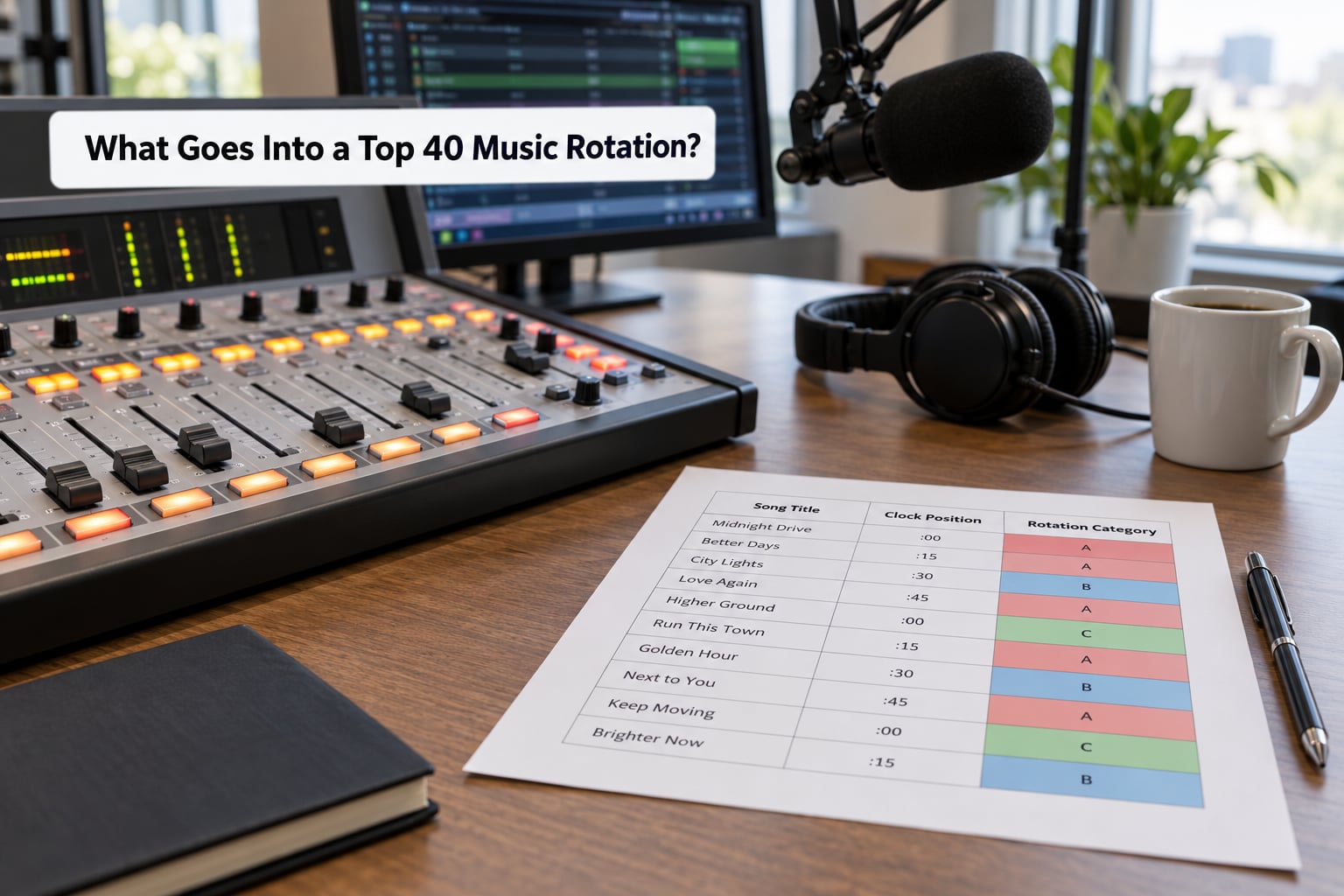
Rotation is simply the answer to how often a song plays. Every song in the library is given a category, and the category carries a spin count, so the scheduler has a defensible number to work with instead of taste.
The categories stack, and a song moves up or down between them as its performance changes:
| Category | Job | Typical treatment | Typical frequency |
|---|---|---|---|
| Current | New and rising records getting the station’s attention | Low repetition, cushioned by familiar songs | A few plays a day, phased in over 2-3 weeks |
| Power / heavy | The songs the audience came for | Highest repetition, fixed clock positions | Roughly 30-40 spins a week in a tight US market |
| Secondary | Strong current and recent hits not yet at power level | Regular but lighter rotation | Roughly 15-25 spins a week |
| Recurrent | Older current-era songs holding a steady audience | Light rotation, spread across the day | Roughly 8-15 spins a week |
| Gold | Established hits, often subject to a 35-year rule | Very light rotation, usually weekend or holiday | A few spins a week |
A song earns a promotion when it tests well and holds the audience, and gets demoted when it stops delivering. Demotion is normal: the point of a tier is that it can move.
Two rules sit over the top of all of it. Artist separation keeps the same artist out of consecutive hours, usually until one to three hours have passed. A no-repeat rule stops a title coming back inside a fixed window, often the same hour or a two-hour block.
How Are Songs Scheduled and Spun?
Once songs are coded, the scheduler generates the music log: hour by hour, position by position, in software such as Music Master or RCS. Large owners including iHeartMedia and Cumulus run proprietary systems instead, and Mediabase is widely used for tracking what comparable stations are playing.
The plan that comes out of that process is called a format clock. Each hour is divided into fixed positions, and the same elements land in the same places every day, with variation built in rather than improvised.
Here is what a Top 40 hour typically looks like:
| Time | Element | Category or job |
|---|---|---|
| 00:00 | Top of hour ID | Call letters, legal, station imaging |
| 00:04 | Song | Power rotation |
| 00:08 | Song | Power rotation |
| 00:12 | Sweeper | DJ ID over an acapella intro |
| 00:14 | Song | Secondary rotation |
| 00:18 | Song | Current |
| 00:20 | Stopset | Four commercials and two sweepers |
| 00:28 | Song | Power rotation |
| 00:32 | Talk break or features | Local content, contests, interviews |
| 00:34 | Song | Power rotation |
| 00:38 | Song | Recurrent |
| 00:42 | Song | Secondary rotation |
| 00:46 | Song | Gold or seasonal |
| 00:50 | Stopset | Four commercials and two sweepers |
| 00:58 | Song into the next hour | Power rotation, segue |
Those two stopset breaks are the frame around the music. Most Top 40 hours carry two commercial breaks, and the music between them is arranged so tempo moves rather than stalls.
Dayparting changes the mix without changing the format. Morning drive leans on personality and local information, the afternoon is often the most experimental slot for new music, and the overnight graveyard run simplifies to fewer songs and more of the deepest power category.
Artist clusters handle variety. Songs with a similar tempo or mood are grouped, and the scheduler avoids placing two from the same cluster back to back, which keeps the flow moving without making the hour unpredictable.
Clock variants handle repetition. One clock repeated for nine days is unbearable, so stations run several variants of the same hourly template. A common rule is to keep nine clocks in rotation so each day starts on a different one, which changes the running order without changing the structure listeners recognise.
How Do Chart Data and Audience Research Shape the Playlist?
The chart is an input, not the playlist. A song can top a chart and never get added, because popularity and fit are different tests.
Programmers weigh several signals at once: official chart positions and airplay monitoring across the market, streaming and Shazam recognition signals, callout research where listeners are asked to name songs they have heard recently, focus groups and auditorium testing where people react to music in real time, and the station’s own audience research in markets measured by Nielsen PPM or RAJAR.
Records arrive through label pitching, station playlists at large owners, and the physical or digital delivery of the audio file into the station’s music system, which is a step more listeners ask about than they expect.
Unfamiliar songs are deliberately cushioned. The pattern is a familiar power song, then the new record, then another familiar song, so the new track is judged on its own merits instead of triggering a tune-out.
The economics explain part of the picture too. Music-industry commentary has put the cost of getting a single onto US radio in the millions of dollars, which is a structural reason independent artists can struggle to get added even when listeners tell research panels they want to hear them.
Who Builds the Station’s On-Air Sound?

The sound is a group effort, and the job titles matter because each one owns a different decision.
- Program director owns the format and the ratings outcome.
- Music director researches, tests, selects and codes the music.
- Scheduler builds the clock and enforces the rotation and separation rules.
- Talent delivers the talk, features and local content inside the clock.
- Producer and engineer handle imaging, sweepers, jingle beds and how everything sounds.
- Researchers run the callouts, focus groups and audience panels.
- Sales sell the commercial breaks the whole model depends on.
Here is one song moving through the system. A distributor sends a record to the music director, who puts it into a software test alongside the current library and watches which spots listeners skip. It performs acceptably, so it goes into a research callout for the target demo.
When it tests well enough, it is added as a current, played in the cushioned pattern with familiar songs either side, and it gets a voiceover introducing the artist. At the next weekly meeting its spins are reviewed, and if it holds it moves to secondary or power rotation. If it does not, it goes back down or comes off.
How Do Stations Test and Refine the Format?
Nobody launches a format untested. The sequence usually runs from a prototype, through software testing and vehicle testing, to a short live run and then a full market rollout.
The prototype is the format rulebook plus a sample playlist. Software testing checks that the scheduler can actually deliver the rules without breaking them, and vehicle testing puts a simulated hour in the car with target listeners to see how the pacing, the talk and the imaging feel in a real drive.
Live testing introduces audience feedback and ratings monitoring, and a light-up-daypart approach lets a station run an experiment in one segment without committing the whole day.
When something does not work, the response is usually quick and specific. A song that causes tune-outs gets fewer spins or comes off. A segue that feels clumsy gets dropped from the jingle grid. A personality test that scores badly in audience panels goes, and a morning show that wins cume but loses share gets a format tweak rather than a personnel change.
The format clock is judged the same way, position by position, using format clocks to compare what actually aired against what was supposed to air.
How Do Ratings, Revenue, and Streaming Fit Into the Format?
Money shapes the margins of the format rather than its purpose. Broadcast ratings, audience retention hour by hour, advertising revenue and event income all feed into programming decisions, because a station that loses its audience loses the budget that funds the music.
Streaming is now part of the same conversation. Downloads, playlist placements and recognition data feed research, and songs reach radio sooner than they used to because the audience already knows them.
None of this replaces the underlying job, which is serving a defined audience consistently. A station that chases every trend will sound like nothing in particular, and the point of the format rules is to prevent exactly that.
Frequently Asked Questions
How is a Top 40 radio station different from a CHR station?
They are usually the same thing. Top 40 is the historical name for the format that broadcasters formally call contemporary hit radio, or CHR. A station branded Top 40 is a CHR station, and you will see both words used interchangeably in US industry coverage, with Top 40 still common in station marketing and CHR preferred in ratings language.
Do Top 40 stations play only the most popular songs?
No, though popularity is one input. Stations add songs that test well with the target audience even when a song is not charting, and they hold records that charted weeks earlier because the audience still wants them. Equally, a song can top a chart and never be added if it tests poorly or does not fit the format rules on tempo, era or familiarity.
Why does a radio station play the same song several times a day?
Because listeners switch on for a fraction of a minute at a time. Stations assume that if a listener tunes in and the familiar hit is not playing, they move to another station immediately. Tight rotation from a core of a few hundred songs maximises the chance that a casual listener hears something they like within a song or two, and stays long enough to hear the advertising.
How do programmers decide whether a new song gets added to rotation?
A new record is tested against the current library in software, heard in focus groups, and put into research callouts with the target demographic. If it holds attention and tests well against songs listeners already know, it goes in as a current, cushioned between familiar tracks. Spins are then reviewed weekly, and the song is promoted, held or dropped based on how it performs.
Why can two Top 40 stations have very different music lists?
Each station builds its own playlist from its own audience research and its own market, even when both follow the same format rules. One may weigh rhythmic or country crossover tracks heavily because that is what its listeners test well, while another leans singer-songwriter pop. Scheduling software, clock variants and different rotation depths add to the difference, so two stations can sound like the same format without sharing a playlist.
Conclusion
A Top 40 station is built from measurable audience data turned into written format rules, a tight core playlist coded into rotation tiers, a scheduled hourly clock with clock variants, and personality doing the talking between the songs. Each piece is built on the one before it, which is why the result sounds repetitive to a casual ear and consistent to a regular one.
The best way to understand it is to pick a station you like, note the time you tuned in, then listen to the same hour again on three different days. Track which songs repeat, where the two commercial breaks fall, and where the DJ talks. Within one hour you will have seen every block in the build.