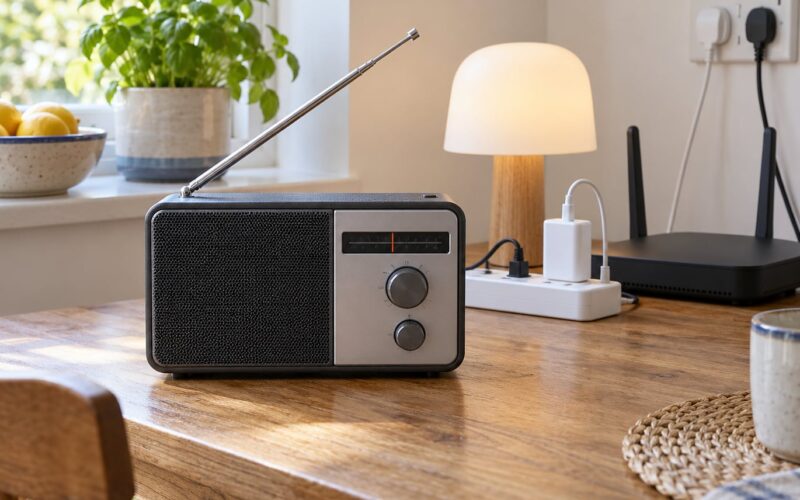
To tell if a radio tuner is broken, work through the chain in order: power, audio output, controls, antenna, then reception on each band. If sound is missing but the display lights up, the tuner is often fine and the amplifier, speakers or mute circuit are at fault. A tuner is genuinely faulty only when it produces no signal reading with a known-good antenna attached.
The same seven tests apply whether you are holding a car head unit, a vintage hi-fi receiver, a tube or valve radio, a portable boombox or a CB handheld. Only the access points change: a car stereo hides its antenna behind a trim panel, a valve set hides its antenna socket on the back, and a CB set has no separate antenna fault at all because the aerial is part of the radio.
A radio tuner is the section that picks one station out of everything the antenna collects, locks onto its frequency and hands a small audio signal to the amplifier. Everything downstream of that — the volume control, the amplifier, the speakers — is a separate piece of equipment, and confusing the two is the most common reason owners throw away a receiver that only needed a ten-minute fix.
What follows is the order I would use on a bench. It is deliberately dull: cheap, external checks first, and only then anything that involves opening a case.
Table of Contents
- What You Need Before You Can Tell If a Radio Tuner Is Broken
- Step-by-Step: Seven Tests That Tell You If the Tuner Is Faulty
- 1. Check the Power and Front-Panel Indicators
- 2. Test the Audio Output
- 3. Check the Tuning Controls and Presets
- 4. Compare Reception on More Than One Band
- 5. Inspect the Antenna and Connection
- 6. Perform a Reset or Check the Firmware
- 7. Decide Whether the Radio Tuner Is Broken Beyond Repair or Worth Fixing
- Common Mistakes That Send Owners Down the Wrong Path
- Frequently Asked Questions
- Conclusion
What You Need Before You Can Tell If a Radio Tuner Is Broken
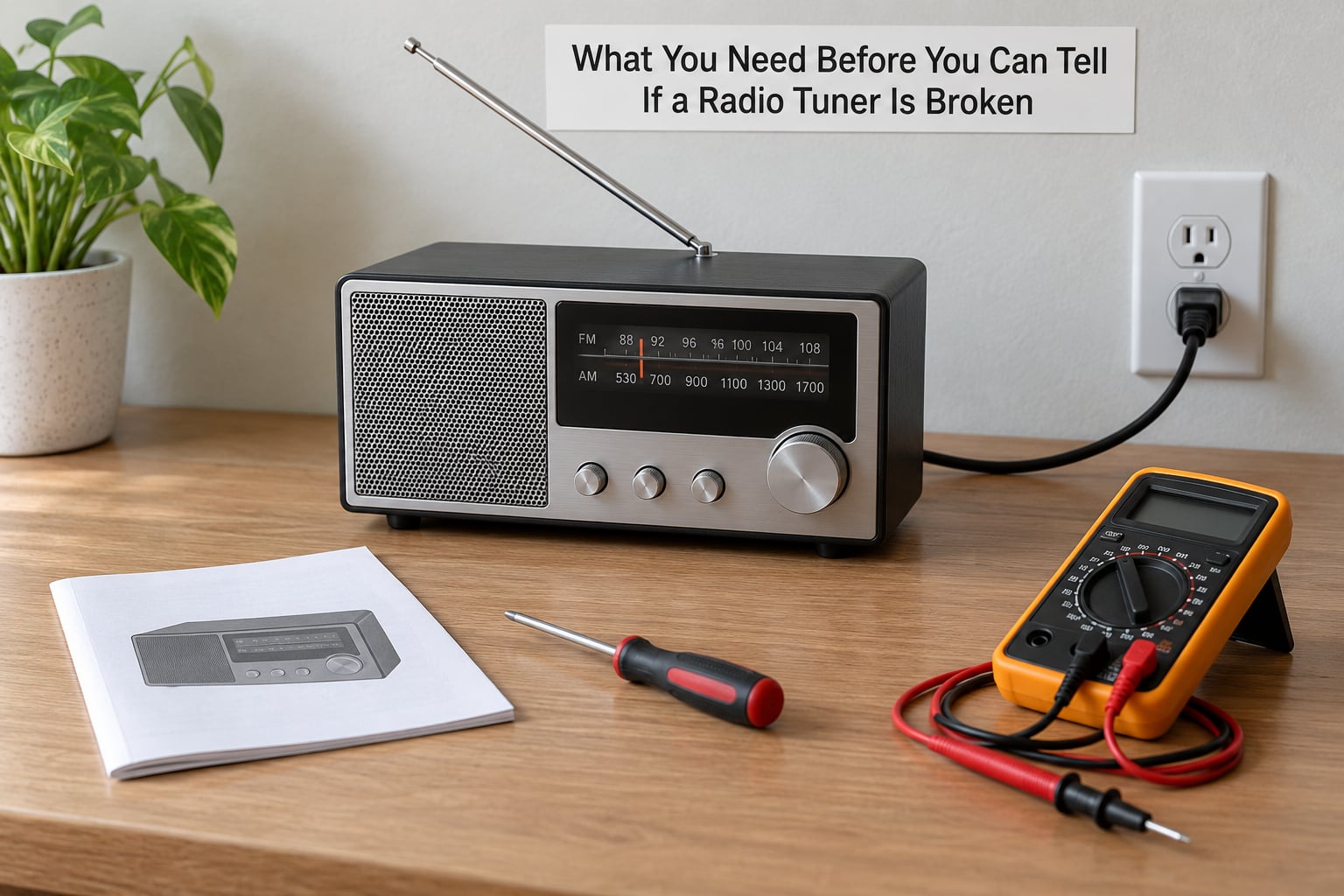
You need very little to run most of this sequence. The list below covers it, and the fourth item is the one people skip and then regret skipping.
- A known-good power source. A different wall outlet, or a fresh set of batteries or a tested bench supply for a portable set. Intermittent mains faults cause a startling number of phantom tuner failures.
- A known-good audio path. A pair of headphones, a different set of speakers, or an auxiliary input and a second amplifier. This is what lets you separate a dead tuner from a dead amplifier.
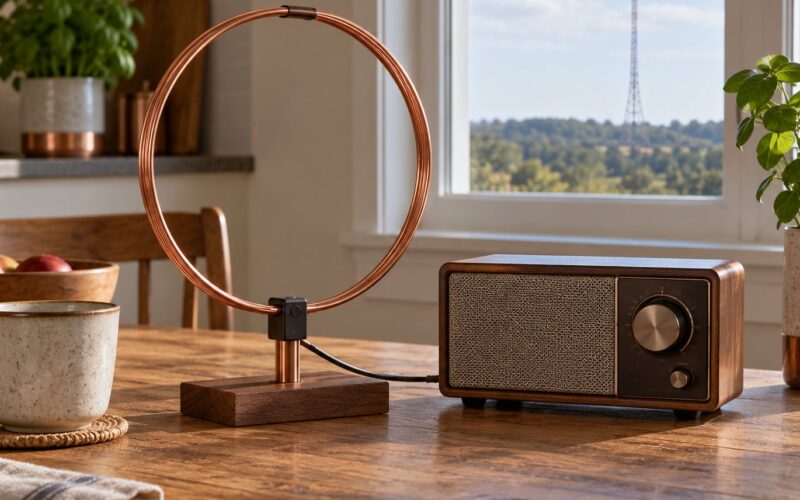
- A known-good antenna. For a car, a known-good roof or pillar aerial with a fresh lead. For a home set, the supplied telescopic rod or a proper FM aerial with a solid coax run.
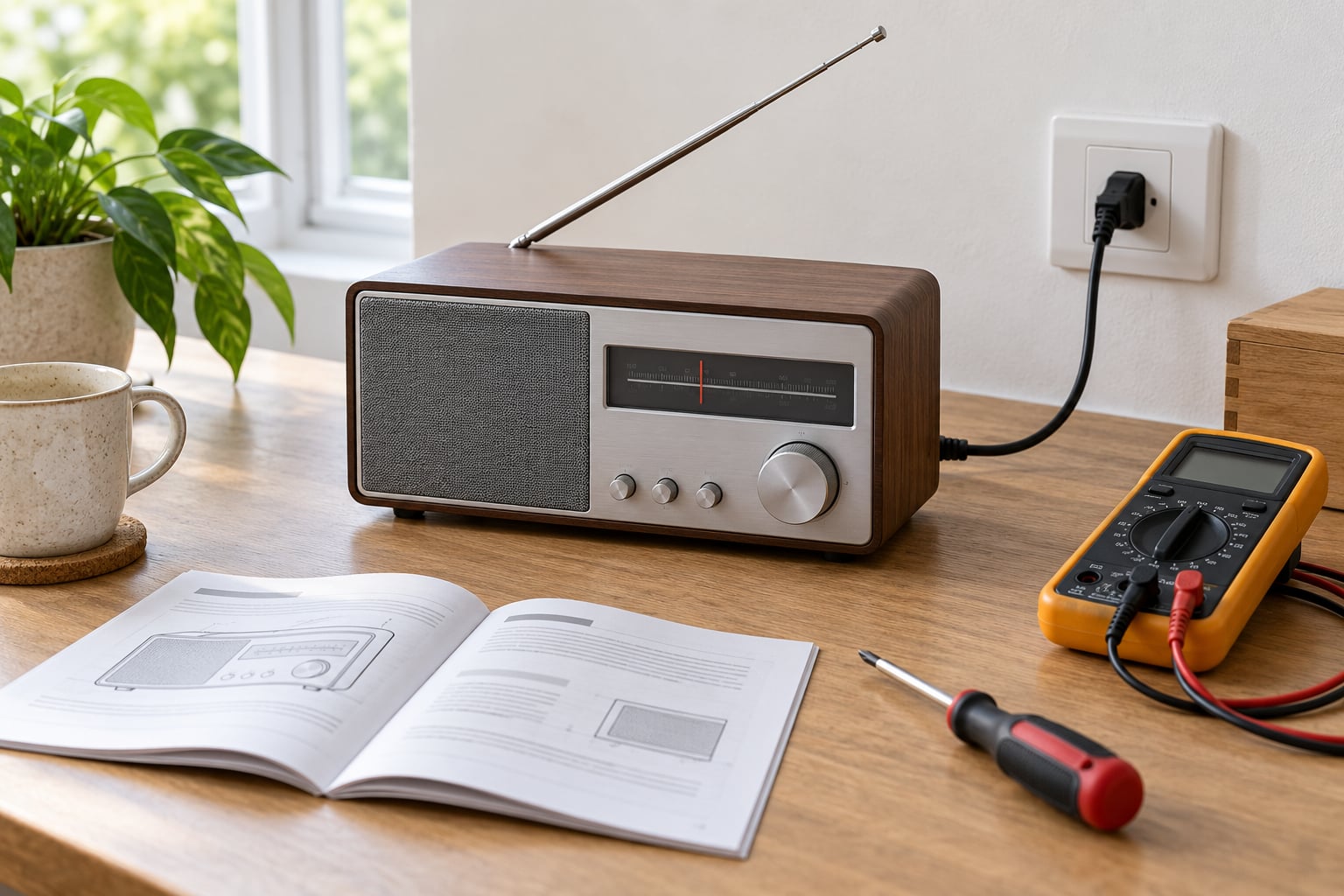
- The owner’s manual. It tells you the reset procedure, the Local/Distant (LX/DX) setting and, on a car stereo, which fuse belongs to which circuit. Guessing at those is how people replace perfectly good receivers.
- Small hand tools and a multimeter. Screwdrivers, a socket set for a car head unit, and a meter for continuity and DC voltage checks at the accessory and ground points.
One warning before any of this. Mains-powered receivers and valve or tube sets store charge in capacitors that can hold a lethal voltage long after they are unplugged. If your set runs from a wall outlet, or it has a valve or tube inside, stop at the external checks and hand the internals to a technician. Nothing in this guide requires you to open a chassis, and nothing on this page should be read as a licence to do so.
Step-by-Step: Seven Tests That Tell You If the Tuner Is Faulty
1. Check the Power and Front-Panel Indicators
Unplug the set, wait thirty seconds, plug it into a different outlet and switch it on. Watch what happens rather than what you expect to happen.
If a display, dial light, tuning indicator or stereo lamp comes on, the power supply and the front panel are alive, and the fault sits somewhere downstream. If nothing lights at all, you have a power problem, not a tuner problem — check the fuse, the adapter and, in a car, the accessory fuse and the ground point. A set that powers on at full volume for a second or two and then drops out is usually reporting a supply fault or a protection circuit, not a dead tuner.
A blinking or reset-looping display points the same way: the supply is collapsing under load. Check the DC voltage at the set with your meter before condemning anything.
2. Test the Audio Output
This is the step that saves the most receivers. Plug headphones into the headphone jack, or feed an auxiliary input into a known-good amplifier and speakers. Then turn the volume up on the set itself and listen.
If you get clean audio from a station you know is transmitting, the tuner and the RF section are working and the fault is in the amplifier, the speakers, the speaker wiring or the mute circuit. If you still get silence, move on. Silence at the headphone output with a live signal means the fault is upstream of the audio stage.
One channel only being dead changes the diagnosis entirely. A dead left or right channel points at the amplifier or speaker path, not the tuner, because the tuner feeds both channels from the same signal.
3. Check the Tuning Controls and Presets
Turn the tuning dial slowly across the band and watch the signal strength meter and the display frequency. Every movement should produce some change.
A dial that spins freely without moving the displayed frequency, a display that stays frozen on the last channel, or preset buttons that no longer recall anything, all point at a failed encoder, a worn potentiometer or a broken switch bank rather than a faulty tuner. A dial cord that has gone slack on an older receiver causes exactly the same symptom and is a far cheaper fix.
While you are there, check the Local/Distant or DX sensitivity switch on car and portable sets. Left in Local, a healthy tuner will sound weak and pick up few stations, and owners routinely mistake that setting for a fault.
4. Compare Reception on More Than One Band
Tune a strong local station on each band the set supports. FM, AM, long wave and short wave all share the antenna but have separate RF paths, so the pattern of what works tells you where the fault lives.
- One band dead, the other clear: the fault is in that band’s RF front end or detector stage, not a total tuner failure. On AM, also suspect interference from a Class D amplifier in the same system, which can wipe out AM while leaving FM untouched.
- Every band weak or noisy: look at the antenna, the antenna lead, the ground connection and corrosion before you look inside the set.
- Stations that drift off tune after a few minutes: that is usually heat-related component drift in an older set, or a failing supply rail. It is a real fault, but rarely a tuner fault.
5. Inspect the Antenna and Connection
Follow the lead from the antenna input to the aerial. In a car that means pulling the head unit, checking the coax plug is fully seated and not green with corrosion, and confirming the mast and pillar connections are intact. At home, check the telescopic rod, the spring inside it, and the screw terminal at the back.
Corrosion is the quiet killer. A boombox that has lived in a damp garage or a coastal house can look fine and still present the aerial with a connection that barely works, and cleaning the parts with a contact cleaner often restores reception outright.
Do the hold-it-close test as a quick confirmation: if reception improves dramatically when you touch or hold the aerial while tuning, the fault is almost certainly the aerial or its connection, not the tuner.
6. Perform a Reset or Check the Firmware
Modern car head units, DAB receivers and network tuners hold settings that can block the radio path entirely — a mute engaged from a phone call, a half-finished station scan, a saved region that no longer matches the broadcast area.
Do the manufacturer’s reset and let the unit rebuild its station list from scratch. On a car stereo this usually means holding a button or using a menu option; the manual will tell you exactly which. Confirm the clock and date have reset afterwards, because that tells you the procedure actually ran. On a DAB receiver, rescan and check the antenna is the correct DAB aerial, since a plain FM aerial will receive DAB poorly or not at all.
Where the unit has app or firmware support, check for an update through the manufacturer’s own app or site. Skip any procedure the manual does not describe.
7. Decide Whether the Radio Tuner Is Broken Beyond Repair or Worth Fixing
You have reached the end of the beginner’s sequence when the set powers on, produces audio through a known-good path, has a known-good antenna fitted, and still shows no signal activity on any band.
Four findings point at the tuner itself: the signal strength meter never moves from its resting position on any station on any band; audio output contains only hiss with no station content, and you can hear that a strong station is on air; reception is uniformly weak regardless of station, distance or antenna position; or a set that worked normally has gone quiet without any change in power, antenna or settings.
Beyond that you are into component-level work. Drifted carbon resistors, tired electrolytic capacitors, a failing local oscillator or an IF chain that has lost gain all look identical from the outside. On a vintage set, recap the board and check the resistors before paying for any alignment — realigning a set whose components have drifted is money wasted, and enthusiasts on restoration forums say so repeatedly.
One cheap trick can separate a receiver that is truly dead from one with a gain fault: a car FM transmitter on an unused frequency acts as a local signal source. If the set picks it up clearly, the receiver works and your problem is antenna or signal strength. If it hears nothing at two metres, the receiver itself is faulty. Note that a cheap RF generator topping out around 30 MHz is useless for FM broadcast, which sits near 108 MHz, so check the range before buying one.
Decide repair or replacement on value rather than pride. A sensible rule is to repair when the quote comes in below half of what a comparable working unit costs, and to replace above it. A car radio repair commonly runs from tens to a couple of hundred pounds depending on the fault and the vehicle; a vintage receiver is worth a bench assessment first, because the fault may be a simple recapping job.
Common Mistakes That Send Owners Down the Wrong Path
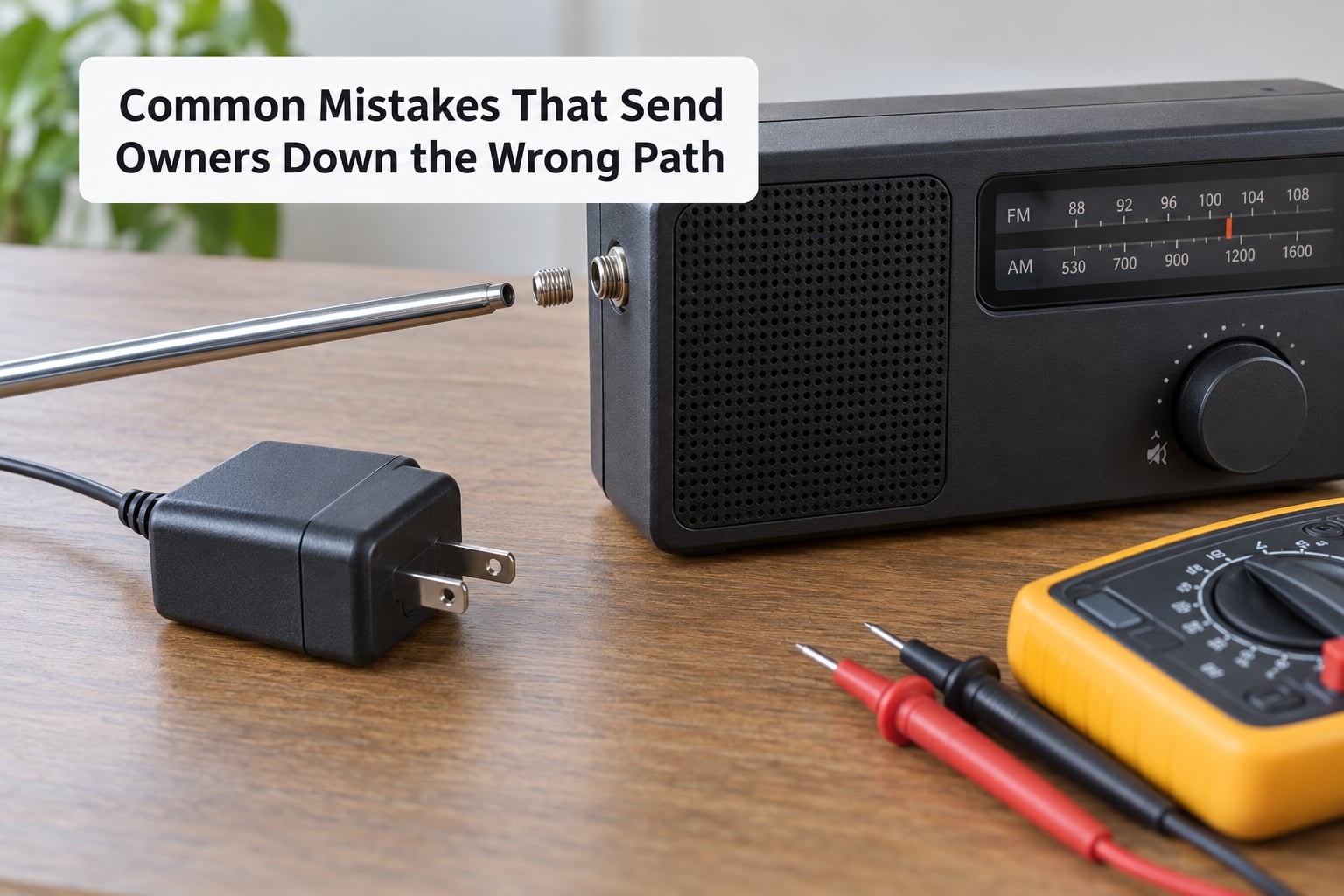
Almost every misdiagnosis I have seen traces back to one of these, and each has a straight fix.
- Testing with a dead battery or a tired power brick. A set that barely powers up will fail every signal test that follows. Test the supply with a multimeter before anything else.
- Overlooking a muted volume control or an active mute. A phone call through a car stereo can leave it muted, and some receivers mute themselves on a failed station. Check the mute state and the volume level before assuming a fault.
- Using the wrong antenna. An FM-only aerial on a DAB set, a bare wire on an FM band, or an aerial lead with a broken centre pin all produce the same weak-signal symptoms.
- Assuming weak reception means a broken tuner. Distance, terrain, thick building walls and metal roofing all cut signal before it ever reaches the set. Compare against a phone or a second receiver on the same spot before blaming the tuner.
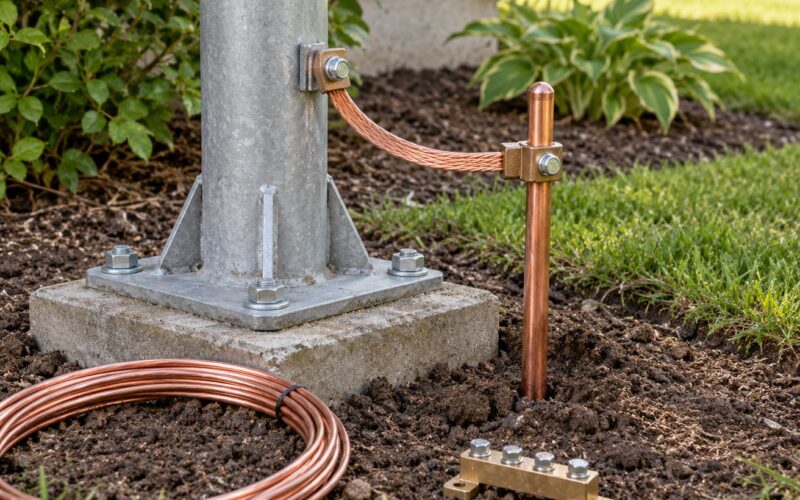
- Opening a mains-powered or valve set. Charged capacitors in a set like that can injure or kill. Stop at the external checks.
- Replacing the receiver before isolating the fault. The cheapest components in the chain are the antenna lead, the fuse, the ground strap and the mute setting. Check those first, every time.
The symptom mapping below is the fastest way to narrow things down. The last column is the one that answers your actual question.
| Symptom | Most likely cause | Fix | Tuner fault? |
|---|---|---|---|
| Nothing lights up, no display | Blown fuse, failed adapter, bad ground | Test supply voltage, replace fuse or adapter | No |
| Display on, no sound anywhere | Amplifier, speakers, wiring or mute circuit | Test with headphones and a known-good amplifier | No |
| Sound on one channel only | Amplifier channel or speaker | Swap speakers left to right to confirm | No |
| Hiss on every station, no content | Lost RF or IF gain, or no signal reaching the set | Check antenna, then test with a local transmitter | Possibly |
| Signal meter never moves | RF front end, local oscillator or meter circuit | Known-good antenna first, then bench diagnosis | Likely |
| AM dead, FM fine | AM RF path or Class D amplifier interference | Check the amp, its gain setting and the antenna lead | Possibly |
| Stations drift off after a few minutes | Supply rail sagging or heat-related component drift | Measure supply rail under load | Rarely |
| Reception only when aerial is touched | Corroded or broken antenna connection | Clean contacts, replace the lead or aerial | No |
| Stereo light never illuminates | Multiplex board or stereo decoder | Confirm the station is broadcasting in stereo | Possibly |
| Static that changes with engine speed | Alternator or ignition interference, poor ground | Check ground points and engine electricals | No |
For anyone tracking problems over time, keep a short log: date, time, band, station, signal strength reading, what you changed. Enthusiast forums have used reception logs like this for decades, and the pattern usually names the fault faster than another evening of guessing.
Frequently Asked Questions
Is my radio broken or is it the antenna?
Connect a known-good antenna or antenna lead and listen to a strong local station. If reception improves or returns, the fault was the antenna or its connection. If it stays exactly the same, move to the next test. Touching the aerial while tuning and hearing a big improvement is the same result in about two seconds. Corrosion on the coax plug or the telescopic rod spring is the usual culprit, and a contact cleaner often fixes it outright.
Why is my radio only static on every station?
Static across the whole band means the tuner is receiving RF energy but resolving no station content, which points to lost RF or IF gain rather than a dead set. Check the antenna connection and supply voltage first, because those cause the same noise. On a car, an alternator or ignition fault often adds noise that changes with engine speed. If a local transmitter on an unused frequency is heard clearly two metres away, the tuner works and the problem is signal strength.
Why does my radio work on Bluetooth but not on FM?
If Bluetooth audio plays normally, the speakers, amplifier and power supply are all healthy, which tells you the fault is upstream in the tuner or its antenna. Check the aerial connection, the Local/Distant or DX switch, and whether the station list is intact after a reset. It also rules out the most expensive guess people make, replacing a head unit that was never the problem.
Why does sound only work on one channel?
A single dead channel is almost never a tuner fault, because both channels are fed from the same tuner output. Swap the speakers left to right and listen: if the dead side follows the speaker, the problem is the speaker or its wiring. If it stays on the same side, suspect the amplifier channel, its input or output connection. Test with headphones, which bypass most external speakers and often restores both channels.
How do I fix poor radio reception at home?
Start with the aerial: check the telescopic rod or the coax connection for looseness, corrosion and a broken centre pin, then try a proper external FM aerial in a higher position. Confirm the Local/Distant or DX switch is set for maximum sensitivity and reset the unit to rebuild its station list. If nearby stations are strong but distant ones are weak, that is normal propagation rather than a fault. A local transmitter on an empty frequency is a quick way to prove the set still receives.
What can I do about poor reception on a DAB radio?
DAB needs a dedicated DAB aerial, and an FM-only aerial will receive it poorly or not at all, so check that first. Rescan the station list after any antenna change, since the set caches results. Interior aerials in metal or foil-backed insulation also cut DAB badly, and moving the set near a window often helps. If it improves when you hold the aerial against the set body, the aerial or its lead is the fault rather than the tuner.
Conclusion
Start with power, then audio, then controls, then antenna, then compare bands. That order tells you how to tell if a radio tuner is broken without guessing, and it clears the two faults responsible for most false alarms, a dead fuse and a bad antenna connection.
A tuner deserves the blame only once it has power, produces audio through a known-good path and has a known-good aerial attached and still shows no signal activity on any band. Past that point, on a set that runs from mains or contains valves, stop and take it to a technician.