Yes — weather is one of the biggest reasons radio reception changes from day to day. How atmospheric conditions affect radio reception comes down to one thing: the air itself bends, absorbs and reflects radio waves, and its temperature, moisture and ion content shift hour by hour. If your signal follows the forecast, the problem is not your radio.
That last sentence is the one worth sitting with. A lot of people spend money on boosters, better aerials or a replacement set when the real cause is a still, high-pressure evening bending an FM signal 120 miles across the North Sea. No amplifier fixes that. It fixes itself when the weather moves on.
So here is what is actually going on, band by band, symptom by symptom.
Table of Contents
- What Is the Basic Science Behind Atmospheric Radio Reception?
- How Do Rain, Snow, Fog, and Humidity Change Radio Signals?
- Why Do Storms and Lightning Interfere with Radio Reception?
- How Do Temperature Changes and Inversions Affect Radio Propagation?
- How Do Atmospheric Conditions Affect AM, FM, and Digital Radio?
- What Can You Do When Weather Makes Radio Reception Worse?
- Frequently Asked Questions
- Does rain make radio signals weaker?
- Why does my radio reception get worse during a storm?
- Can fog or humidity interfere with AM and FM radio?
- Does cold weather affect radio reception?
- How can I improve reception during bad weather?
- Is a sudden loss of radio reception likely to mean the station has gone off air?
What Is the Basic Science Behind Atmospheric Radio Reception?
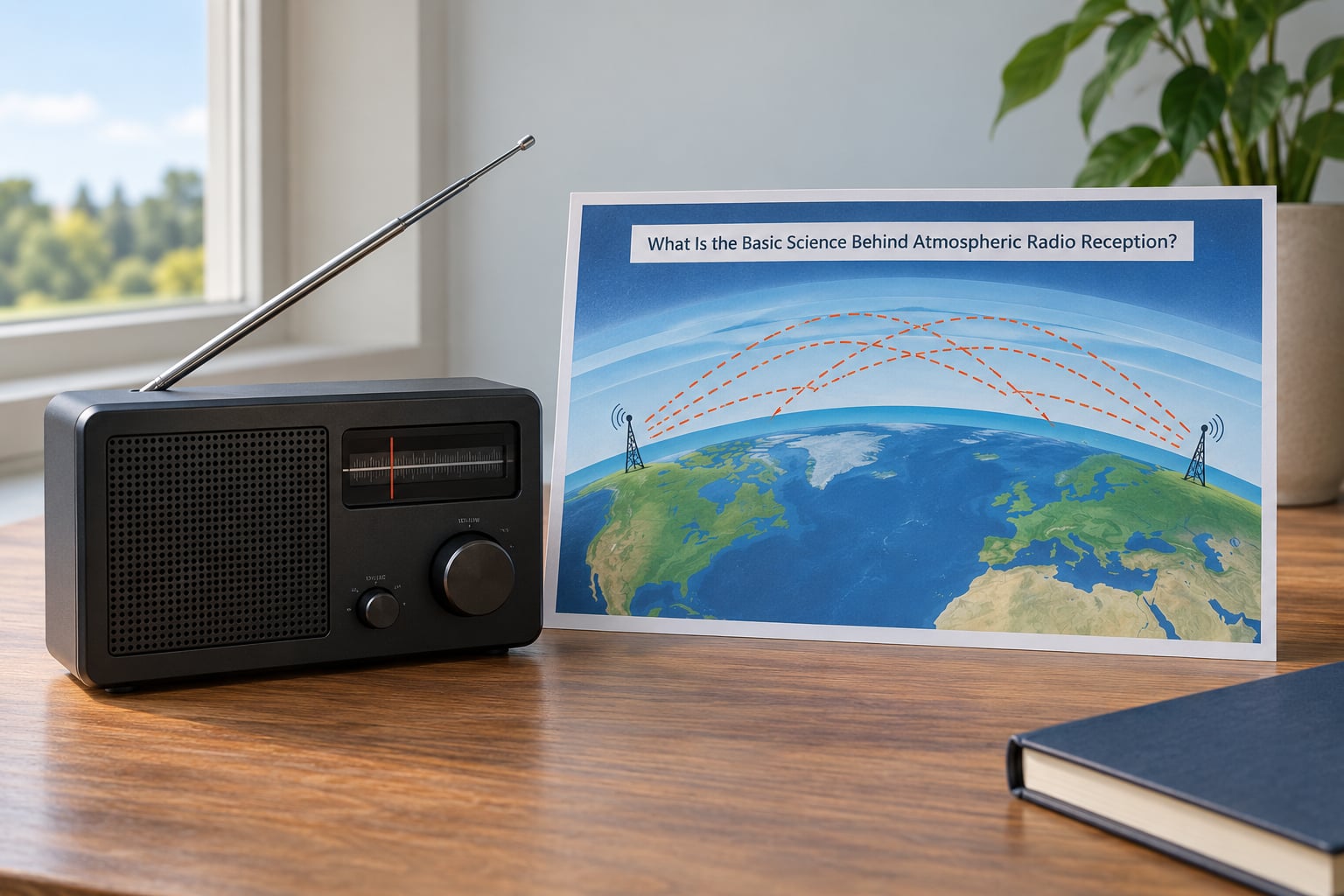
Radio reception is what happens between a transmitter and your set. Transmission is the studio sending a signal out; reception is your aerial picking up whatever reaches it, cleanly or otherwise. A station can be transmitting perfectly while your reception is dreadful, and that split is worth keeping in mind whenever you blame the broadcaster.
The default assumption about radio waves is that they travel in a straight line. For VHF and UHF — FM, DAB, and most of the modern dial — that is largely true. Line of sight to the transmitter ends at the radio horizon, roughly 4.8 times the square root of the height in metres. That horizon is why a transmitter 40 miles away can be invisible to a set sitting in a valley floor but perfectly receivable from the top of the hill.
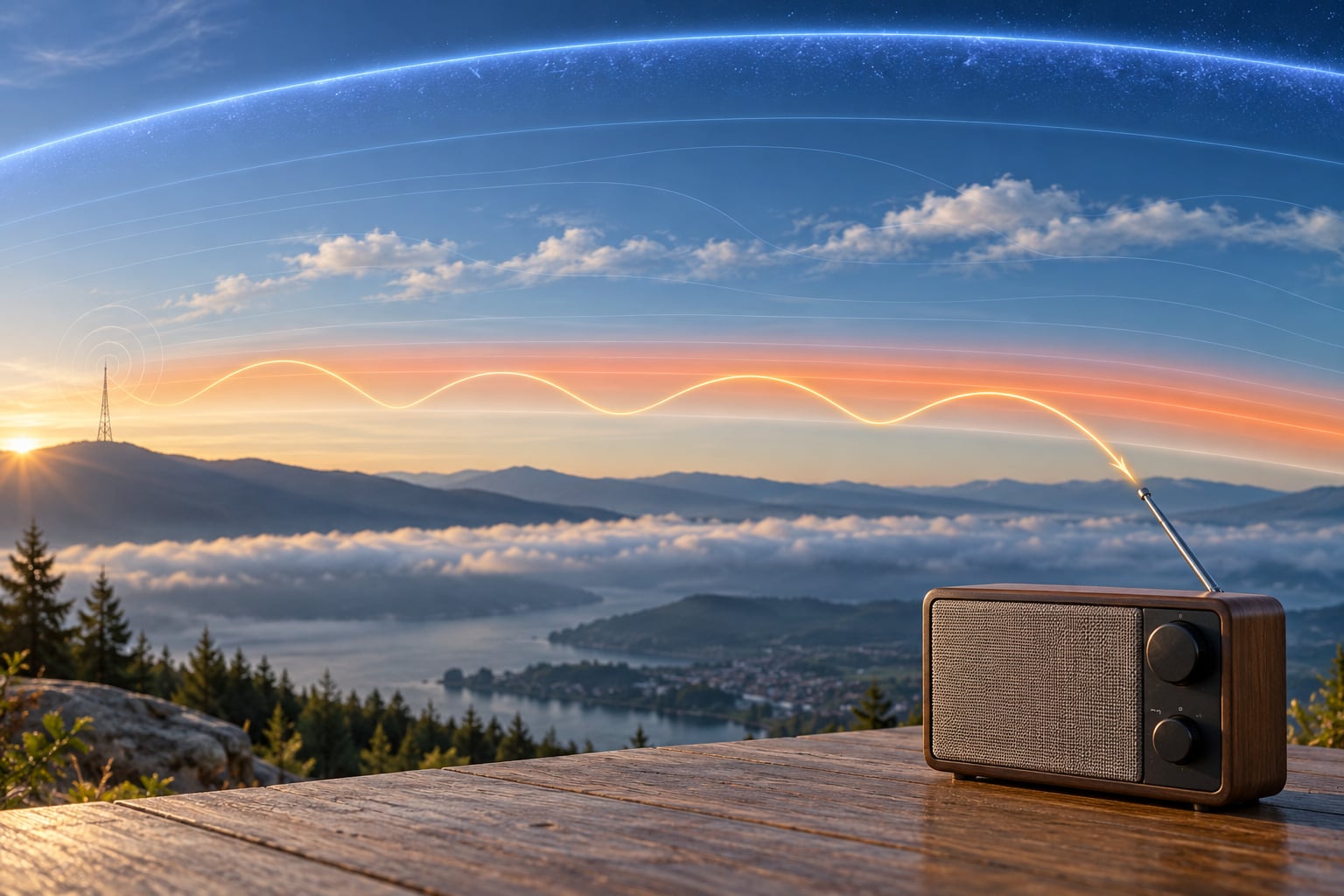
The catch is that radio waves travel slightly faster in cold air than in warm air. The measure of this is the refractive index, and when it changes with height, the wave bends. Bend it downwards and the signal curves along the ground far past the horizon. Bend it the wrong way and it goes up and out to space. Everything else in this guide is a variation on that bending.
Four layers of air matter to a listener:
- The lowest few hundred metres, where temperature and humidity change fastest and decide whether your local FM signal behaves.
- The troposphere, the bottom 8 km or so of the atmosphere, where most weather happens and where ducting forms.
- The ionosphere, a shell of ionised gas roughly 60 to 100 km up that reflects medium-wave and shortwave signals back to earth after dark.
- Space weather — solar flares and geomagnetic storms — which disturb the ionosphere itself and degrade the whole chain.
DAB sits awkwardly across two of those, which is why it behaves differently from FM under exactly the same sky. We get to that later.
How Do Rain, Snow, Fog, and Humidity Change Radio Signals?
Rain, snow, fog and humidity change radio signals, but the honest answer is that on most domestic sets the effect is far smaller than people expect. Heavy rain does weaken a signal, particularly on satellite and on the higher microwave bands. On local FM, drizzle and cloud are usually irrelevant. Anyone who insists rain ruins FM is describing correlation with a storm that also brought a power cut or an aerial fault.
The bigger everyday effect is atmospheric absorption at very high frequencies, where water vapour absorbs energy efficiently. This matters for some microwave links and for satellite services at the top of their band, where a downpour can measurably cut the margin. It barely touches the 88 to 108 MHz FM band you listen to in Yorkshire.
Humidity and mist work more indirectly. Water vapour in the lowest few hundred metres lowers the refractive index near the ground, and if it is combined with a temperature inversion you get exactly the conditions that trap and bend VHF signals. That is why listeners in the UK and elsewhere repeatedly report fringe stations arriving on grey, misty mornings and vanishing when the sun comes out.
Snow is the interesting one, because it is not the falling snow that matters but what it does to the ground. A couple of centimetres of wet snow on a roof or on a garden aerial mast changes the resonant length of the aerial and damps it badly. Reception falls, and no amount of re-tuning brings it back. Clear the snow and it returns. Dry snow on a plastic aerial is far less troublesome than wet snow on metal.
So: fog and humidity are mostly harmless on their own, rain fade is real but modest at FM frequencies, and snow is a genuine physical problem for the aerial itself rather than for the signal in the air.
Why Do Storms and Lightning Interfere with Radio Reception?
Storms make noise. A thunderstorm is a huge electrical event, and receivers pick up two distinct problems from it.
The first is broadband electrical noise, which is what most people mean by static on an AM set during summer afternoon storms. Discharge within the cloud produces impulses at every radio frequency at once, and on medium wave, where the ionosphere is doing nothing useful in daylight, those impulses dominate the wanted station. It sounds like a hiss or crackle over the top of the broadcast, and it often persists well after the rain has stopped at your location.
The second is lightning itself. Each return stroke is a very short, very intense radio transmitter, so a strike anywhere along the path produces a sharp click, a burst of noise, or a brief moment of complete deafness. In severe storms a receiver can simply be overwhelmed for a second at a time. If your reception is oddly fragile during a storm and then normal again within the hour, that pattern is almost always lightning rather than the broadcast.
There is a third possibility people forget: a storm takes out mains power, and when it comes back, the supply is often briefly unstable. A cheap hi-fi or set will sometimes pick up buzzing or a hum on FM from that, and it has nothing to do with the weather in the sky.
Protecting your equipment is mostly common sense. Keep aerials well clear of the mains supply and of overhead power lines, and never handle an aerial in a thunderstorm. A properly earthed set is safer than an unearthed one in British weather, and mains-borne surge protection is worth having if you are in an exposed spot.
How Do Temperature Changes and Inversions Affect Radio Propagation?
This is the big one for FM, and it is the reason a distant station can appear on a still evening and vanish a day later.
A temperature inversion is a layer of air where temperature increases with height instead of decreasing, which is the opposite of normal. In Britain these form when a clear night lets the ground cool and radiate heat away faster than the air above it, so the air closest to the surface becomes colder, and therefore denser, than the air a few hundred metres up. High pressure helps by holding everything still and stopping the wind from mixing the layers.
Tropospheric ducting is what happens when that inversion is strong enough to trap the signal between the cold air below and warmer air above. Instead of the wave curving gently towards the horizon and dropping out, it curves back down towards the ground and keeps going. Stations well past the radio horizon become receivable, sometimes over a sea path with no terrain in the way at all.
Signs that you are in a duct: a local FM station suddenly sounding thin and noisy, a station from 60 or 100 miles away appearing on the dial, your own station mixing with another one, or an unusual whistle or fluttering sound as two distant signals beat against each other. Long-standing listeners on r/RTLSDR and r/amateurradio log these often, and the pattern they report matches the forecast, not the compass direction — if the isobars say south-westerly, it is a southerly ducting event.
Ducting events have a rhythm. They favour settled, anticyclonic weather, usually in summer or autumn, often late evening into early morning, and they frequently repeat on consecutive nights before disappearing for months. Distances vary wildly: an ordinary inversion might add 20 or 30 miles to your reach, a strong sea-path duct can run to several hundred, and verified FM records have reached roughly 2,500 km.
You can predict one. Look at the pressure forecast: a high-pressure centre sitting over or close to the region, pressure above about 1020 hPa, light winds, clear skies and a big overnight drop in temperature is the classic setup. If you want the daily detail, our radio gear guides cover the meters and receivers that make these effects visible.
A related summer phenomenon is sporadic E, short-lived patches of ionised air forming high in the atmosphere. VHF signals that normally hop straight past the ionosphere get reflected back down, opening temporary paths over several hundred kilometres. It usually appears for a day or two, favours summer, and can bring in distant transmitters that seem impossible at the time.
How Do Atmospheric Conditions Affect AM, FM, and Digital Radio?
How atmospheric conditions affect radio reception, band by band
Medium wave behaves nothing like FM because it uses the ionosphere rather than the troposphere. In daylight the ionosphere absorbs most medium-wave energy, so you are limited to groundwave, which hugs the surface and gives a predictable local service. After dark, the D layer thins and ceases to absorb, and medium-wave signals start bouncing off the ionosphere and coming back from hundreds of kilometres away.
That is why AM gets worse after dark rather than better. Your local station fades as the groundwave weakens, and distant stations arrive on the same frequency. Where two broadcast areas overlap, you get co-channel interference: two stations on one frequency beating against each other. The maximum usable frequency, the highest frequency the ionosphere will reflect at that moment, falls at night and after sunrise, which is why distant AM stations fade out around dawn and why listening is often better in the small hours.
DAB sits in a strange middle position. It is VHF, so it is not reflected by the ionosphere at all, but its signals are weaker and more fragile than FM, with less headroom before they break up. In a duct, DAB can behave more erratically than FM because a marginal digital multiplex turns into scratchy noise and then silence, while analog FM just gets quieter. Digital drop-out on a clear, still evening is a ducting signature.
| Band | Main atmospheric driver | What you notice | Best conditions |
|---|---|---|---|
| FM (VHF) | Tropospheric ducting, temperature inversion | Distant stations appear, local stations go thin, whistling or fluttering | High pressure, clear still nights, light winds |
| AM / medium wave | Ionosphere, day-night absorption cycle | Local fades after dark, distant stations and co-channel interference | Small hours, lower solar absorption |
| DAB | VHF ducting and interference | Scratchy then sudden silence rather than gradual fade | Unsettled weather with no inversion |
| Shortwave | Ionosphere, geomagnetic storms | Big swings in what is receivable, fading on fading | Night-time, quiet geomagnetic conditions |
| Satellite | Rain fade at high frequencies | Picture break-up or loss in heavy rain | Clear sky, high elevation |
And then there is the sun. Sunspots and the solar cycle change how ionised the ionosphere is, and a solar flare or geomagnetic storm raises the absorption and disturbs the reflections that shortwave and medium wave depend on. During a serious event, shortwave bands fade out and ionised aurora can appear further south than usual. It is real, and for a domestic FM listener in Yorkshire it is close to irrelevant.
What Can You Do When Weather Makes Radio Reception Worse?
The most useful thing is to diagnose the cause before you spend anything. Almost every forum thread about this topic involves someone who bought a booster for a problem that no booster could solve.
| Symptom | Most likely cause | Will equipment help? |
|---|---|---|
| Distant stations appear, then vanish over days | Tropospheric ducting | No. Wait for the weather to change |
| Two stations mixed on one frequency | Co-channel interference, often ducting | No. Keep the frequency, wait it out |
| Whistling, fluttering or twittering on FM | Distant signals beating together, or multipath | No. Moving the aerial helps the multipath case |
| Hiss and crackle in stormy weather | Atmospheric electrical noise, lightning | Only a good outdoor aerial with decent filtering |
| Local AM fading after dark | Ionosphere opening the band up | No. A ferrite rod or loop aerial helps most here |
| Buzz or hum that never changes | Mains or electrical interference nearby | Yes. This one is worth chasing |
| Reception fell and stayed down after snow | Snow loading or icing on the aerial | Get up there and clear it |
| A station appears that is not on any list | Relay transmitter, or a pirate station | No. Check whether it broadcasts a legal ident |
Fixes worth trying, cheapest first:
- Rescan and do not re-tune repeatedly. During a duct, constant re-tuning locks you onto a distant station that will disappear in a few hours. BBC’s own advice on this is blunt: wait, and do not re-tune.
- Rotate or relocate the aerial. FM is line of sight, so height and clear horizon beat almost everything. Rotating a directional FM aerial away from a nearby transmitter is the single most effective tweak on a hi-fi aerial.
- Turn a ferrite rod the other way. On AM the rod is directional and picks up least from its narrow end. Swapping the aerial for a loop is a bigger upgrade still.
- Move away from electrical noise. Mains transformers, LED lamps, dimmer switches, cheap chargers and plasma TVs all radiate on the FM band. A metre of separation can remove a buzz that no amount of amplification ever will.
- Check the coax. A corroded aerial lead, a chewed cable or a loose plug produces exactly the same symptoms as a bad day for ducting. Tighten everything before you blame the sky.
And do not buy a booster for a problem that arrives and leaves with the forecast. Signal boosters amplify noise along with everything else, and they will not pull in a station whose signal never arrived at all. If reception changes with the weather, you are watching the atmosphere, not a fault.
Frequently Asked Questions
Does rain make radio signals weaker?
It does, but less than most people expect at broadcast FM frequencies. Rain droplets scatter and absorb radio energy, and the effect grows sharply with frequency, so heavy rain is a real problem for satellite and microwave links and only a minor one for local FM. If reception drops when it rains, something else is usually going on at the same time, such as a lightning burst or a power cut.
Why does my radio reception get worse during a storm?
A thunderstorm puts a great deal of electrical noise into the air across a wide range of frequencies at once. On AM this shows up as hiss and crackle, because the ionosphere is not helping the signal during the day. Lightning adds sharp clicks and can overwhelm the receiver briefly. On FM you may only notice buzzing, and often the real cause is mains power flickering rather than the storm itself.
Can fog or humidity interfere with AM and FM radio?
On their own, almost not at all. Water vapour lowers the refractive index of the air near the ground, and when that combines with a temperature inversion under high pressure it helps bend VHF signals along the ground, which is exactly the condition for tropospheric ducting. So mist is rarely the problem itself, but it is often part of the weather pattern that causes distant FM stations to appear.
Does cold weather affect radio reception?
Cold on its own does very little. The mechanism is the temperature inversion, where a clear cold night makes the air near the ground colder and denser than the air above it. That trapped layer bends FM signals far past their normal range and can bring in distant stations. In winter the effect is limited because the sun is low and ground heating is weak, so cold clear nights in high summer and autumn produce the most dramatic results.
How can I improve reception during bad weather?
Start by diagnosing. If distant stations come and go with the forecast, no equipment will help and you should simply wait, without re-tuning. Check every cable connection, move the aerial higher or turn it away from a nearby transmitter, and increase the distance between the set and any LED lamp, dimmer or charger. Persistent buzz that ignores the weather is electrical interference and is worth chasing properly.
Is a sudden loss of radio reception likely to mean the station has gone off air?
Rarely. A broadcast engineer will normally check the signal is leaving the mast before assuming anything, and the station logs interruptions separately from transmission faults. Far more often a sudden loss is your own reception changing, either because the station is at the edge of coverage, because a duct has closed, or because electrical noise nearby has risen above the signal. Contacting the station is still worthwhile if it happens repeatedly at the same time of day.
Start here: check whether the problem tracks the forecast. If your reception changes with the weather, you are watching the atmosphere, and no aerial or amplifier will change that. Tighten the cables, clear snow off the aerial, keep electrical noise away from the set, and otherwise leave the dial alone until the weather does. Updated for 2026.