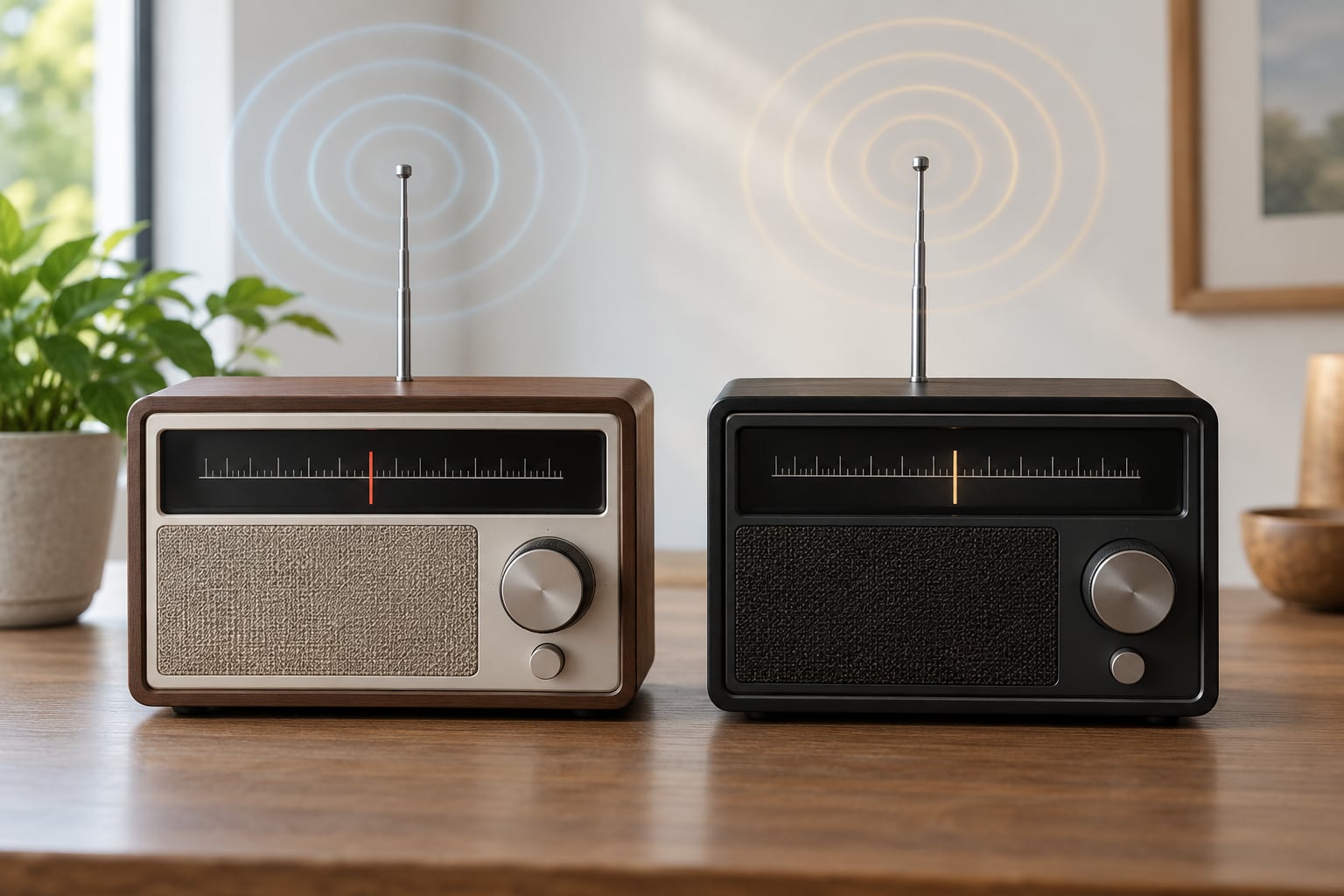
A radio frequency is simply how often a wave repeats each second, measured in hertz. Radio covers roughly 3 kilohertz to 300 gigahertz, and 1 hertz means one cycle per second. Tune a radio to 101.1 FM and you are asking it to pick out waves completing 101.1 million cycles every second.
The trouble is that frequency sounds like a technical word, when in practice it is just a position on a dial. Once you see that the number printed next to a station name is the frequency itself, a lot of radio stops being mysterious.
This guide covers what that number means, how it gets from a studio microphone to your speaker, why AM and FM behave so differently, and what to do when a frequency shows up on your display but nothing comes out of the speakers.
Table of Contents
- What a Radio Frequency Actually Is
- How Radio Frequency Works
- Why Radio Frequency Numbers Matter
- FM and AM Radio Frequencies at a Glance
- How Frequency Differs from Signal Strength
- Analog and Digital Radio Frequencies
- How to Find a Station by Its Frequency
- Why a Radio Frequency Does Not Identify a Streaming Station
- Common Radio Frequency Problems
- Key Radio Frequency Terms and Units
- Frequently Asked Questions
- Is a radio frequency the same thing as a channel?
- Why are FM station numbers listed with a decimal?
- Does a higher radio frequency always sound better?
- Why can I see a station frequency but hear no sound?
- Can two radio stations share the same frequency?
- Do internet radio stations have AM or FM frequencies?
- What to Do First
What a Radio Frequency Actually Is
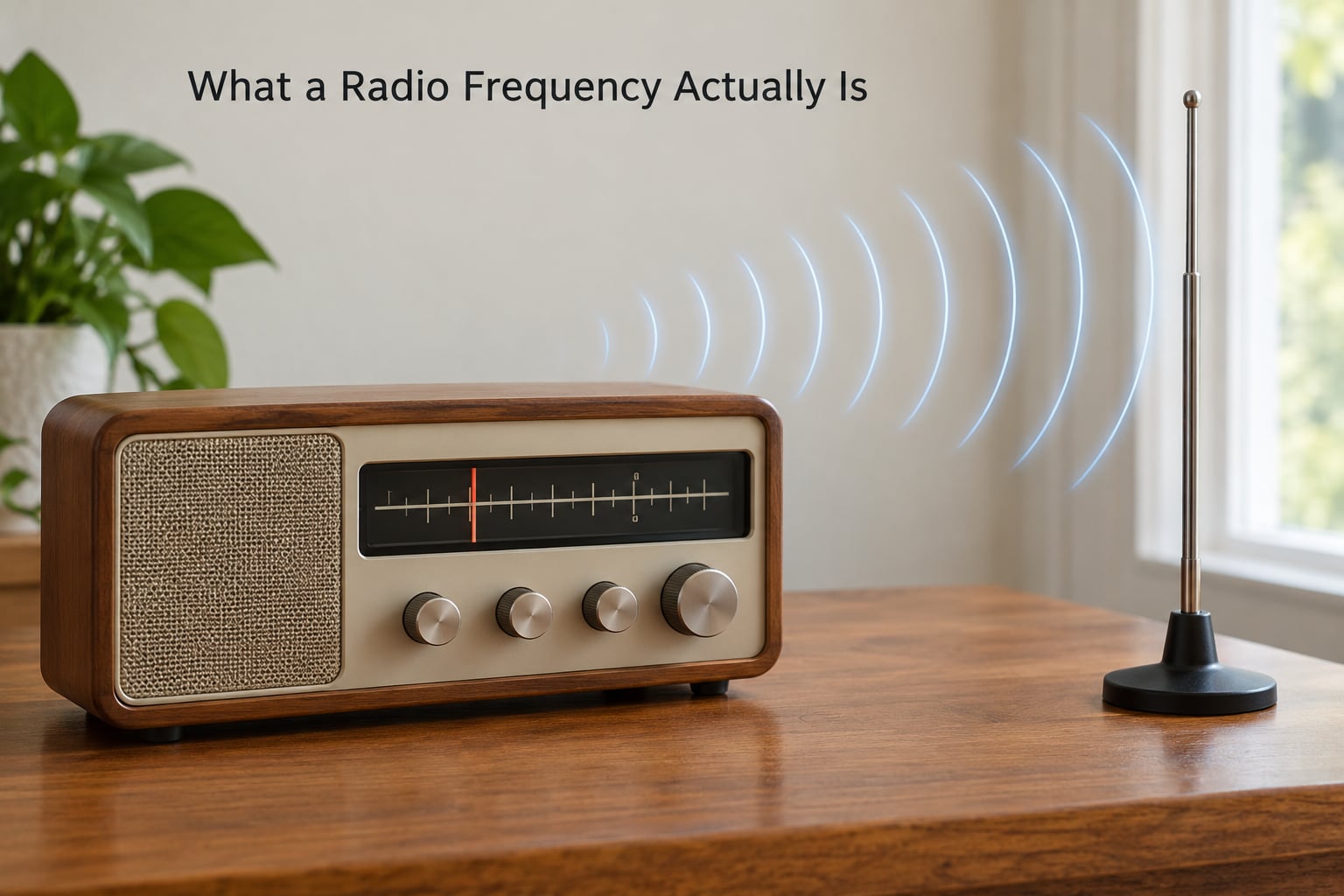
Radio is an electromagnetic wave, the same family of energy as light, microwaves and X-rays. What separates radio from visible light is only how fast it oscillates and how long its waves are. Your eye sees light at around 430 to 750 terahertz. Your radio tuner picks up waves in the megahertz range, billions of times slower.
Each broadcasting station is given its own frequency and stays there. One transmitter sends at 88.8 MHz, the next one down sends at 88.6 MHz, and they never share a slot. When you turn the dial to a number, you are telling a filter: pass me this frequency and nothing else.
Waves travel at the speed of light, roughly 300 million metres per second, so the timing is not the problem. The problem is separation. Dozens of transmitters surround you at once, and your radio has to pick one out of the crowd.
It is worth separating frequency from three things it is often confused with. Frequency is not signal strength, which describes how strong a signal arrives. It is not sound quality, which describes how much audio a station fits into that slot. And it is not popularity, which tells you nothing about the physics at all.
How Radio Frequency Works
The path from a person speaking in a studio to sound coming out of your speaker has eight stages, and each one is doing something fairly simple.
1. Microphone. Someone speaks and the microphone turns that sound into a small electrical signal.
2. Amplifier. The signal is boosted because a microphone’s output is far too weak to transmit any distance.
3. Carrier wave. A pure, steady wave is generated at the station’s assigned frequency, such as 100.7 MHz. On its own it carries nothing at all.
4. Modulation. The audio is imprinted onto the carrier. AM varies the height of the wave. FM varies the spacing between peaks.
5. Power amplifier and aerial. The modulated signal is boosted to kilowatts and pushed into a transmitter aerial, which converts electrical current into radio waves radiating outward.
6. Tuning. Your receiver’s aerial picks up every frequency in the area. The tuner circuit selects only the one you asked for and rejects the rest.
7. Demodulation. The receiver strips the audio back off the carrier, undoing whatever was done at step 4.
8. Speaker. The recovered audio signal drives the speaker, and you hear speech or music again.
What a Radio Frequency Actually Is in Everyday Terms
Picture a road with numbered lanes running past your house. Each lane is one station, and each lane carries one conversation. To follow a particular station, you stop in its lane and ignore the others.
That is why neighbouring stations must have separate frequencies. Two broadcasters cannot occupy the same lane, so regulators assign them separate slots, and your radio’s tuner behaves like a driver refusing to look out of the window at the wrong lane.
The analogy has a limit worth knowing. A lane is fixed and short, while a broadcast frequency can travel hundreds of kilometres depending on the band. But for the basic idea of separate slot, separate station, it holds up well.
Why Radio Frequency Numbers Matter
The unit tells you the size of the number. Kilohertz (kHz) means thousands of cycles per second, megahertz (MHz) means millions. A number without a unit is meaningless, and radios always show the unit alongside the value.
UK FM broadcasting runs from 88.0 to 108.0 MHz. Stations sit 0.2 MHz apart, which is why the decimals matter so much: 101.1 and 101.3 are different stations, while 101.1 and 101.2 fall in the gap between channels where you get only hiss.
Medium wave uses kHz rather than MHz, roughly 530 to 1600 kHz in the UK, with a station every 9 kHz. Long wave sits below that, with UK stations on 198 kHz and 252 kHz. Low numbers are not worse numbers. Medium wave numbers are simply longer waves measured in thousands instead of millions.
FM and AM Radio Frequencies at a Glance
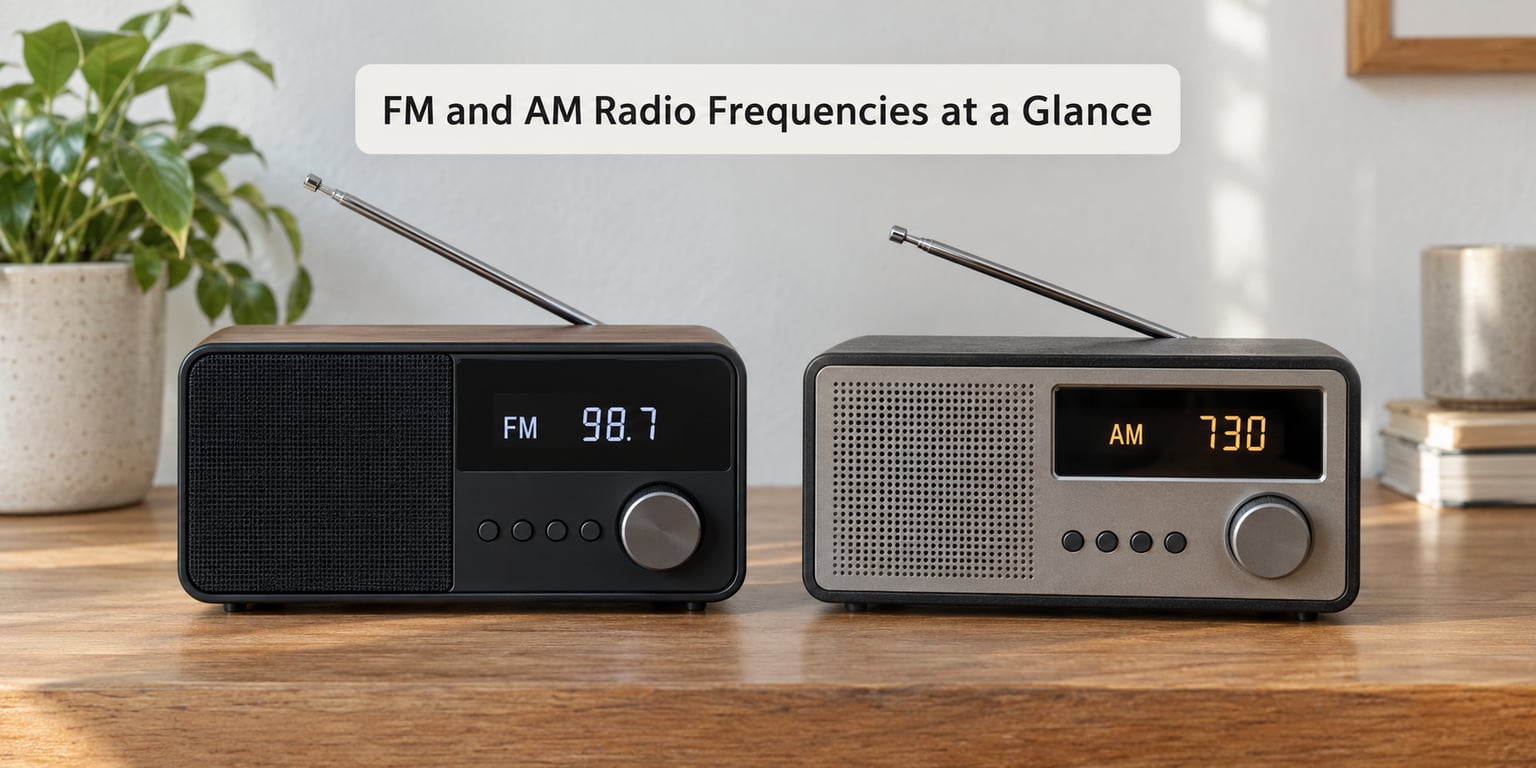
| What differs | FM | AM |
|---|---|---|
| UK broadcast range | 88.0 to 108.0 MHz | About 530 to 1600 kHz on medium wave |
| Spacing between stations | 0.2 MHz | 9 kHz |
| What the modulation changes | Spacing between wave peaks | Height of the wave |
| Typical sound | Fuller, cleaner, less hiss at the edges | Thinner voice, more hiss and crackle |
| Station spacing that fits audio | Wide enough for a full stereo signal | Narrow, so only a voice channel fits |
| Range you can expect | Line of sight, roughly 30 to 60 km | Follows the ground and can skip further at night |
| Behaviour near a strong transmitter | Clean until the edge, then drops away quickly | Fades in and out gradually |
| What listeners mostly use it for | Music and speech stations | Talk radio, sport, traditional services |
That trade-off comes directly from bandwidth. AM channels are narrow, so they fit a voice signal with little else. FM channels are wider, which is how a full stereo music signal fits, and why FM sounds cleaner when reception is good.
How Frequency Differs from Signal Strength
Frequency tells you where a station sits. Signal strength tells you how loudly its waves are arriving. A station does not change frequency because reception improved.
This is why a strong signal can still sound poor. If a very powerful transmitter sits next door in frequency, its waves can overwhelm part of the wanted station’s signal, and you hear that neighbour’s voice bleeding underneath yours. The tuning is correct; the conditions are not.
FM behaves differently because it resists this. As long as the wanted station stays stronger than the interfering one, FM keeps the sound clean right up until the signal falls off a cliff. Beyond that point it breaks up sharply rather than fading gradually, which surprises people the first time they drive out of a city.
A useful habit is to watch both numbers on a car stereo. Frequency stays fixed at 96.3 while the signal bars climb and drop, which makes the two ideas easy to tell apart in practice.
Analog and Digital Radio Frequencies
Digital radio still uses broadcast frequencies. DAB transmitters occupy part of the FM frequency range, and each one carries several channels at once in a multiplex. BBC Radio 1, Radio 2 and a dozen others share one transmitter and one frequency.
Because the audio is encoded as data, a DAB receiver shows you a channel name or number rather than a frequency. Pressing the down arrow on a DAB set moves between channels on the same transmitter, not between frequencies.
Digital reception also behaves differently. Once a signal drops below the threshold, the audio stops improving and simply cuts out or repeats, rather than degrading gradually the way AM does.
How to Find a Station by Its Frequency
Every receiver does the same job, so the same steps work on a kitchen radio, a car stereo or a DAB set.
1. Identify the band. Check the display for FM, MW, LW or DAB. A set with separate FM and AM buttons needs you to press the band first.
2. Enter or dial the number. On a car stereo, type the frequency into the keypad. On a portable set, turn the tuning knob slowly and watch the number move.
3. Set the text mode if available. Many radios show RDS station names on FM. If the display shows a blank or a scrolling string, press the RDS or Info button to see the name instead of the raw number.
4. Adjust for clarity, not volume. If the station is fuzzy, nudge the tuning a fraction either side of the printed number and listen. Transmitters are not always perfectly centred.
5. Improve the aerial first. On a portable set, rotate it fully upright and away from metal objects. On a car, fit the aerial before rewiring anything else.
6. Store it. Press and hold the memory button, pick a number, and confirm. Recall it later with one press instead of hunting.
Why a Radio Frequency Does Not Identify a Streaming Station
Internet radio and podcasts have no frequency at all. A broadcast station occupies a licensed slice of spectrum and every listener within range receives the identical signal. A stream is a file of audio delivered from one server to one device.
You choose a stream from a list, a search result or an app entry, often a live audio URL behind it. Nothing is tuned, there is no dial number, and there is no interference to fight.
The practical difference shows up when reception fails. A radio frequency either arrives or it does not, and the failure is about distance, buildings or a broken aerial. A stream fails because of the data connection. Same audio, completely different plumbing.
Podcast apps behave like a library of downloaded or streamed files rather than a live transmitter. You pick an episode, not a channel number.
Common Radio Frequency Problems
Interference from another transmitter. Two strong stations close together on the dial, or electrical equipment radiating noise. Try moving the tuning a fraction either side, and check whether the problem follows you or stays in one spot in the house.
Weak signal indoors. Thick walls and foil-backed insulation swallow FM, which travels in a straight line. Reposition the radio near a window and rotate the aerial upright, or move it to the room where it receives best rather than where it looks tidy.
Station drift or howl. A wandering reception squeal usually means adjacent-channel interference or an overloaded front end, common when a strong transmitter is nearby. Fine-tuning by a small amount settles it.
A frequency with no sound. If the number looks right but stays silent, you are likely between channels, on an empty frequency, or on the wrong band. Check the band indicator first, then tune slowly until audio appears.
Confusing dial labels. Some radios label AM frequencies as kHz and others as tens of kHz, so 100 on one set means 1000 kHz on the next. The band indicator tells you which convention is in use.
Noisy channels that always sound bad. Leave those frequencies alone. The physics of that slot is worse, and no amount of tuning fixes it.
Key Radio Frequency Terms and Units
| Term | What it means in plain terms |
|---|---|
| Hertz (Hz) | One wave cycle per second |
| Kilohertz (kHz) | Thousand cycles per second; medium and long wave use this |
| Megahertz (MHz) | Million cycles per second; FM broadcast uses this |
| Gigahertz (GHz) | Billion cycles per second; mobile and Wi-Fi sit here |
| Frequency | The repeat rate of a wave, and the dial position of a station |
| Wavelength | The distance one wave cycle covers; speed divided by frequency |
| Carrier wave | The steady wave that carries the audio, with no sound on its own |
| Modulation | Imprinting audio onto the carrier by changing its shape |
| Bandwidth | The slice of spectrum a signal occupies |
| Aerial | The antenna that sends or receives radio waves |
| Tuner | The circuit that selects one frequency and rejects the rest |
| Static | Random noise heard when no clear signal is present at the tuned frequency |
| Signal strength | How strong an arriving signal is, shown as bars or numbers |
| Line of sight | The direct path a wave takes; FM mostly follows it |
| Non-ionising | Radio waves lack the energy to break chemical bonds, unlike X-rays |
Frequency and wavelength are the same wave measured two ways, and they move in opposite directions. A 100 MHz FM wave works out at about 3 metres per cycle. A 1000 kHz medium wave signal works out at about 300 metres, roughly the length of three football pitches laid end to end.
Radio waves are non-ionising, which means they do not carry enough energy to knock atoms out of molecules or damage cells the way X-rays and gamma rays do. The higher up the spectrum you go, the more energy each photon carries. The real difference in kind, not degree, arrives with X-rays.
Frequently Asked Questions
Is a radio frequency the same thing as a channel?
Often, but not always. On FM and medium wave a channel is a slice of the band centred on a frequency, and UK FM channels are spaced 0.2 MHz apart. On DAB, one channel carries many programmes at once, all sharing a single frequency. So the frequency identifies the transmitter slot, while the channel identifies what you listen to.
Why are FM station numbers listed with a decimal?
Because UK FM stations sit 0.2 MHz apart, the number has to show a decimal to separate them. 101.1 and 101.3 are separate stations, and 101.2 sits in the gap between them where you get only hiss. The decimal is not a quality score or a volume setting. It is simply the part of the number that lets stations fit next to each other.
Does a higher radio frequency always sound better?
No. Sound quality depends on how much audio a station fits into its channel and on reception conditions, not on the number itself. Medium wave numbers are far lower than FM numbers and FM generally sounds cleaner, but that is a result of bandwidth, not of being higher on the dial. A well-sited medium wave station can sound better than a badly received FM one.
Why can I see a station frequency but hear no sound?
The most common cause is that you are between channels, where no station is transmitting, and the receiver simply amplifies the background noise floor. Other causes include being on the wrong band, a station that is off air at that hour, or an aerial that is unplugged or badly positioned. Check the band indicator, then tune slowly until audio appears.
Can two radio stations share the same frequency?
Not within the same broadcast area, because that would mean your radio could not tell them apart. Regulators assign separate frequencies so stations can overlap geographically. Relays and translators are the exception: a low-power station may rebroadcast a distant station’s programme locally, using a different frequency in your area.
Do internet radio stations have AM or FM frequencies?
No. Internet radio is delivered as data over a connection rather than broadcast through the air, so there is no frequency to tune. You choose a station by name from a list or app, and the audio arrives as a live stream. The same presenter can appear on a broadcast frequency and an internet stream at the same time without any conflict.
What to Do First
A radio frequency is the speed at which a wave repeats, measured in hertz, and the number on your dial is that measurement. Stations sit at separate frequencies because your tuner can only listen to one at a time.
Start by finding out which bands your radio supports. Look for FM, MW and any DAB labels on the case or display, because that tells you whether the numbers you will see are MHz, kHz or channel numbers instead. Then tune slowly across the FM band and note three station frequencies with their wavelengths worked out from the speed of light.
Once you know which band you are on, every reception problem becomes easier to place. Frequency tells you where a station should be, signal strength tells you how well it is arriving, and the gap between those two answers is almost always where the fault sits.