What radio skip is: a radio signal travelling far beyond its normal range because the ionosphere or a layer of warm air bends it back toward the ground. The result is that you pick up stations hundreds of miles away, often with nothing wrong with your equipment at all.
If you have ever switched on a set at half past eleven at night and heard a station from another part of Britain, or caught a distant FM station fading in on a warm afternoon, you have heard skip. It is not a fault, a glitch or a station playing tricks. It is the atmosphere doing something predictable.
One warning before we go further. The word skip gets used for at least three different things, and mixing them up is why so many listeners think their radio is broken. There is skywave skip on shortwave and medium wave, there is tropospheric ducting and sporadic E on VHF and FM, and there is the everyday meaning where a receiver simply skips past a channel or the audio cuts out.
On this site we mostly talk about the first two. If a Yorkshire listener hears a mainland European station on medium wave on a dark winter night, that is skip. If the set in the car changes station when you touch the volume wheel, that is not.
Table of Contents
What Radio Skip Means
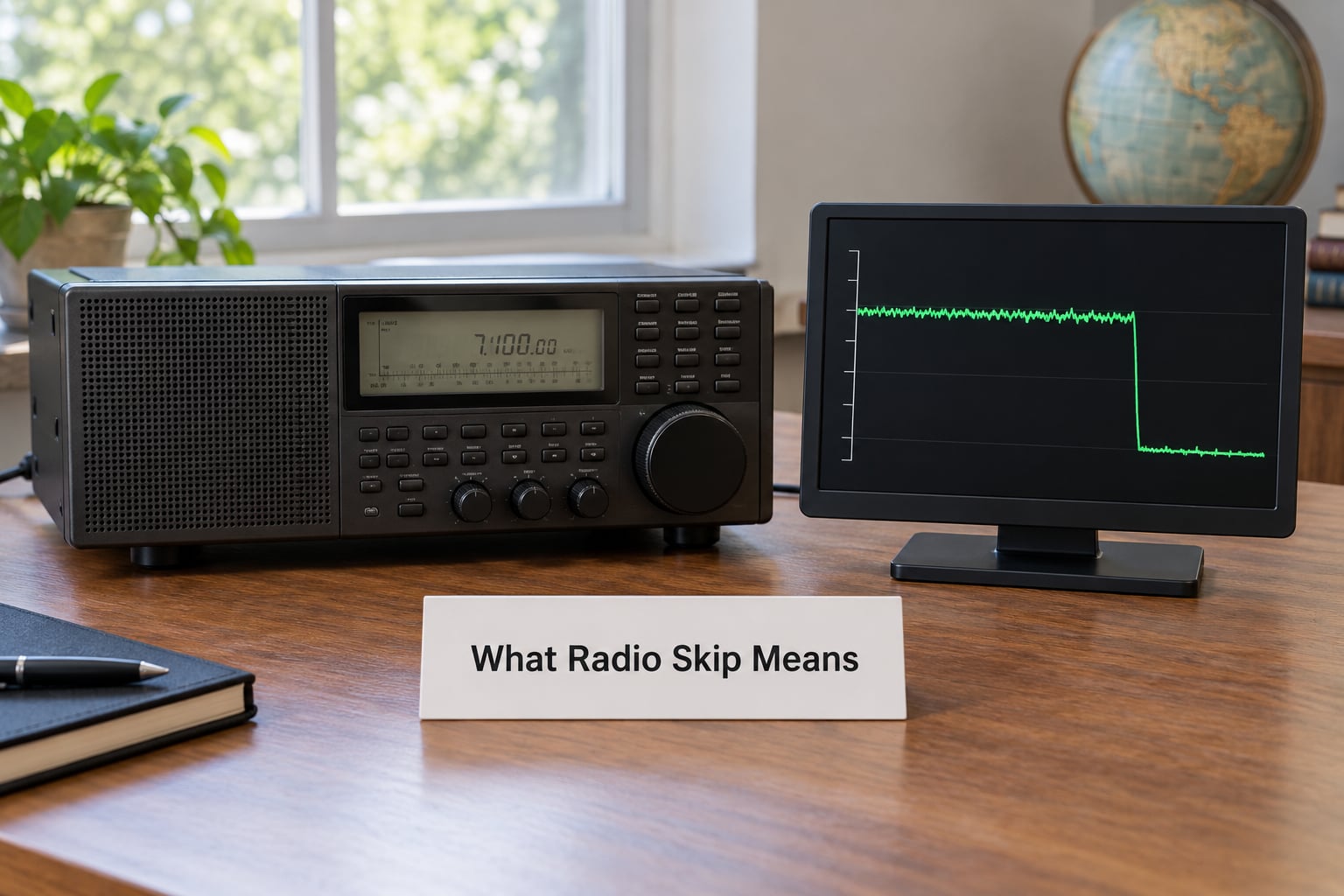
Skip gets its name from the fact that the signal appears to leap over the ground between you and the transmitter. A medium wave station on 500 kHz might have a normal range of a hundred miles or so. At night, under the right conditions, the same station can be copyable three hundred miles away.
The landing point matters more than the distance. The gap between the end of the station’s normal ground wave and the first place its sky wave comes back down is called the skip distance, and inside that gap sits the silent zone — the area where you can hear neither the local signal nor the distant one.
That silent zone is the part that confuses people. Move ten miles in the wrong direction and a station that was crystal clear vanishes completely, even though the transmitter has not changed and your receiver has not moved appreciably. You have stepped into the dead ground.
When Radio Skip Happens
This is the half of the question that most pages never answer. Skip is not random and it is not a once-a-decade event. It follows a daily and seasonal rhythm.
| Condition | What changes | Bands affected | UK listener example |
|---|---|---|---|
| After sunset | The D layer absorbs lower frequencies and stops killing the skywave path, so medium and long wave signals escape far past their daytime range | Long wave, medium wave, shortwave | A mainland station fading in on 500 kHz around 10pm in winter |
| After sunrise | The D layer reforms, low bands go quiet again and the first skip zone appears almost immediately | Long wave, medium wave, low shortwave | Your overnight medium wave station fading out by 7am |
| Summer afternoons | Warm air sitting over cold ground traps VHF signals in a duct and carries them far past the radio horizon | FM, VHF air band | A Scottish FM station appearing in West Yorkshire on a mild afternoon |
| Early summer mornings | Sporadic E forms over the continent, opening brief VHF paths hundreds of miles long | FM, 2 m amateur band, air band | A single afternoon where the band sounds unusually busy |
| High solar activity | More sunspots lift the maximum usable frequency, so higher shortwave bands start working reliably | Shortwave, especially above 10 MHz | More stations on the 16 m and 19 m bands during a solar maximum |
| Geomagnetic storm | The ionosphere churns, absorption rises and normal shortwave paths degrade for a day or two | Shortwave, some medium wave | A bad listening day during a storm that also shows as aurora |
The pattern listeners on r/cbradio describe is exactly this: they talk about skip as a live, checkable condition, asking each other whether it is happening tonight rather than whether it is real. On longwave and medium wave the answer is almost always yes after dark, and the interesting question becomes which stations are coming in.
Season matters too, and not only for daylight. Winter gives you long, dark evenings and a stable ionosphere, which is why medium wave DX sessions are a cold-evening habit. Summer brings the E-layer activity that gives you FM openings instead.
How Ionospheric Skip Creates Sudden Signal Loss
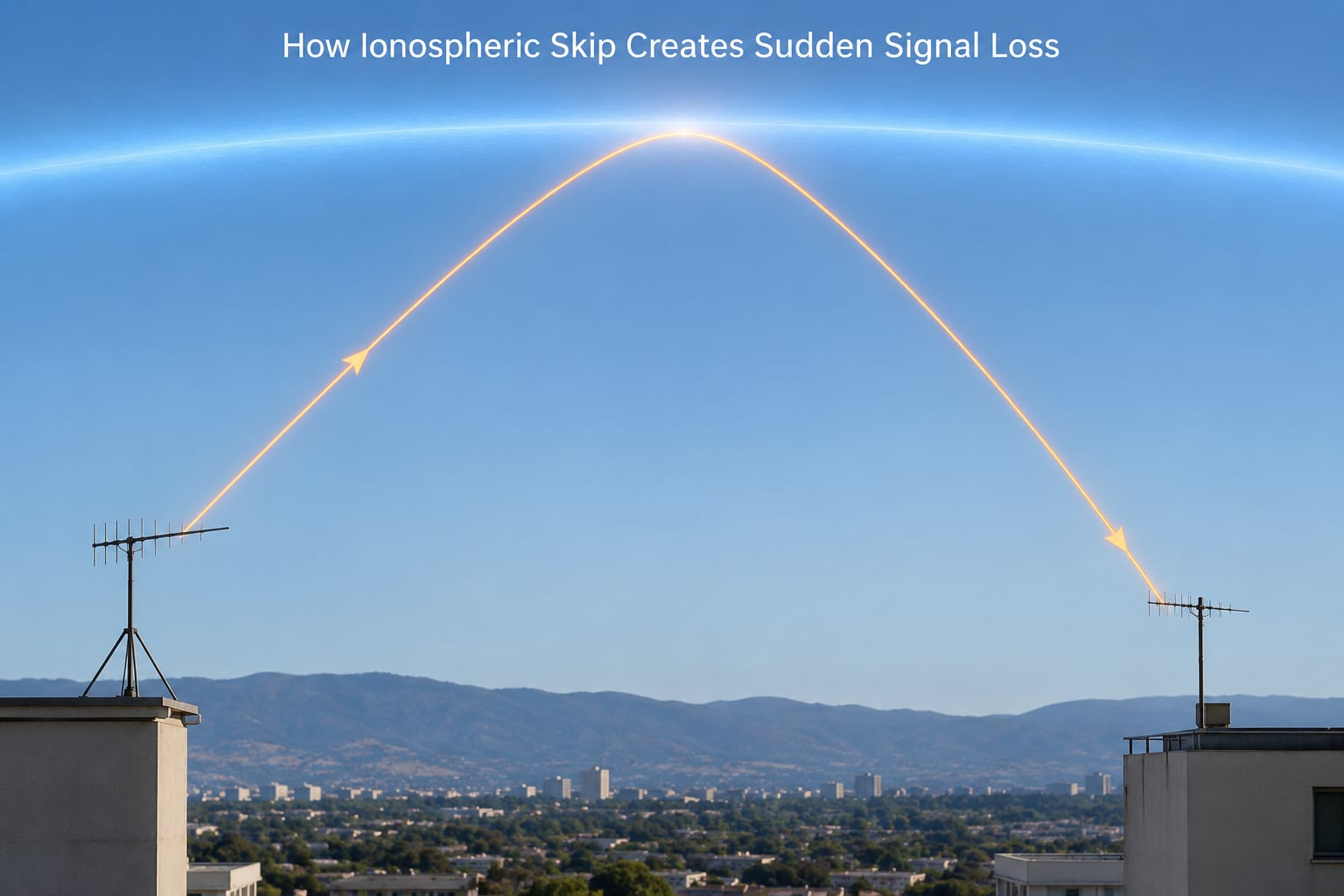
Sunlight ionises the upper atmosphere and leaves it with a layer of free electrons that will reflect radio waves. That region, from roughly 60 km up to about 400 km, is the ionosphere, and radio people divide it into named layers because each one behaves differently.
- D layer sits at roughly 60 to 90 km. It only exists in daylight and it soaks up the lower frequencies, which is why medium wave dies down after sunrise.
- E layer sits at roughly 90 to 120 km. It reflects some VHF at low angles and, on its own, is not the main event for broadcast listeners.
- F1 layer sits at roughly 180 km and only appears in daylight.
- F2 layer sits at roughly 250 km and does the heavy lifting for shortwave. It is the layer that carries broadcast signals back down to ground hundreds of miles away.
The signal does not bounce like a ball off a wall. At the frequencies used for shortwave, the wave is refracted, bent gradually as it passes through the electron density, and turned back down at a shallow angle. That shallow angle is why the returned signal lands far away instead of close in.
Two limits govern whether the path exists at all. Below the lowest usable frequency, absorption is too high and the signal simply dies. Above the maximum usable frequency, the wave passes through the F2 layer instead of bending back and never returns. Between those two sits the working window, and it moves up and down with the sun and the solar cycle.
Solar activity works the same way. More sunspots mean a higher, denser F2 layer, which raises the maximum usable frequency and lets higher shortwave bands work reliably. Fewer sunspots pull that ceiling down. The other extreme is a geomagnetic storm, when the ionosphere churns violently and normal paths degrade for a day or two at a time.
VHF works differently. Tropospheric ducting happens when a layer of warm air sits above cool air near the ground and traps the signal in a duct, carrying it well past the line-of-sight limit. Sporadic E is a localised patch of ionised air in the E layer that reflects VHF for a few hours. Neither involves the F2 layer, and both are summer things.
Which Radio Bands Are Most Affected
Skip is physically possible on some bands and simply cannot happen on others, which is the question most listeners cannot answer from a general radio page. Here is the honest band-by-band version.
| Band | Typical use | Can skip happen? | When |
|---|---|---|---|
| Long wave (LW) | Non-commercial broadcasts, time signals, some weather and navigation traffic | Yes, strongly | Nighttime only, with a long skip distance |
| Medium wave (MW, 500 kHz) | Talk radio, older local services, foreign stations | Yes, strongly | Nighttime only; silent during daylight |
| Shortwave (HF, 3 to 30 MHz) | International broadcasting, amateur radio, utility and time stations | Yes, this is the classic case | Day and night, varying with solar conditions |
| FM broadcast (88 to 108 MHz) | Local music and speech | Only via tropospheric ducting or sporadic E | Warm, settled afternoons and early summer mornings |
| DAB+ digital | The same services as FM, encoded digitally | Not in the same way | Drops cleanly to nothing rather than fading gradually |
| CB (27 MHz) | Personal two-way and trucker chatter | Yes, on favourable ionospheric conditions | Daytime, with variable reach |
DAB+ is worth a sentence of its own. When a digital multiplex fades it does not go quiet gradually, it buffers and then drops to nothing or reverts to the strongest ensemble it can find. That sudden, complete loss is a codec and multiplex effect rather than skywave skip, which is why people on digital sets never describe what they hear as skip.
Radio Skip vs. Fading, Static, and Station Switching
The reason people conclude their radio is faulty is that they have no framework for telling the causes apart. Here is one. If the signal strength rises unexpectedly and a station you have never heard before appears out of nowhere, that is skip. Genuine skip tends to arrive, strengthen, weaken and leave over minutes or hours.
Fading looks different. Fading is a slow, steady loss that tracks conditions: daylight eating a medium wave signal, a car moving behind a hill, a building getting in the way. The station you are tuned to stays at the same frequency throughout, and the sound degrades rather than being replaced by a different station.
Multipath is the sound of two copies of the same station arriving by different routes and cancelling or distorting each other. It buzzes, flutters or warbles, and it is worst in urban areas with a lot of steel. Interference from electrical equipment is a different animal again: buzz, hiss or clicks that change when you switch something on.
A dead zone is the opposite of skip in one respect — the signal is absent rather than unexpected — but it shares the same ionospheric cause. And station switching is not propagation at all. If the receiver moves off the frequency when the signal drops below its scan threshold, or if a preset has stored the wrong frequency, the station you get next is simply the next thing the set could find.
What Causes Radio Skip to Happen
Five things produce it, and they are worth separating because they behave differently.
Ionosphere variability is the everyday driver. The F2 layer rises and falls with local time, season and solar activity, so the same frequency that works at 10pm may be above the maximum usable frequency by dawn.
Geomagnetic disturbance comes from solar activity. A storm increases absorption and distorts the layers, which can close paths that were open all evening and degrade the ones that remain. Operators on r/amateurradio describe this well: the bands can go from excellent to unusable within an hour.
Tropospheric ducting and sporadic E produce VHF and FM skip. Ducting needs a warm layer sitting over a cool one and typically a few hours of settled weather. Sporadic E is a patch of ionised air that appears without much warning and usually fades by early afternoon.
Sitting on a band edge is underappreciated. The lowest and highest frequencies that work on a given path are marginal, and marginal signals come and go with tiny changes in ionisation. A station at the very top of the working window will arrive and vanish repeatedly through one evening.
Weak or marginal signal strength at your end is the fifth cause. If you are at the outer limit of the skip path, your antenna height and local noise floor decide whether you can hold the station at all. A perfectly good skip opening still means nothing if your aerial is indoors.
How to Improve Reception During Radio Skip
The important expectation first: better equipment cannot prevent skip, because skip is a propagation behaviour, not a reception problem. What gear can do is help you hold a marginal signal long enough to hear it. Here is what actually moves the needle, in rough order of usefulness.
- Get the aerial out and up. Height is the single biggest factor for medium wave and shortwave. A whip on the roof beats a telescopic indoors every time, and a ferrite AM loop with a clear view of the chosen direction is worth trying on MW.
- Check the ground connection. A poor earth on a long whip costs you more on the receive side than most people expect.
- Change bandwidth. A receiver set to a narrow channel filters out adjacent noise and lifts weak stations out of the clutter. On AM, a noise reduction or bandwidth limiter setting can turn unusable into listenable.
- Switch to mono. On FM and on AM at night, mono reception often holds a marginal station that stereo cannot lock onto.
- Tune to the better side of the carrier. FM drops off sharply at the edge of a channel. Ease the tuning until the signal sounds its best.
- Move. Ten feet in one direction can put you out of a null. A hill, a rear window and an upstairs landing all make real differences.
- Shift the time. If a medium wave station is fading in, stay with it. If a shortwave station is marginal, try the hour either side of local sunset and local sunrise, when the F2 layer is changing fastest.
- Cut local electrical noise. Try switching off LED lighting, chargers and switch-mode power supplies one at a time to see whether the hiss changes.
- Test with a second set. If the same station vanishes on two different receivers at the same time, the atmosphere is the likely cause. If it only happens on one, suspect that receiver.
Listeners who spent years on long-haul lorries describe overnight AM skip as unremarkable, which is the right attitude to copy. It is regular, predictable and worth looking forward to rather than troubleshooting.
Frequently Asked Questions
Is radio skip the same as a station going offline?
No. A station going offline means the transmitter has stopped, been switched off or lost its feed. Radio skip means the signal is still being transmitted at full power but the path between you and that transmitter has changed, so it lands somewhere else entirely. If the station is genuinely off air, no amount of propagation will bring it back. If it is skipping, it will usually reappear within minutes or hours.
Does radio skip happen on FM radio?
Yes, but by a different mechanism. FM signals travel in a straight line, so ordinary ionospheric skip does not apply. Instead they get bent by tropospheric ducting, where a layer of warm air traps the signal, or by sporadic E, a patch of ionised air that reflects VHF. Both are warm weather events, and both are what listeners usually picture when they say radio skip.
Why does radio skip sometimes happen at night?
Sunlight builds the D layer of the ionosphere, and that layer absorbs the lower radio frequencies during the day. Once the sun sets, the D layer disappears, medium and long wave signals stop being absorbed and can travel hundreds of miles by skywave. The same D layer then reforms at sunrise and closes those paths again, which is why a distant station fades out sharply in the morning.
Can a radio antenna stop skip from happening?
No. Skip is caused by the ionosphere or by a temperature inversion in the lower atmosphere, neither of which an antenna can influence. A better antenna can only make a marginal skip path more audible by capturing more of the signal. That is still worth doing, because many listeners miss a real opening simply because their aerial is indoors and their receiver is noisy.
What should I check if a station suddenly disappears?
Note the frequency, the time, the band and what your signal strength meter was doing just before it went. Then work through the obvious causes: move the aerial, switch off nearby LED lights or chargers, try mono instead of stereo, and tune a fraction either side of where you were. Testing the same frequency on a second receiver or in a different room separates an atmospheric event from a fault in your own set.
How long does radio skip usually last?
It varies with the band and the cause. A medium wave station fading in after dark can stay receivable for the whole night. A tropospheric duct on FM usually lasts from a couple of hours to most of an afternoon. A sporadic E opening often appears suddenly, peaks around midday and is gone by early afternoon. Geomagnetic disturbances work the other way, degrading normal paths for a day or two.
Conclusion
Radio skip is normal propagation, not a fault and not a glitch. The first thing to do when a station vanishes is write down the frequency, the time, the band and what your signal meter showed, then check the same frequency on a second receiver or from another room.
If it disappears on both, the atmosphere did it and there is nothing to repair. If it only happens on one set, or only in one position, you have an aerial, tuning or electrical noise problem worth chasing. Either way, the station that comes in at midnight is a reminder that your set is working exactly as intended.