If you have ever wondered why radio reception is worse in buildings, the answer is that the construction sits between your receiver and the transmitter. Metal, reinforced concrete and coated glass weaken the signal before it reaches the aerial, and the wiring and electronics inside add interference on top. The building rarely blocks radio outright; it changes the signal arriving at your set.
The practical part is telling two different faults apart. One is a signal that is too weak. The other is a signal buried in noise. They sound similar in a room and need opposite fixes, which is why buying an antenna for a noise problem is the most common wasted tenner in this whole subject.
Here is how the physics works, which parts of a building cause the most trouble, and an order of things to try before you spend anything.
Table of Contents
- Why Radio Reception Is Worse in Buildings
- What Is Happening to the Radio Signal?
- Which Building Features Cause the Biggest Problems?
- Does FM, AM, or DAB React Differently?
- Is Internet Radio Affected by the Building Too?
- How to Diagnose the Problem Where You Are
- How to Improve Radio Reception Indoors
- Frequently Asked Questions
- Conclusion
Why Radio Reception Is Worse in Buildings
Radio reception is worse in buildings for two separate reasons happening at the same time. Walls, floors, metal frames and wiring absorb or reflect the signal so it arrives weaker, while concrete, glass and underground rooms add further loss. The result is static, crackling, fading or, on digital radio, sudden silence.
Break it down like this:
- Signal too weak — the building is between you and the transmitter, or there is no clear path to it.
- Too much noise — chargers, LED lamps, monitors and mains wiring are adding electrical buzz that masks the music.
- Reflections — the signal bounces around inside and arrives from several directions at once, distorting what the set decodes.
- Wrong equipment for the job — a small internal aerial has no chance against a steel-framed warehouse wall.
If you can work out which of those four is happening, you already know where to look next. The rest of this guide takes them one at a time.
What Is Happening to the Radio Signal?
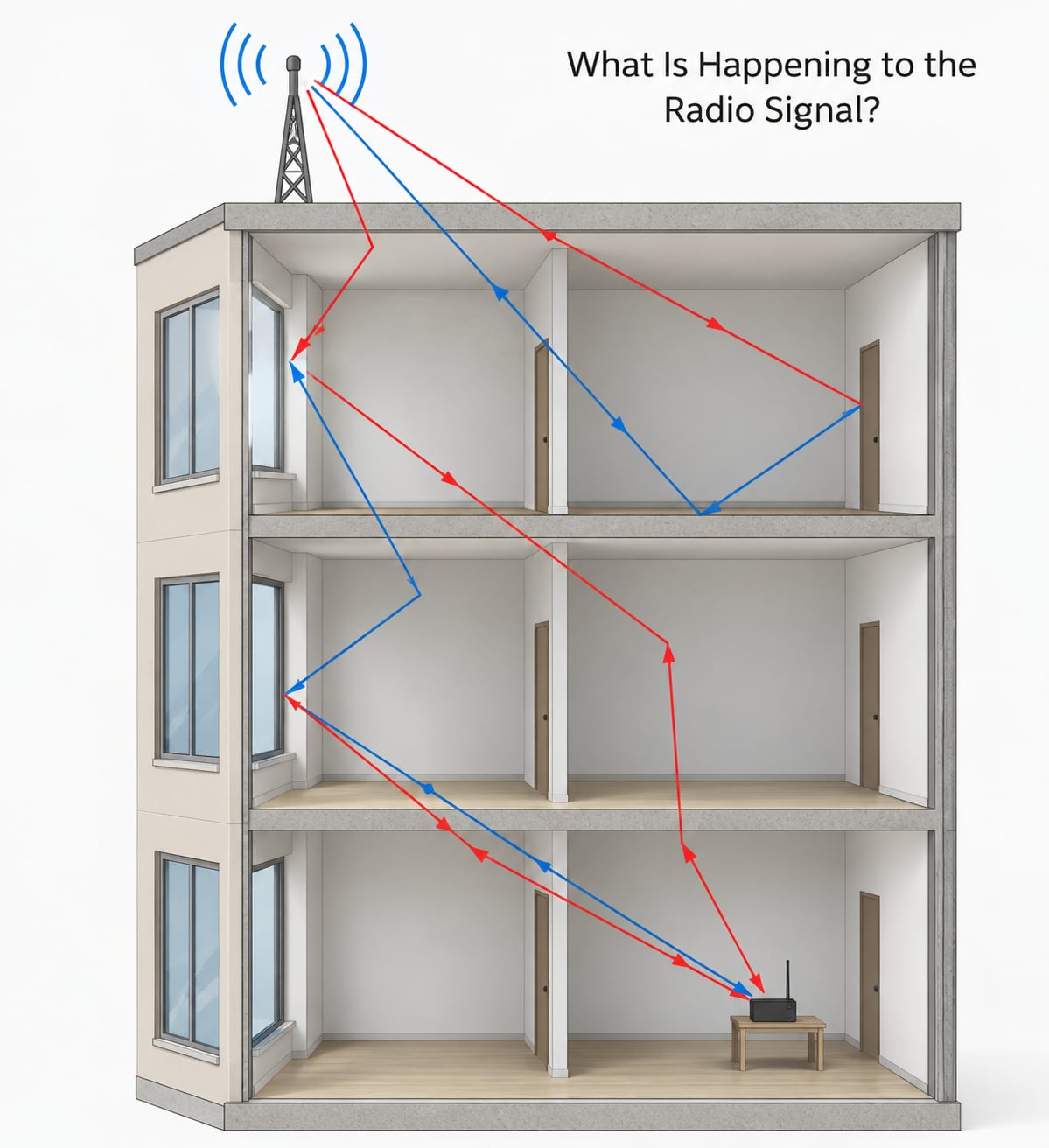
Four ideas explain almost every reception complaint. You do not need the maths, but you do need the vocabulary, because the fix changes with each one.
Signal strength is how much of the original signal reaches the aerial. It falls with distance, walls and obstructions. Strength is what most people mean when they say reception is bad.
Signal quality is how cleanly that strength is preserved. A strong signal off a nearby transmitter can still sound bad indoors because reflections distort the waveform it carries.
Noise floor is the background hiss a receiver hears when nothing is transmitting, or when the wanted station is weaker than the electrical clutter around it. Raise the noise floor and even a decent signal becomes hard to hear.
Multipath means the signal reaches your aerial by more than one route at once. The direct path and the reflected paths do not arrive together, so the receiver receives a smeared version of the original.
The signal-to-noise ratio is simply how far the station sits above that noise floor. It is the number that decides whether you hear music or hiss, and both halves of the problem drag it down.
| Problem | What you hear | What is happening | Where to look first |
|---|---|---|---|
| Weak signal (attenuation) | Quiet reception fading in and out, stations appearing then vanishing | Too little signal is reaching the aerial | Windows, upper floors, distance from the transmitter, aerial orientation |
| Electrical noise (interference) | Buzz, hum, crackle, whistles or hissy tone under the station | Other devices are adding signals on top of yours | Chargers, LED bulbs, monitors, switch-mode power supplies, mains wiring |
| Multipath distortion | Flutter, warbling, or two stations bleeding into each other | Reflected signals arriving late and out of step | Metal objects near the aerial, reflective rooms, rotating or moving the set |
| Digital dropouts | Silence or a hard click, then the station returns | The digital stream fell below the workable threshold | Same as weak signal, but with no quiet fade in between |
Why radio reception is worse in buildings with metal and concrete
Radio waves are electromagnetic. Metals conduct them, so they reflect most of what arrives and pass almost none of it through. Dense, dry materials such as brick and concrete absorb a good share of what is left. That is the attenuation, and it happens at every layer between the mast and your set.
Reinforced concrete is the usual villain in flats and offices. The concrete blocks signal, and the steel rebar inside it blocks a good deal more. Older properties often receive better simply because they use less metal in the frame, less foil-backed insulation and fewer coated windows.
Other common offenders:
- Steel framing and metal cladding — warehouses, industrial units, retail units and modern retail-park stores.
- Foil-backed insulation and radiant-barrier membranes — common in new builds and loft conversions.
- Low-E or metal-oxide coated windows — energy-efficient glazing has a thin conductive layer that behaves like a mesh.
- Mirrors, metal shelving and appliances — they do not block much but they scatter and redirect what gets past the walls.
Stack enough of these layers together and you get the effect known as shielding, where conductive surfaces enclose a space and behave like a Faraday cage. A fully enclosed steel box has no usable radio reception at all.
Two caveats worth keeping in mind. Thicker or more conductive does not mean a fixed amount of loss that we can quote as a neat figure, because building design, joint details and the frequency in use all shift the result. And a metal building is not automatically hopeless — it is just a problem antenna placement solves, as we cover later.
Which Building Features Cause the Biggest Problems?
Some parts of a building are consistently worse than others. If your reception changes as you walk through the flat, these are the rooms to suspect.
Basements, cellar rooms and underground car parks — soil and concrete above you block most of the signal before it arrives. Likely cause: attenuation. Check by taking the receiver up to street level and seeing whether it comes back to normal.
Lift shafts and stairwells — a shaft is a vertical metal box running the height of the building. Concrete stair cores next to it are dense too. Reception will usually collapse inside one and recover the moment you step out.
Thick exterior walls — party walls between flats, and walls facing away from your local transmitter, put several layers plus steel between you and the mast. Rooms on the far side of the building from the transmitter are the usual victims.
Metal roofs and metal-clad walls — common in warehouses, workshops and some converted industrial units. Check whether the signal improves dramatically just outside the door; if it does, the building shell is the cause.
Server rooms, plant rooms and comms cupboards — these are less about blocking and more about noise. Racks of switches, routers and cooling equipment raise the local noise floor dramatically.
Long corridors and rooms far from any window — every metre away from an opening adds wall to cross. A kitchen at the back of a deep flat is a harder reception environment than a front room, and the same station may play perfectly in one and badly in the other.
Rooms with metal on all sides — a metal filing cabinet pressed against the wall behind a set, a fridge next to the aerial, or a mirror opposite it, can undo a decent signal all on its own.
Does FM, AM, or DAB React Differently?
All three bands use the same building, and all three suffer indoors. They just fail in different ways, so it helps to know which one is misbehaving.
| Band | How it behaves indoors | Typical symptom | First thing to try |
|---|---|---|---|
| FM | Fades gradually rather than cutting out; tolerates moderate multipath; quality degrades before audibility does | Hiss creeping in, flutter, stations drifting apart as you move | Extend the telescopic aerial fully, spread it to a V, move toward a window |
| AM | Longer wavelength, so it gets around obstacles more readily, but the antenna is an electric-field loop and picks up far more household buzz | Buzz and crackle that changes when you switch a lamp or charger on | Rotate the internal loop, try a battery, unplug chargers one at a time |
| DAB and DAB+ | No fade. The codec holds the last frame or the signal is gone, so a marginal signal produces abrupt silence | Sudden cutting out, sometimes only in one room, while FM still plays | Rescan, reposition, check how many multiplexes come up before tuning |
None of the three is always the better choice indoors. FM degrades musically, DAB cuts out abruptly, and AM is the most likely to be swamped by noise in a modern home. What usually settles the choice is whether you want the station without noise or the station without dropouts, in the room you are actually sitting in.
Digital reception deserves one more note. Many sets report how many multiplexes they can find, and a building that only finds two or three of the five local ones is telling you that coverage, not the audio, is the problem.
Is Internet Radio Affected by the Building Too?
Yes, but through a completely different route. Internet radio does not need a broadcast signal at all, so thick walls cannot attenuate a transmitter. What they can do is weaken your Wi-Fi.
A 2.4 GHz network is absorbed heavily by concrete and steel in the same way broadcast radio is, and it shares that spectrum with neighbouring networks, so an apartment block can look like a crowded car park of overlapping channels. Elevators, thick communal cores and routers tucked in a utility cupboard make it worse.
Typical symptoms are buffering, dropouts, a station that will not start, or audio that cuts out while video on the same device keeps playing. If video survives and audio does not, the network is close to the limit and the audio is the first thing to sacrifice.
Useful checks: walk the stream around the building with the phone in hand to see where it holds, test on mobile data to separate the Wi-Fi problem from the stream itself, and note that a single bar of signal is not the same as a stable one.
How to Diagnose the Problem Where You Are
Ten minutes of testing tells you more than any specification. Work through these in order and stop when the picture becomes clear.
The window test. Take the radio to the room with the best window, ideally the one facing your local transmitter. If it plays cleanly there and not in the failing room, the building fabric is the obstacle and placement will fix it.
The movement test. Shift the set a couple of feet, or turn it 90 degrees on the spot. A dramatic change over a small distance means reflections are dominating, which is exactly what a repositioned aerial corrects.
The battery test. Run the set on batteries for a few minutes with the mains adapter unplugged. If the hiss drops, the noise is coming in through the power supply or the wiring it is plugged into.
The breaker test. Switch off the lighting circuit or the sockets in the affected room for a minute while listening. Improvement points to LED drivers, fluorescent ballasts or a noisy appliance on that circuit. Switch it back on afterwards, obviously.
The unplug test. Unplug chargers and power bricks one at a time and listen between each. AM responds fastest to this.
The band comparison. Try the same station on FM and AM, and the same set on DAB. Weak signal hurts every band; noise mostly hurts AM; digital dropouts point to signal rather than noise.
The streaming test. Play the station over mobile data on a phone. If that is clean while the radio is not, your problem is reception, not bandwidth or the station feed.
The room-to-room test. Walk a handheld set through every room. The pattern tells you which wall is doing the damage, and it is often not the one you would guess.
How to Improve Radio Reception Indoors
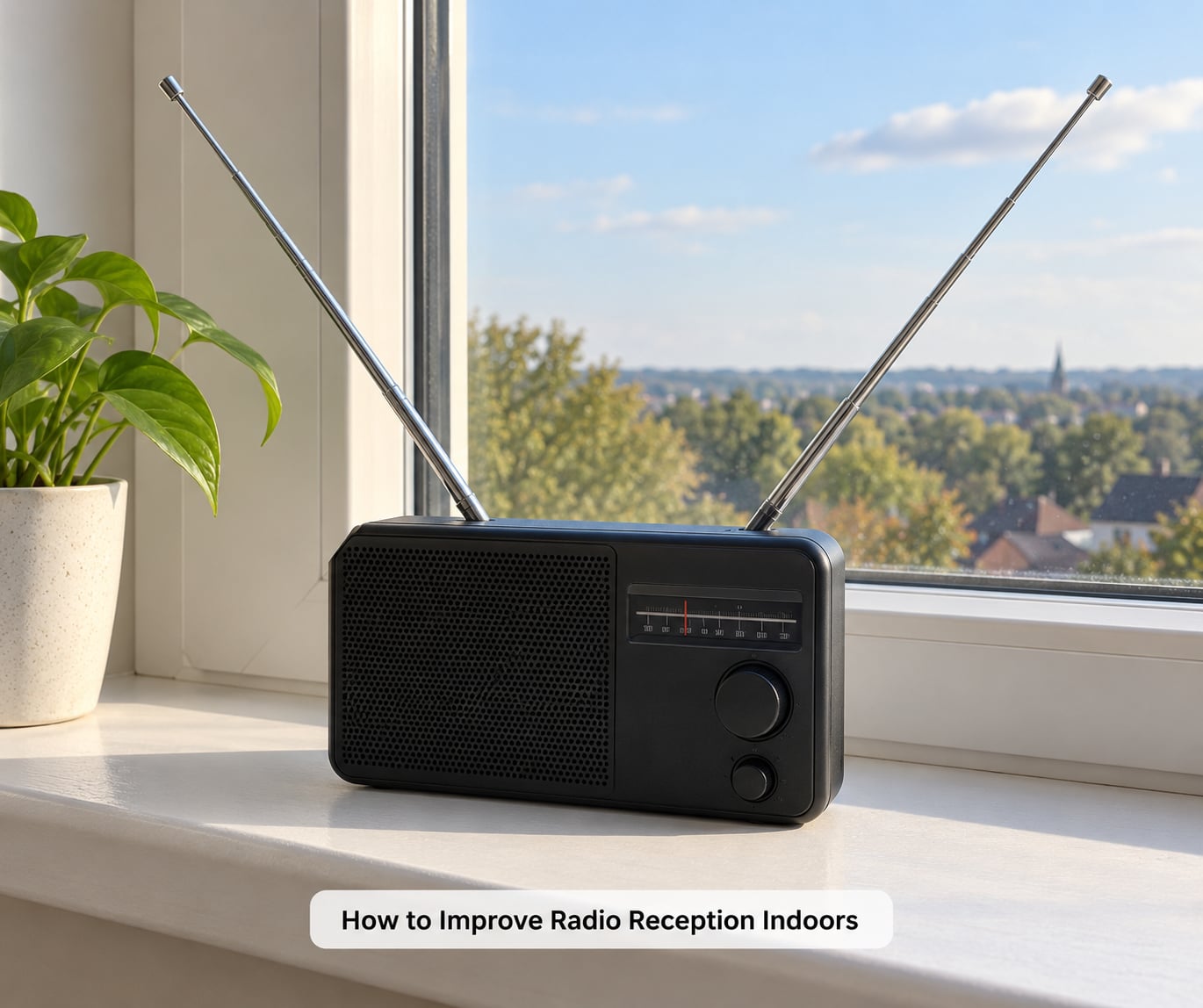
Start with the free options and work down. Most reception problems indoors get better without anything being bought.
1. Move the receiver toward a window. Even a few inches of clear glass in the signal path is worth more than any antenna you can fit indoors. Then move the set a little more, because inside a room the best position can be surprisingly specific.
2. Get the aerial out properly. Extend telescopic aerials fully and spread them into a wide V rather than leaving them vertical and touching. If the manual says the set performs best in a particular orientation, try it on its side and with the aerial laid flat, since reflections can rotate the arriving signal and change the best angle by 90 degrees.
3. Keep metal away from the aerial. Move filing cabinets, a fridge, a mirror or a wall of metal shelving a metre back if you can. This costs nothing and helps more than people expect.
4. Tune to a clearer station. On FM, stepping back 20 kHz from a busy frequency often finds a cleaner signal. On DAB, rescan after moving the set; the multiplex list may change with position.
5. Cut the noise at the source. Unplug chargers near the set, try battery power, and turn off LED lighting in the room to test it. Use a lower-quality power brick with a proper screened output if you suspect the adapter.
6. Run a wire dipole. A few metres of twin or speaker wire strung across the room and connected to the aerial terminal is the classic DIY step up. Keep it away from mains wiring and joiners, and keep both legs roughly equal.
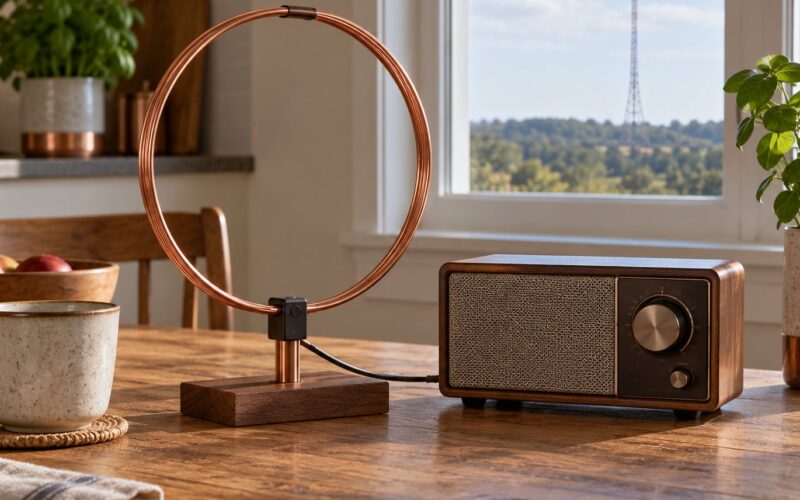
7. Use a magnetic loop for AM. A small loop of wire wound onto a ferrite rod or core rejects electric-field noise and responds to the magnetic component the AM loop antenna actually wants. It is the single most effective AM fix indoors.
8. Add an amplified indoor antenna. Worth it where the signal is there but weak. It also amplifies noise, so rule noise out first or you will amplify the problem.
9. Go outside with a directional aerial. A rooftop or garden Yagi aimed at your local transmitter, or an outdoor dipole, brought in by coax, is the real answer for metal-clad buildings, basements and upper-floor flats. Note that an aerial pointed at a very strong nearby transmitter can overload a cheap receiver’s front end and make things worse.
10. Ask the building manager. In a block of flats, a communal masthead amplifier and a good rooftop aerial serve every home far better than anything a tenant can install. This is the option most worth raising in a metal-clad or high-rise building.
11. Work around it where fixes are not allowed. In offices and workplaces, streaming the station over a wired network to a speaker, or a low-power FM transmitter on the desk, is often the only change permitted. It also sidesteps the whole building problem.
One safety note: do not work on mains wiring, roof fixings or anything above a drop yourself unless you are qualified. Aerial installers and electricians handle these properly.
Frequently Asked Questions
Why is radio reception bad in some high-rise apartments?
High-rise blocks stack concrete, steel rebar and often steel framing between you and the transmitter, and the floors above and below add more loss with every level. Local stations are usually sited for outdoor coverage, so the signal arriving at a twentieth-floor window may already be weak before the building does anything. Communal areas, stairwells and lifts often pick up stations that flats cannot, which is a quick sign the problem is coverage rather than your equipment.
Does FM or AM radio work better inside buildings?
Neither is reliably better. FM holds together better against moderate noise and multipath, but it fades to hiss and needs a longer aerial to perform well. AM gets around obstacles more easily because of its longer wavelength, yet its loop antenna is far more sensitive to chargers, LED bulbs and switch-mode power supplies. In a modern home FM is usually the easier band indoors, and AM becomes usable once a magnetic loop is fitted or a few chargers are unplugged.
Can a metal roof cause radio interference?
A metal roof rarely causes electrical interference, but it does block or reflect the signal outright. Take the receiver outside and up a stairwell: if it works there and not under the roof, the roof is the cause rather than your set. Some metal roofs also carry foil-backed insulation beneath the covering, which adds a second reflective layer. Metal cladding on walls behaves the same way, and that is why warehouse and workshop listening usually needs an external aerial.
Why does my car radio lose stations in a garage?
A garage puts a reinforced concrete structure between the car aerial and the transmitter, often with a metal roller door as well, so the weak signals that worked in the drive are gone. The fix that works is moving the car first: open the door fully, or drive out of the garage before searching for stations. Built-in aerial boosters only help when some signal is reaching the car, so they cannot rescue a fully shielded structure. A portable set near an open door is the practical test.
Is reception affected when it rains?
Ordinary rain has very little effect on radio reception. Broadcast signals travel well through ordinary weather, so a wet afternoon will not normally make a station disappear. What people often notice is that bad reception coincides with weather because wet ground, wet foliage and people staying indoors with more lights and electronics running are all happening at once. If reception really does change with rain, suspect nearby interference sources or a marginal signal rather than the rain itself.
Conclusion
Materials, reflections and equipment placement account for most indoor reception complaints. Those are the reasons why radio reception is worse in buildings than on the pavement outside the same door.
Start with two moves before buying anything: carry the receiver to the best window in the place, and play the same station on a phone over mobile data. If the window position fixes it, keep the set there. If the stream is clean and the radio is not, it is reception, and a proper aerial or a communal amplified aerial through your building manager is the answer.