Most old time radio programs were not recorded at all in the way a podcast is. They were performed live to air in a network studio and broadcast as they happened, while a separate reference recording was cut alongside the transmission for the network archive, the sponsor, and time-shifting to other stations. That sidecar capture lived on lacquer-coated discs, then magnetic wire, and finally magnetic tape.
It is a strange arrangement, and it explains almost everything about the era: the sound quality listeners still hear, the episodes that vanished, and the reason a “recording” of a 1937 show is often a scratchy, reverberant copy made while it went out live.
Here is exactly how old time radio programs were recorded, medium by medium, and how to tell what you are listening to when a show from that period turns up online.
Table of Contents
- How Old Time Radio Programs Were Recorded
- What Recording Equipment Did Old Time Radio Stations Use?
- What Was the Difference Between Live and Recorded Broadcasting?
- How Were Scripts, Voices, and Sound Effects Put Together?
- Why Did Old Time Radio Programs Sound Different From Modern Podcasts?
- How Old Time Radio Programs Preserved Their Recordings
- Frequently Asked Questions
- Conclusion
How Old Time Radio Programs Were Recorded
The direct answer: the shows went out live from a studio through a microphone, and a parallel signal ran to a cutting lathe in another room, where a stylus carved a groove into a rotating lacquer disc while the performance was still in progress. Nothing was recorded in advance, because the national networks banned it, and listeners heard the performance as it happened.
That ban had a stated reason. Disc sound in the early 1930s was thin, noisy and obviously inferior to a live voice in the room, so the networks refused to let a recorded show masquerade as a live one. Historians have also argued that the restriction protected something more valuable than fidelity, namely the phone lines and wire revenue that sponsors paid for.
Networks did allow exceptions, usually programmes nobody considered prime-time property. A short pre-network edition of Amos ‘n’ Andy ran from March 1928 to September 1929 as the first programme recorded specifically to be broadcast. Local stations had more freedom, and the pragmatic workaround grew everywhere: record the show anyway, and use the recording to repeat it for listeners in a different time zone, or to shift it by an hour when the clocks changed.
The economics followed the medium. A 16-inch disc gives you about four minutes a side, so a half-hour show needed six or eight discs cut in sequence by hand. When a network wanted to send the same episode to a hundred affiliates, technicians made a master cut, electroplated a stamper from it, and pressed copies in vinyl or shellac. Disc was the distribution format of the golden age, and it worked because a disc could be stacked, shipped and played on almost any station equipment in the country.
| Year | Change | What it meant for recording a show |
|---|---|---|
| 1928-1929 | Pre-NBC Amos ‘n’ Andy recorded for broadcast | First programme made specifically to be aired, outside the network live-only rule |
| 1930s | Bare aluminium reference discs | Embossed rather than cut grooves; playable only with a heavy fibre or diamond stylus |
| mid-1930s | Electrical transcription discs adopted | Cellulose nitrate lacquer on aluminium, then glass bases during the war, 16 inches at 33 1/3 rpm |
| late 1940s | Magnetic wire recorders | Cheaper per minute and almost unbreakable, but editing meant cutting and taping wire back together |
| 1947 | Bing Crosby demonstrates tape recording | First public demonstration of usable magnetic tape for broadcast in the United States |
| 1949 | NBC lifts the restriction on network recordings | Recorded programmes become normal; editing by cutting and splicing replaces dubbing to disc |
| 1950s onward | Preservation and copying | AFRS distribution to troops, regional archives, and later rebroadcast and collector dubbing |
One last wrinkle matters if you want to picture a prime-time evening. The same show was often performed twice, once for the East Coast audience and again hours later for the West. That was not a dub, it was a second full performance, which is why casts have to be re-recruited and why scripts carried timing notes tied to a specific performance.
What Recording Equipment Did Old Time Radio Stations Use?
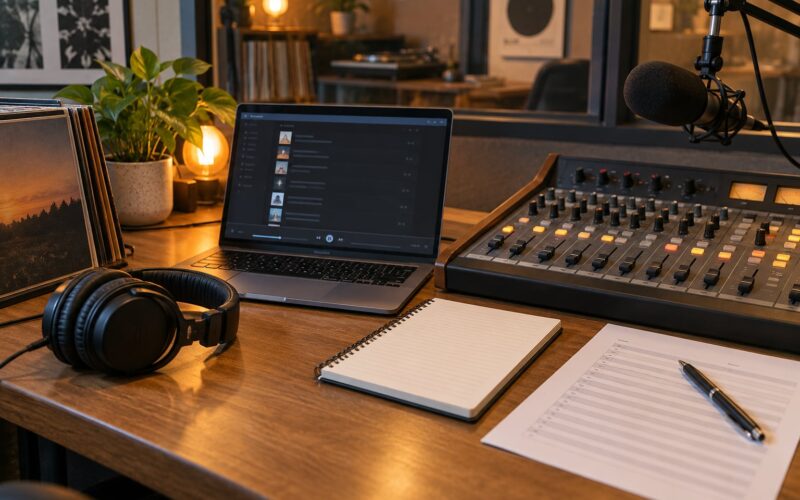
The studio itself looked closer to a small theatre than to a recording booth. Performers stood at a table or near a standing microphone, the audience sat in the room, and the engineer worked a mixing desk in a booth with a window over the studio floor. The sound you hear on surviving recordings is the room, the mic, the room again, and whatever the disc could hold.
The microphone of the era mattered. Ribbon mics, including the dual-face RCA 44 with a separate pickup face on each side, let a host and a guest speak from one stand while each voice kept its own level. Placed at an inch or two from the mouth, a ribbon mic had a warm, soft character but very little top end, and it could not be pushed hard without distorting. Performers learned to project rather than shout, and the raised, careful diction that survives in old time radio is partly a microphone response.
For a drama, the room did the rest. Footsteps were walked on a wooden floor, a door was a hinged panel on a frame, and rain was a sheet of metal shaken near a mic. Foley was performed live, in the studio, during the scene. If a script called for a car starting, somebody in the booth made that noise at the right moment, and an error could not be corrected because there was no second take.
Script handling was a craft of its own. Scripts were typed, marked with timings, and often stapled at the top corner so pages could be torn away as the read progressed. A dropped page was a timing error, and regulars were judged on it. Sound effect men worked from cue sheets and were the closest thing the medium had to a modern sound department.
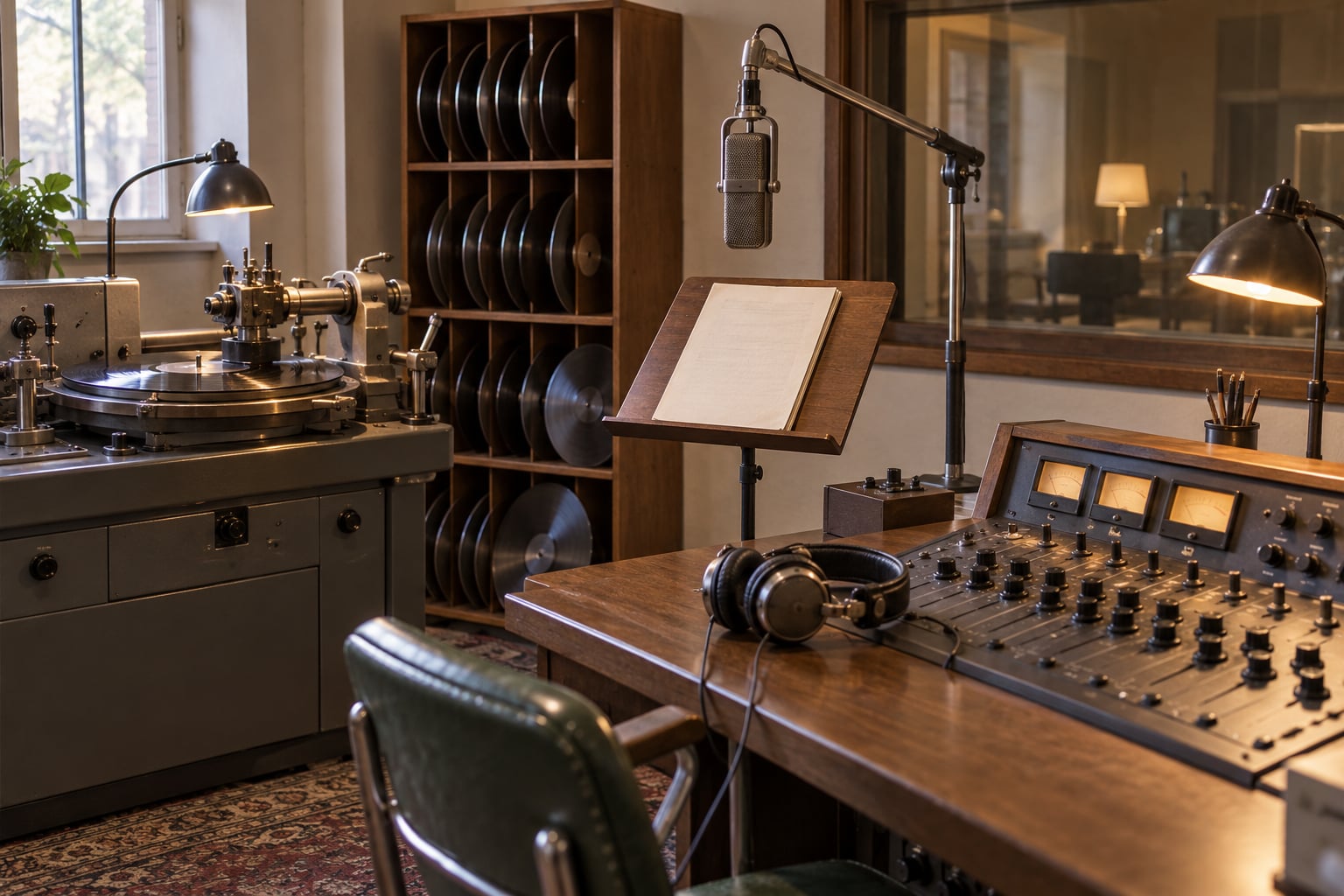
On the technical side, the reference recording was made by a disc cutting lathe, a heavy, slow turntable with a precisely ground sapphire or diamond stylus. The signal arriving from the studio was modulated onto the groove as it cut. If the stylus cut from the inside of the disc outward, that is an inside-start recording; from the outside in, an outside-start. The distinction matters to collectors, and the reason for the flip is well documented: lacquer is a cellulose nitrate coating, the swarf it produces is flammable, and crews kept the chips away from any ignition source. The disc cutting engineer was a skilled technician who sat with headphones and judged level by ear, because nothing on the chain could be undone once the groove was cut.
Here is what the media themselves were like.
| Medium | Typical format | Editable | Reusable | Common today |
|---|---|---|---|---|
| Bare aluminium disc | 12 inch, 78 rpm, embossed groove | No | No | Rare, fragile, needs a fibre or diamond stylus |
| Lacquer electrical transcription | 16 inch, 33 1/3 rpm, lacquer on aluminium or glass | No | No | Common in archives, playable with a modern stylus |
| Pressed vinyl or shellac | 16 inch, 33 1/3 rpm, pressed from a stamper | No | No | Common, the standard syndication copy |
| Magnetic wire | Single spool, 16 to 24 inches per minute | Poorly | Yes | Uncommon, thin and treble-poor |
| Reel-to-reel magnetic tape | Reels, several tape speeds | Yes, by cutting and splicing | Yes | Dominant, but much of it was wiped |
That last column is the whole story of what exists today. Disc is write-once: once the groove is cut, the recording is permanent, and reuse was never an option. Tape is reusable, so it went back into the library for the next show. The medium that sounded better destroyed more of the archive.
What Was the Difference Between Live and Recorded Broadcasting?
Live to air meant the microphone was open and the network was carrying the show at the moment it was performed, with no copy held anywhere except the reference recording being cut at the same time. Recorded meant the programme was captured first, edited, and then fed to stations on a schedule the producer controlled. For most of the golden age those were mutually exclusive, and the distinction confused listeners for decades afterwards.
| Factor | Live to air | Recorded in advance |
|---|---|---|
| Network policy before 1949 | The only permitted form | Blocked, with narrow exceptions |
| Editing | Impossible; mistakes went out live | Cut and splice on tape, dub to disc before that |
| Rehearsal | Full run-through, then the broadcast | As many sessions as the budget allowed |
| Distribution | Simultaneous network feed, plus a West Coast repeat performance | One capture, fed to many affiliates on tape or disc |
| Listener experience | Immediacy, and the possibility of a mistake | Consistent, repeatable, and closer in sound |
| Survival odds | Only via the reference disc cut alongside | Only if the tape was not reused |
The hybrid in between was the commonest arrangement. A show performed live in New York, captured on disc as it went out, and then played back to affiliates in a different time zone. Stations used it for two purposes: shifting a live broadcast when daylight saving time moved the clock, and giving a second airing to a show that had already been heard nationally. A disc cut only for those repeats is why an episode sometimes survives in two performances with different casts and different running times.
After 1949 the balance reversed quickly. With tape, a producer could pull a show’s worst fifteen seconds off it with a razor blade and a strip of splicing tape, and the same week could host a correction, a re-recorded insert, or a network-wide re-run. The four-directional show with an eleven-member cast, once a nightmare of scheduling, became ordinary. What did not change was the performance itself. A script taped in 1951 was still read live by actors in a room, and it still carried the room in the recording.
For listeners who want the practical version: a reference disc gives you the live show plus the room, and nothing else. A pressed copy gives you a cleaner transfer with less surface noise, because it is a copy of a copy. Neither is wrong. They are different objects and they are worth hearing side by side.
How Were Scripts, Voices, and Sound Effects Put Together?
A network drama went through a fixed sequence, and knowing the order makes the surviving audio easier to read. The steps below are roughly how a radio script moved from a typewriter to a cutting lathe.
1. The script was commissioned and timed. A producer set the running time to the second, because a live show that overran cut into the following programme with no way to recover. Writers wrote to that number, and actors learned to hit it.
2. The cast and music were booked. Regulars were assigned roles; guests filled small parts. Music was licensed from a publisher or a stock library, and the composer or conductor was given the same timings the script had.
3. Readings and rehearsals happened first. Table reads sorted the script, and a full rehearsal in the studio let the director time the play and place the effects. Studios of this period often recorded a rehearsal to disc or wire, which makes the “official” recording the third performance of the same material rather than the first.
4. The cast performed it live in the studio. The microphone opened, the control room faded up, and the effect men stood ready with their cue sheets. Everything, including the sound effects and the applause, happened at once.
5. The reference recording was cut simultaneously. The programme feed was split, one path going to the network transmitter and one to the lathe. The engineer monitored the level, started a disc before the top, and changed discs at the agreed break points.
6. Copies and edits were made afterwards. For affiliates, a master was cut and duplicates pressed, or the programme was re-recorded to wire or tape. After 1949, an editor cut the tape directly. A disc could not be edited, so any change meant recutting a section onto a fresh disc, which is why many of the edits you hear in old time radio are crude by modern standards.
7. Paperwork closed the show. The network logged the air time, the sponsor signed off on a quality check, and the disc or reel went into storage, in a library, or out to the affiliates.
Sponsors are the forgotten part of this. Large advertisers ran their own quality review, often with a listener sitting in the control room and a comment card to fill in, and the reference disc is what they were listening to. Complaints about volume, dialect or a sponsor mention were dealt with before the next broadcast, using that disc. It is the clearest evidence that the reference recording existed for a working purpose, not as nostalgia.
Why Did Old Time Radio Programs Sound Different From Modern Podcasts?
Most of the difference is bandwidth and room, in that order. A ribbon microphone, a limited network line, a studio built for acoustics rather than isolation, and a disc that could hold a narrow band of frequencies all conspired to remove the top end, and what is left is voices with a dark, close quality. Modern podcast chains keep a wide band open and process it for clarity, so even a well-restored transfer can sound bright and thin beside the original.
Then there is the acoustics. A radio studio was a small, hard-surfaced room with a live audience in it, so every footstep, chair creak and paper rustle is on the recording. A modern treated room is designed to remove exactly those sounds. The old time radio sound, for all its noise, is unusually honest about the conditions in which it was made.
Performed effects are the third difference. A modern drama builds effects from libraries, layered and mixed, so a door closes in a clean, close, controlled way. In 1938, a door was a wooden frame slammed by a stagehand, and it happened once, in the room, at whatever level the room allowed. The roughness is the point, and it is why contemporary recreations often sound wrong when they use polished library sounds instead.
There is also a generational problem layered on top. What circulates online is rarely the network master. A disc master may have been played several times, transferred to tape, played again, dubbed onto another disc, and only then ripped. Listeners on the antique radio and 78 rpm forums describe exactly this chain as the reason so much of the material online sounds muffled, with dropouts and unsteady pitch. Some of the audio people first met in the late 1970s and 1980s came from cassette compilations rather than broadcasts, and that is a claim worth holding loosely, because those dubs are re-dubbed constantly.
A Simple Recording Setup Recreating the Old Time Radio Sound
A modern creator can get most of the way there without pretending to be authentic, and honesty is better than fakery. Use a quiet untreated room, a large-diaphragm condenser or a ribbon microphone, and a pop filter. Keep the mic close, around four to six inches, and leave the level well below clipping. A little compression and a gentle high-pass are enough; heavy de-essing kills the sibilance character that made the era sound the way it did.
For the music, use material you have the rights to and keep it sparse, because a busy cue gives away the fake instantly. Perform your own effects rather than reaching for a library, and accept a rougher result. Most importantly, write and perform as though there is no second take: read the timings honestly, leave real pauses, and let a mistake through now and then. A modern production that is too clean never sounds like radio from 1941.
How Old Time Radio Programs Preserved Their Recordings
Preservation was never a deliberate policy. It was an accident of which medium a station could afford and which one it chose to reuse. Discs could not be erased, so disc recordings accumulated in basements, in network libraries, and in the hands of engineers who kept them because the format made forgetting them pointless. Tape could be erased, and it was.
The clearest case is KIRO in Seattle. The station cut its affiliate feed from the network onto 16-inch discs in a basement studio in the Cobb Building, and the discs were write-once, so when the tape era arrived the discs were still there. Decades later those discs, including ones pencil-labelled with news copy, were catalogued by Milo Ryan at the University of Washington in 1963 and transferred for the National Archives. KIRO had broken the network rules to time-shift broadcasts, and the reason the archive exists at all is the rule it broke.
Overseas distribution produced the same effect for a different reason. The Armed Forces Radio Service and its successor network shipped electrical transcription discs to troops, and in a number of cases an AFRS copy is the only surviving recording of an episode. Travelling, being stacked in a warehouse, being played by someone with no reason to care for it, all helped. A shipped disc is write-once and almost never catalogued, and it survives anyway.
Listeners recorded at home, too, and their constraints set the character of what they kept. A home disc recorder on a 12-inch 78 rpm blank gave about four minutes per side, so a listener caught an excerpt, not a show. Wire recorders arrived for home use in 1947 and reel-to-reel machines in the early 1950s, and those machines made whole shows recordable, which is also when the habit of wiping and reusing began.
Listeners ask constantly how to tell what generation of recording they are holding. Five checks cover most cases.
Listen for the surface. A sharp crackle that repeats on the same word each loop, or a repeating pop, means a defect in the disc itself. Random crackle and hiss that varies is the lacquer.
Check the bandwidth. A dull, telephone-quality presentation with almost no top suggests magnetic wire, whose thin steel strand at high speed lost treble badly.
Listen for speed wobble. Pitch that drifts and comes back, with a scratchy attack on fast transients, is characteristic of wire and of badly stretched tape.
Listen for the room. A genuine live studio capture has audience, room and a wide dynamic range, and often the same mistake repeated from the performance. A dubbed copy is often quieter, more compressed, and tighter.
Listen for edits you did not perform. A splice, an abrupt level jump, or a segment that starts in the middle of a scene means somebody edited it after capture, which is either a network trim or a collector’s cut.
Collectors on the 78 rpm and antique radio forums raise the same warning constantly: a modern steel needle on an early bare aluminium disc will destroy the embossed groove, and fibre or bamboo needles are the only safe choice. Modern pickups can play lacquer discs well; the old aluminium ones need care and a stylus matched to the groove.
To hear this material now, the Internet Archive holds large collections of old time radio in original transfer, RadioEchoes and 1940sradio.com carry episode-level listings, and the surviving Armed Forces Network material is still broadcast on shortwave. SiriusXM runs a classic radio channel. Most of it is legally distributable because the original shows entered the public domain, though a 2016 court decision and the 2018 Music Modernization Act changed some of that for music, and some episodes circulate with rights unclear.
Frequently Asked Questions
Were old time radio shows recorded live or in advance?
Both, but mostly live. From the early 1920s to the late 1940s the national networks prohibited recorded programming because disc sound was poor, so shows were performed live in a studio and broadcast as they happened. A reference recording was cut alongside the transmission for the network archive, the sponsor and time-shifted repeats. NBC lifted the restriction in 1949, after tape made recorded programming practical.
What is an electrical transcription disc?
An electrical transcription, or ET disc, was a large lacquer-coated record cut specifically to hold a broadcast rather than to sell music. Stations cut them on 16-inch blanks at 33 1/3 rpm, usually starting from the inside of the disc. The coating was cellulose nitrate lacquer over aluminium, with glass bases used during the war. Because a cut groove cannot be erased, ET discs became the standard archive medium of radio.
Why can I find only fragments of some classic shows?
Two reasons. Recorded programmes were re-recorded, re-edited and shortened, so early broadcasts were often deliberately trimmed, and fragments are often all that was kept. Second, many 1940s and 1950s shows were re-formed with new scripts, new casts and new music rather than simply repeated, so a mid-series episode has no earlier equivalent at all. Collectors also note that airchecks were routinely reused for filler or wiped for space.
Did they have tape recorders in the 1960s?
Yes, and by then they had been standard studio equipment for more than a decade. The useful demonstration came in 1947, when Bing Crosby and John Mullin showed workable magnetic tape recording in the United States, and Ampex built commercial machines from it. NBC allowed network-recorded programming in 1949. By the 1960s reel-to-reel was ordinary, though many stations kept cutting reference discs as a backup.
Why does so much old time radio audio sound muffled?
Usually because you are hearing a copy of a copy. A network reference disc may have been played several times, transferred to tape, played again, dubbed to another disc and only then digitised, and each step costs treble and adds noise. Wire recordings and badly stretched tape add their own losses. Genuine studio originals, such as those preserved from KIRO, sound considerably clearer than the circulated versions.
Is it possible to listen to old radio broadcasts today?
Yes, and most of it is free. The Internet Archive holds large collections of classic radio transferred from network masters, and sites such as RadioEchoes and 1940sradio.com index episodes by series and date. Some original material survives in military channels and satellite radio services. Much of it is public domain, though rights status varies and some modern music licensing changes have affected what can be redistributed.
Conclusion
So how old time radio programs were recorded comes down to this: performed live in a studio, captured in parallel on a reference disc, and distributed to other stations as pressed copies or repeated performances. Magnetic wire and then magnetic tape replaced that arrangement from the late 1940s, which made editing possible for the first time and also made erasure possible, which is why so much of the era is gone.
Start with the studio side of it. Read a live script, notice how the room, the microphone and the performed effects sit in the recording, and compare a reference disc with a pressed syndication copy. From there, look for original transfers rather than collector dubs, and treat the sound of a scratchy 1940s broadcast as evidence rather than a defect.