An indoor AM loop antenna is a closed loop of copper wire that sits near your radio and picks up the magnetic part of a medium wave (AM) signal, so weak stations come through clearly and household electrical buzz drops away. It needs no connection to the station and no power supply in most cases, and understanding how an indoor AM loop antenna works takes about two minutes.
If your local stations are faint, noisy or buried under a hum on the kitchen radio, the supplied telescopic whip is usually the reason. Buildings with metal, wiring and electronics swallow medium wave signals, and every switch-mode power supply in the room adds to the noise floor. A loop antenna is a different kind of antenna, and it solves both problems at once.
This guide covers the mechanism in plain English first, then gets into coil size, tuning, placement and the connection to your radio. Nothing here needs test equipment, though a kitchen radio and a length of wire are enough to try the ideas yourself.
Table of Contents
- How an Indoor AM Loop Antenna Works
- Why AM Radio Uses Amplitude Modulation
- Why a Small Loop Can Improve Reception
- The Main Parts of an Indoor AM Loop Antenna
- How Coil Size and Shape Change Performance
- How Placement Affects Signal and Noise
- How to Connect and Tune the Antenna
- Which Type of Indoor AM Loop Antenna Should You Choose?
- Common Problems and Simple Fixes
- Frequently Asked Questions
- Conclusion
How an Indoor AM Loop Antenna Works
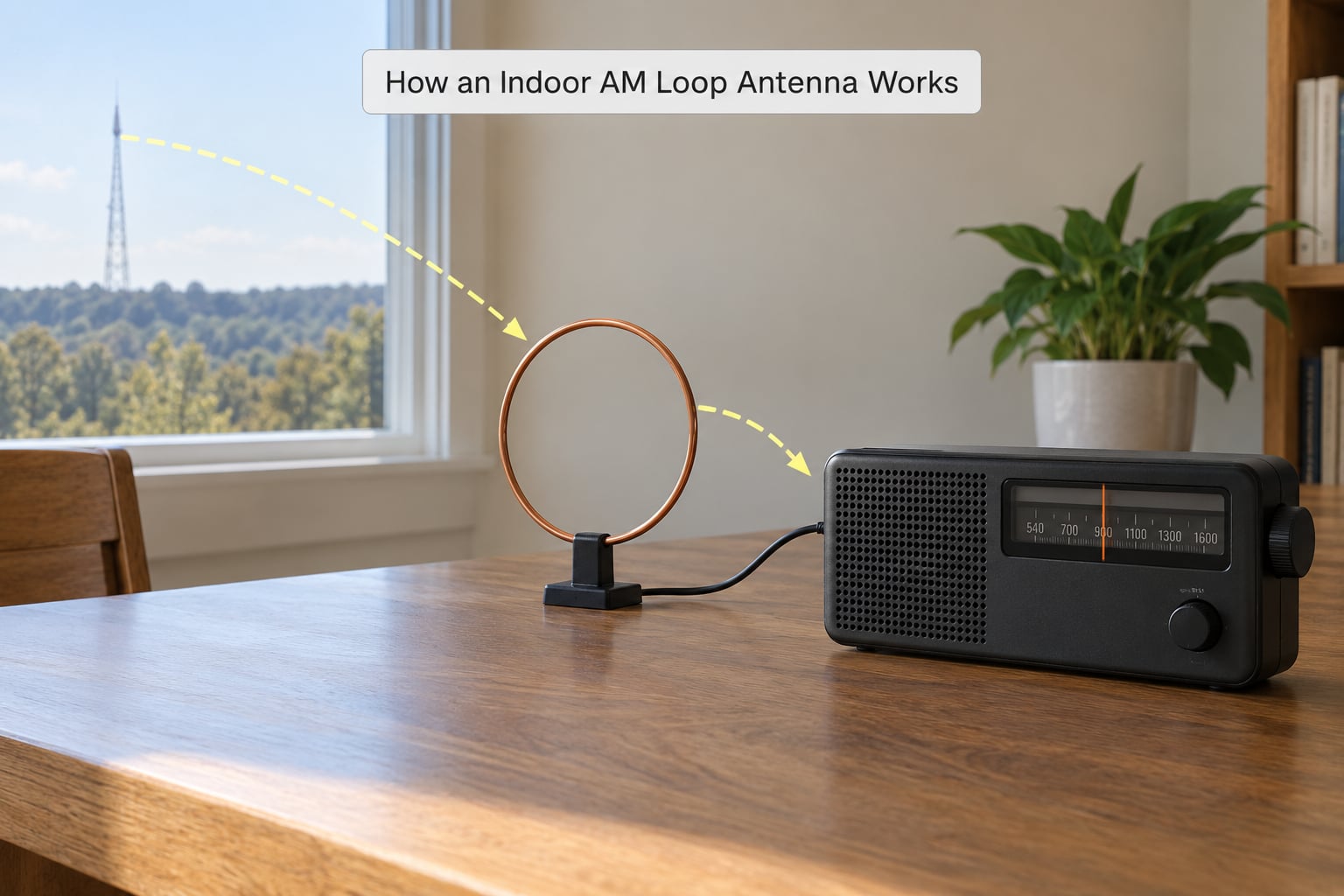
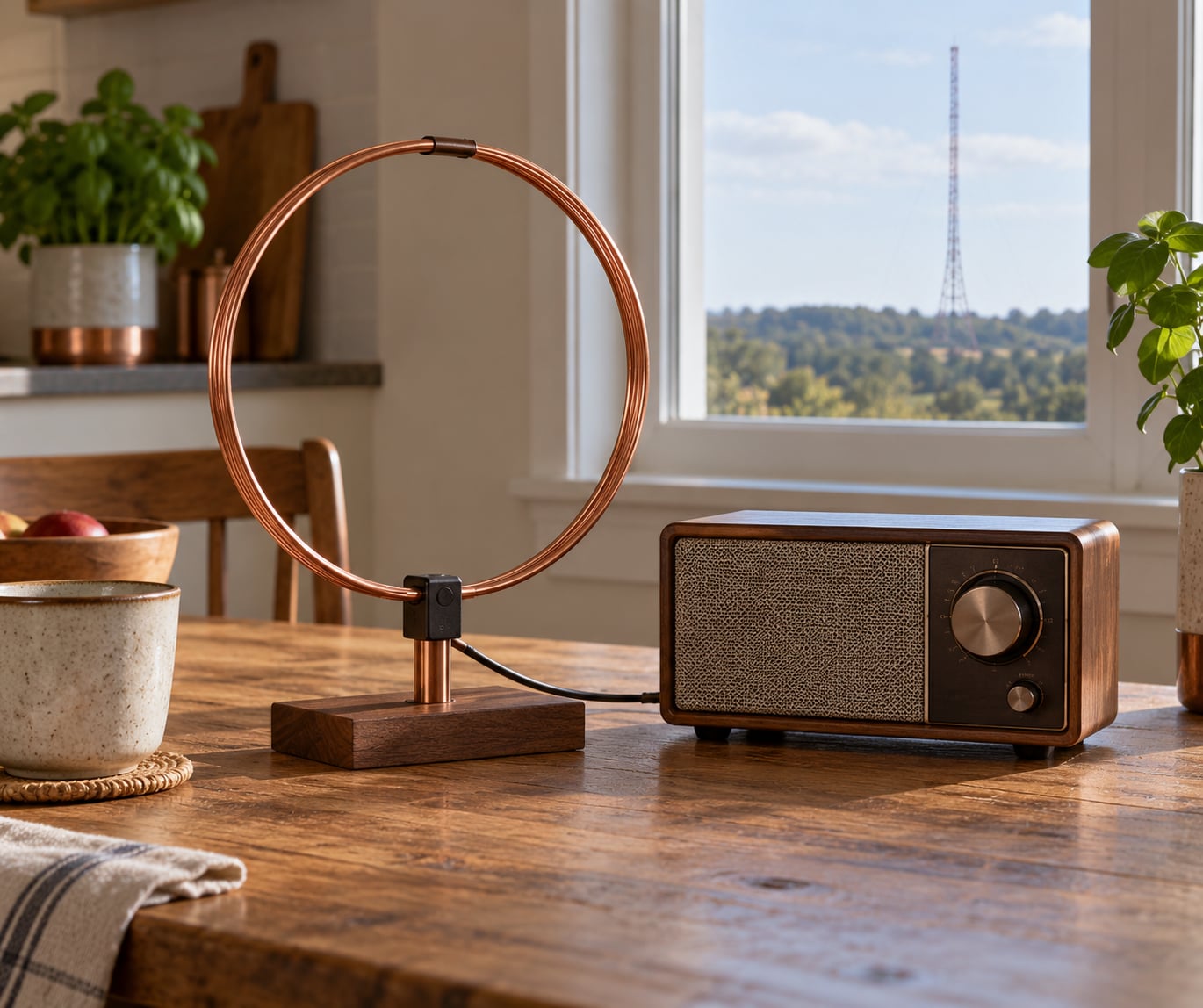
An indoor AM loop antenna is a ring of copper wire, usually wound into two or three turns, that sits near the radio. It picks up the magnetic part of a medium wave broadcast by electromagnetic induction, the same effect as a transformer, and feeds a small voltage to the receiver.
The full signal path is short enough to follow in one breath. A transmitter drives current up and down a tall tower aerial thousands of times a second, and that current builds a magnetic field around the tower. Part of that field travels outwards across the countryside as part of the wave. When the field passes through your loop, it induces a tiny voltage in the wire, usually measured in microvolts or millivolts rather than volts.
That induced voltage is far too small to hear on its own. A tuning capacitor connected across the loop forms a resonant circuit with the loop’s own inductance, so at one particular frequency the two components cancel each other’s reactance and the signal circulating in the loop builds up sharply. The radio’s own tuning capacitor does the same job inside the receiver, and the amplified signal drives the speaker.
Nothing needs to touch the transmitter, and no wire runs to the station. The loop only has to sit inside the wave passing through the room.
How the Loop Detects an AM Signal
Faraday’s law of induction is the whole story: a voltage appears across a conductor when the magnetic flux through that conductor changes with time. A radio wave is not a steady magnet. Its field swings back and forth around one million times a second on medium wave, and every one of those swings nudges a small current along the loop.
A simple demonstration makes it obvious. Hang a mains-powered work light a metre or two from a radio tuned to a strong local station, and the reception stutters as the lamp warms up. Now put a large loop of bare wire near that lamp while holding the radio steady, and the stutter settles down. The lamp’s own magnetic field is being induced into the loop, but the loop is fed to the radio in a way that mostly ignores it, while the broadcast signal arrives in phase.
The analogy that helps most listeners is a transformer with no core. A transformer pushes an alternating current into one coil and picks up a voltage in another because the changing field passes through both. The loop is the second coil. The transmitter is the first, a long way away.
One consequence follows from the physics. Because the induced voltage depends on how the field lines thread the loop, the loop does not care which way up it is, and it works just as well in the far field as in the near field. Loop antennas have almost no length to work with, yet reception is stable.
Why AM Radio Uses Amplitude Modulation
Amplitude modulation varies the strength, or amplitude, of a carrier wave to carry the audio signal. FM does the opposite, varying the frequency slightly while the amplitude stays constant.
That design choice has consequences in a house. An AM receiver is essentially a strength meter: it converts the incoming signal into audio by tracking how much of the carrier it receives. Anything in the room that changes the strength of the electromagnetic field at the antenna therefore shows up as sound.
Mains hum from a transformer, the ripple on a switch-mode supply, a dimmer switch chopping current, a cheap LED lamp driver, a monitor, a PC power supply: all of them push energy into the room at the frequency or harmonics of the electricity running through them. The receiver cannot tell a broadcast fading in from a lamp warming up. Both are a changing amplitude.
FM is largely immune to this. Its information lives in the frequency of the wave, so a steady burst of extra electrical energy usually just gets ignored as a background thud, and most interference sounds like a click rather than a continuous buzz. DAB goes further and uses digital signals that a receiver can clean up far more aggressively.
This is the practical case for a magnetic loop. It responds to the magnetic part of the wave, and it is fed into the receiver so that a great deal of nearby electric-field noise is ignored.
Why a Small Loop Can Improve Reception
A loop antenna does two useful things at once: it picks up more of the broadcast signal than a small whip indoors, and it responds to a lot less of the local electrical noise.
On signal pickup, the whip works because of electric field interaction with a long thin conductor. Inside a room full of metal, that electric field is badly distorted. The magnetic field from a broadcast arrives more or less intact, which is why the loop holds on to it.
On noise, the geometry does the work. A single loop has a figure-eight pattern. The strongest response lies broadside to the plane of the loop, and the weakest response, the null, sits in the plane of the loop. House wiring, a lamp and a monitor all radiate from a particular spot in the room, so if the loop is rotated so the null points at that spot, its contribution falls away while the broadcast signal, arriving from much further away, changes very little.
That is why placement beats everything else in a small antenna. A loop that gives good results in one spot can give poor results ten centimetres away, because the null has moved.
A passive loop needs no power and does a modest job well. An active loop amplifies the tiny induced signal inside the radio’s shielded area and then passes it to the receiver, which recovers stations that a passive loop would leave under the noise. Neither type guarantees perfect reception; a local station on the far edge of its transmitter’s coverage is a problem no indoor antenna solves.
The Main Parts of an Indoor AM Loop Antenna
Whether you buy one or wind one yourself, the parts do the same jobs. Most units are about the size of a paperback.
| Part | What it does | Practical consideration |
|---|---|---|
| Loop wire | One or more turns of copper forming the closed conductor | Larger area picks up more signal; insulated wire keeps it safe if it touches metal |
| Tuning capacitor | Sets the frequency at which the loop resonates, often adjustable | A fixed capacitor limits the loop to a slice of the band; a variable one lets you peak each station |
| Signal lead | Carries the induced signal from the loop to the radio | Keep it short and twisted with its return, or it picks up hum of its own |
| Amplifier | Boosts the microvolt-level signal before it reaches the receiver | Powered units need a supply; passive ones do not |
| Isolation transformer | Decouples the antenna from the radio’s chassis and ground | Reduces noise coupled through the earth lead and protects the radio |
| Radio connection | The plug, terminal or clamp that attaches to the receiver | Match the connector your radio actually has before you buy or build |
Hobbyists build the same chain from an old tuning condenser. One recurring build uses a four-turn loop wired between the receiver’s AM terminal and its ground terminal, which is a well-documented arrangement on the AudioKarma forums. Another popular version runs about five metres of copper tube into a variable air-spaced capacitor.
How Coil Size and Shape Change Performance
Coil size sets how much signal the loop collects, and how much of the band it covers well. The rule of thumb is simple: a bigger loop area collects more of the magnetic field, so you hear more stations at usable volume and less hiss between them.
Turns count too, up to a point. Two or three turns of the same total wire length in a smaller diameter give more inductance than a single large turn, which is useful because the loop needs enough inductance to resonate with a sensible capacitor value. Wind ten turns of the same wire in the same space and you get inductance far beyond what the band needs, and the selectivity falls away. More wire is not automatically better.
Shape matters for another reason. A square or rectangular loop of the same area performs almost as well as a circle, and square loops are easier to build from straight wire in a room. Flat loops are wider in their response than tall narrow ones, so a loop you can lay flat on a windowsill beats a thin vertical shape of the same size. Spacing between turns should be even, with a gap of a few millimetres, so the turns behave as one conductor rather than several competing ones.
Compare dimensions against the wavelength. Medium wave runs from 525 to 1605 kHz in the UK, which is 180 to 570 metres long at the speed of light. Every indoor loop is thousands of times smaller than the wavelength it works on, so it behaves as a small loop: good sensitivity in the near field, a figure-eight pattern, and very little gain over free space. Larger loops of the same proportions are simply better at the same job.
Because a small loop is an inefficient radiator compared with a full-size antenna, indoor loops are receivers only. Nobody transmits AM broadcast power through one, which is also the reason they are so cheap and safe.
How Placement Affects Signal and Noise
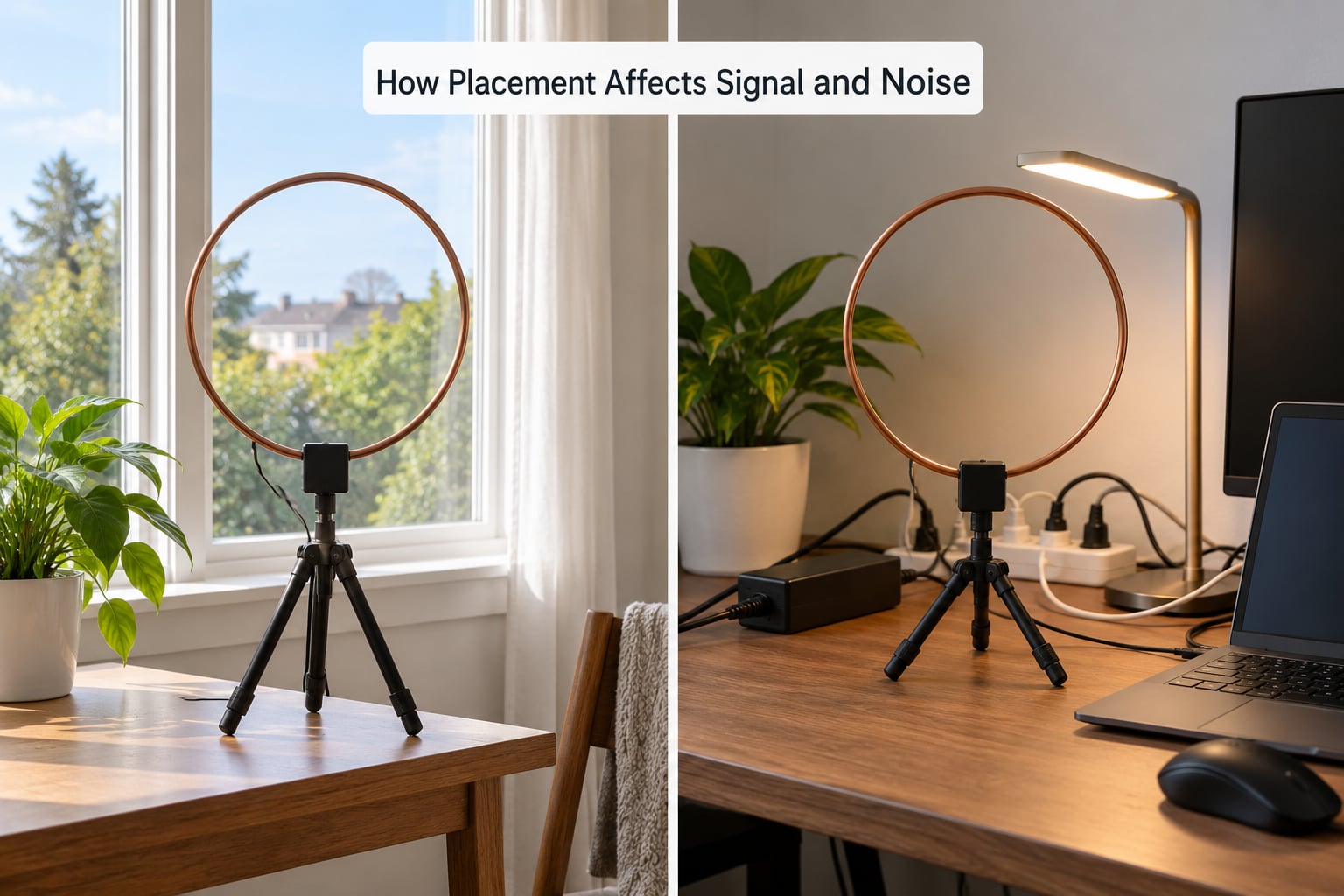
Placement changes reception more than any other setting, and the process is one of moving a loop a few centimetres and listening. Start away from obvious noise sources: computers, switch-mode power adapters, LED lamps and dimmers, microwave ovens, TVs and long runs of mains cable.
Then work through this sequence. Put the radio where it is most comfortable, since the null lives in the loop’s plane and moving the radio moves the antenna with it. Set the loop a metre or so away from the radio at about waist height. Rotate it slowly through a full turn, listening for the point where the buzz and hiss drop away but the station stays. Move it towards a window, which gives it a clearer view of transmitters to the east and west. Repeat in a second room to compare.
If you would rather find the null by hand than by ear, switch on a light fitting or monitor close by and rotate the loop until the hum is at its quietest, then orient the loop perpendicular to that direction for the stations you want.
| Location | Likely result on medium wave |
|---|---|
| Next to a window, loop plane at right angles to the window | Usually the best spot indoors; the clearest path to transmitters |
| Middle of a room, elevated, away from all electronics | Good and predictable; useful as a baseline for comparison |
| Beside a computer, monitor or switch-mode power supply | Noise rises sharply; rotating the loop often nulls it out again |
| Behind a metal or mirrored cabinet | Signal drops; metal shades the magnetic field very effectively |
| On a metal-framed kitchen counter or fridge | Erratic; the loop couples to the metal as well as the signal |
| Low on the floor beside a mains socket | Usually the worst position for mains-coupled noise |
| In a concrete or steel-framed building | Weak throughout; an outdoor aerial may be the only real answer |
Forum listeners report the same pattern from experience rather than theory. A poster on the iRV2 boards, stuck with no AM stations at all in a motorhome, finally sorted it by putting the indoor loop and a rooftop Winegard aerial into an A/B switch, so each could be chosen separately. That is a sensible pattern for a car or boat too.
How to Connect and Tune the Antenna
Connections are where most first attempts go wrong, so check what your radio actually offers before anything else. A mains-powered table radio usually has an AM aerial socket and a separate terminal marked AM or ANT, often alongside a ground or earth screw. A receiver or hi-fi may have an AM loop socket only. A portable radio with a telescopic whip may have no external connection at all, in which case the whip itself is the loop.
Follow the manufacturer’s instructions for whatever your set provides. They know which input is attenuated and how much loading the circuit expects.
Then tune it in a repeatable order. Connect the loop to the AM terminal, and if the set has a separate ground terminal, run the return there or to the chassis as the instructions describe. Place the loop about a metre from the radio with its plane vertical. Rotate the loop slowly until the station is cleanest, and mark roughly where you are. If the loop has a tuning control, turn it while the radio is on a well-received station until the signal peaks, then leave it there. Finally, repeat the last two steps for each station you care about, since the correct capacitor setting and loop angle differ across the band.
When the loop has a high and low band switch, set it for the part of the band you are on before adjusting the dial. This is the arrangement described by the author of PK’s loop antennas: place the loop near the set, switch to the right band, and peak the dial on the station you want.
One caveat on safety: a passive loop is simply wire and a capacitor, so there is nothing to shock you. A powered unit needs an isolating supply and a proper mains plug. Follow the instructions that came with it.
Which Type of Indoor AM Loop Antenna Should You Choose?
Four types cover almost every indoor need, and the differences come down to power, shielding and tuning.
A passive air-core loop is one or more turns of wire with a fixed capacitor and a lead. It needs no power, costs little, and is the safest place to start in a room with mild noise problems. Its weakness is the very low signal level, so it does less when the radio’s own internal antenna is poor.
A shielded loop wraps the turns in a metal screen with a small gap in it, and the gap is the tuner. Screening keeps household electric fields out while still letting the magnetic field through, which makes it noticeably quieter than an unshielded loop in a noisy room. It usually runs passive.
An amplified, or active, loop adds a low-noise amplifier inside the shielded case and delivers a stronger signal to the radio. It is the choice when stations are weak rather than noisy, or when the receiver has no good AM input. It needs power, and power supplies are themselves noise sources, so a poor one can undo the benefit.
A tuned loop, usually with a variable capacitor, covers the whole AM band instead of one section of it. If you listen across the dial rather than to one or two stations, this is the one that gives consistent results.
Compatibility comes down to the connector and the input impedance. Check the radio’s manual for the type of AM aerial terminal, and confirm whether the loop is designed for a high-impedance AM input or a low-impedance antenna input. Mismatched impedance is the most common reason a good loop sounds no different from the whip.
Portability is worth a mention too. A passive loop of about 300 to 500 millimetres across with a two-metre lead is light enough to carry between rooms for testing, which matters more than the specification on the box.
Common Problems and Simple Fixes
Fitting a loop and seeing no change usually means the connection is wrong rather than the idea. Confirm the loop is connected to the AM input and not the FM aerial socket, which is the single most common mistake, then check that the radio is switched to MW or AM rather than FM. If the radio has a band switch marked ANT, check whether the aerial is attenuated on that setting.
Buzz that comes and goes with the signal usually means electrical noise. Identify the culprit by switching off the LED lamp, dimmer, monitor and charger one at a time and listening. Then rotate the loop so its plane points at the noisy device, which puts the null on it. Adding a ferrite bead or lengthening the lead so it is no longer close to a switch-mode supply helps too.
Weak stations across the whole band point to something different. Concrete and steel-framed buildings, underground rooms and basement kitchens are hard cases where the signal never reaches the room in the first place. An outdoor aerial, a rooftop-mounted loop or a different receiver is the honest answer, and a rooftop loop on an A/B switch, as the iRV2 owner found, is a sensible halfway step.
Sound that changes when you touch the loop or the lead means the antenna is being handled as an aerial. Route the lead so it is fixed, keep it twisted with its return, and use a proper insulated connector rather than a loose crocodile clip.
A station that is clear at one spot and noisy at another means the loop is simply in the wrong place. Return to the rotation test and note the best angle for each frequency, since the optimum changes as you move across medium wave.
And if reception is unchanged but no fault is obvious, remember what the loop can and cannot do. It works on medium wave only. FM, DAB and shortwave need their own antennas, and an AM loop will not improve them.
Frequently Asked Questions
Do indoor AM loop antennas need a ground connection?
Usually not. Most passive loops work with a single lead to the radio’s AM aerial terminal and take their return through the receiver’s own chassis. Some sets have a separate ground or earth terminal, and some commercial loops wire to both to decouple the antenna and reduce noise. Check your radio’s manual, and never connect a ground to a mains earth pin on an indoor aerial.
How far away can an indoor AM loop antenna receive stations?
The honest answer is that indoor range depends on the building and the transmitter, not the antenna. A loop will reliably pull in local and regional stations inside a normal house, often the 50 to 100 miles a regional transmitter covers. In a concrete or steel-framed building it may manage only a few miles. A weak loop cannot reach a transmitter whose signal never enters the room.
Can an AM loop antenna improve FM radio reception?
No. Medium wave wavelengths are hundreds of metres long, and FM broadcast sits around 100 MHz, so a loop sized for AM is hopelessly too small to work at that frequency. FM needs a wire dipole of roughly 75 centimetres each side, which most radios already have built in. DAB at around 220 MHz is shorter still and also needs its own aerial.
Where is the best place to put an indoor AM loop antenna?
Near a window, high up, a metre or so from the radio, and as far as you can get from computers, switch-mode power supplies, LED lamps, dimmers and long runs of mains cable. Set the loop’s plane vertical to start with, then rotate it slowly and listen for the angle where noise drops but the station stays. Keep it away from metal cabinets and metal surfaces.
Is it safe to use a powered AM loop antenna continuously?
Yes, provided it is a properly made unit with an isolating power supply and a three-pin mains plug, and you follow the instructions. Powered loops draw very little current and run cool, so continuous use is normal. Mains-powered equipment outdoors or in a damp room is a different matter, and any radio servicing beyond swapping an aerial should be left to a qualified engineer.
Conclusion
An indoor AM loop antenna works because a broadcast’s changing magnetic field passes through a ring of wire and induces a voltage in it, and a small capacitor lets that voltage build up sharply at the frequency you are tuned to. Because a loop listens to the magnetic part of the wave and has a null in the plane of the loop, it ignores much of the electrical noise that makes an AM radio hiss and buzz indoors.
Start with three things: connect the loop to the AM terminal on your radio, following the manual. Put it near a window and well away from computers, chargers and LED lighting. Then rotate it slowly, listening for the angle where the station stays clear and the noise drops away. If that changes nothing, an outdoor or rooftop aerial is the next step, not a bigger loop.