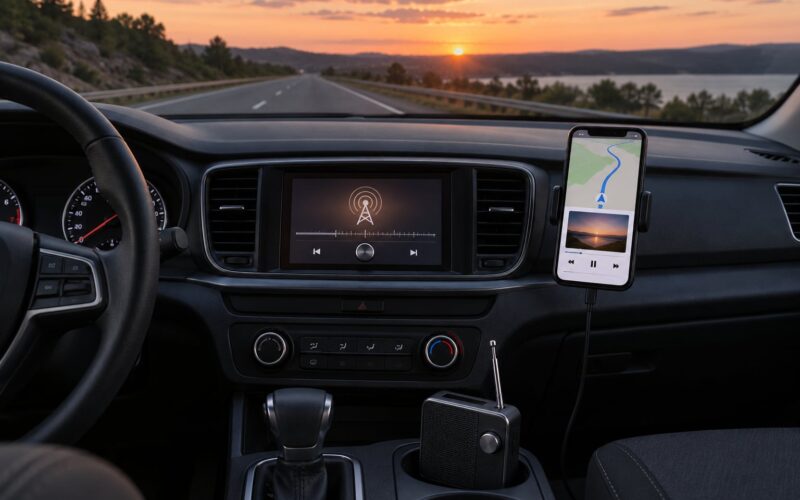
Radio stations change as you drive because your head unit is constantly measuring how strong your tuned station is, and the moment that signal falls below an acceptable level it either hunts for the same station on a different frequency or tunes to whatever else is available. Hills, buildings, tunnels, cuttings and the edge of a transmitter’s coverage area all weaken the signal on the move, and some radios also interrupt your music to pass on traffic or news updates.
Most of that is normal. Some of it is a fault in the car, and the difference is usually easy to spot. This guide covers what is actually happening in the receiver, why FM, AM and DAB behave so differently on the road, which settings cause the switches on purpose, and how to work out whether to change a setting or chase an aerial.
Table of Contents
- How Radio Reception Changes During a Drive
- What Causes the Switch?
- How FM, AM and Digital Radio Signals Behave Differently
- Why the Radio May Change Stations by Itself
- What Can You Do When Radio Stations Change as You Drive?
- When a Station Change Signals a Bigger Problem
- Frequently Asked Questions
- Why does my radio station change when I drive over a hill?
- Is it normal for an FM station to switch to another station while driving?
- Why does my radio lose stations in the city but work on open roads?
- Can a bad car antenna cause frequent station changes?
- Should I rescan my radio every time it changes stations?
- Can an electrical accessory in the car interfere with AM radio?
- What to Do First
How Radio Reception Changes During a Drive
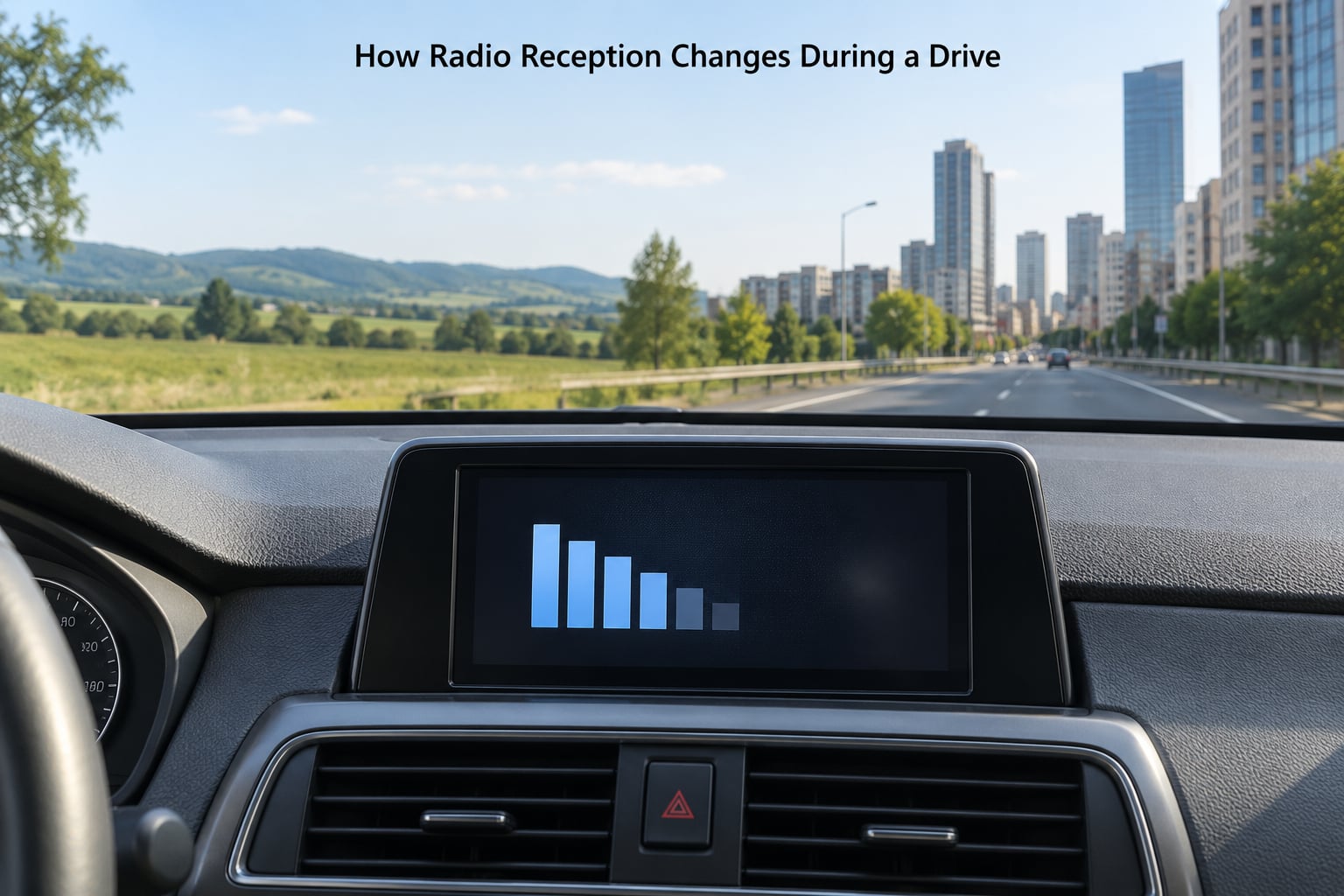
When you park, the radio settles on one transmitter and stays there. The moment you move, the geometry changes constantly. The transmitter is now further away, or a hill is between you and it, or a bridge cuts the path for half a second, and the signal level the receiver sees drops.
Head units do not wait for a station to disappear entirely before reacting. They look for a usable signal, one that is strong enough and clean enough to decode. When the current station drops below that threshold the radio does one of two things: it follows the same station onto another frequency carrying it, or it settles on a different station that is strong enough right now.
That second option is the one drivers notice. You were listening to a local station, and somewhere past the county boundary you are listening to a transmitter based forty miles away with a different playlist and a different phone number for traffic. Nothing went wrong with your radio. It did the sensible thing with the information it had.
The shift tends to happen in the same places every time, which is the giveaway. If the switch always happens at the same roundabout, the same hill or the same stretch of tunnel, you have found a coverage gap rather than a broken radio.
What Causes the Switch?
Six causes account for almost everything drivers notice, and they are not equally common.
Why radio stations change as you drive, ranked by how often it happens
1. Leaving a transmitter’s coverage area. Every FM and DAB transmitter is designed to serve a defined area. Past that area the signal weakens, and the receiver either drops what you were listening to or finds the same service elsewhere. On long motorway runs this is the single most common reason a station appears to change.
2. Terrain blocking the line of sight. Radio waves at these frequencies travel in straight lines. A ridge, a stone cutting, a hillside or a stand of dense trees between you and the mast is enough. Crossing a hill briefly cuts the signal, and what happens next depends on what the radio can find in the gap.
3. Buildings and dense streets. Concrete and stone reflect signals rather than passing them through, so a city centre delivers a weak, distorted version of the same station. Drivers often describe reception that was fine at home becoming fuzzy on the same street in town.
4. Tunnels, underpasses and viaducts. These are close to a total block. Reception for the length of the structure comes from whichever transmitter the radio can latch onto outside, or from a relay and rebroadcast system installed for exactly this purpose.
5. Automatic features doing it on purpose. Alternative frequency following, RDS region retuning and traffic or news interrupts all move your radio without you touching it. This accounts for a large share of the complaints that turn out to have nothing to do with reception quality.
6. A fault in the car. A loose aerial connection, a damaged aerial mast, a failing aerial amplifier or an aftermarket head unit with a poor aerial connection produces switching that no amount of driving around will fix.
Rural transmitters and low-power local stations
Coverage in open country is generally easier than coverage in a city, because there is usually one clear path to the mast. The problem in the countryside is distance rather than obstruction, and low-power local and community stations are the ones that suffer first. They are designed to serve a small area, so a few miles outside it they are gone, and the receiver moves to whatever is broadcasting with real power.
Forum users report jumping to distant transmitters, including low-power and relay services, at exactly the moment a local station fades. That is coverage behaving correctly, but it is also the moment that feels most wrong, because the music changes to something unrelated without warning.
What the signal strength bars on your dashboard actually mean
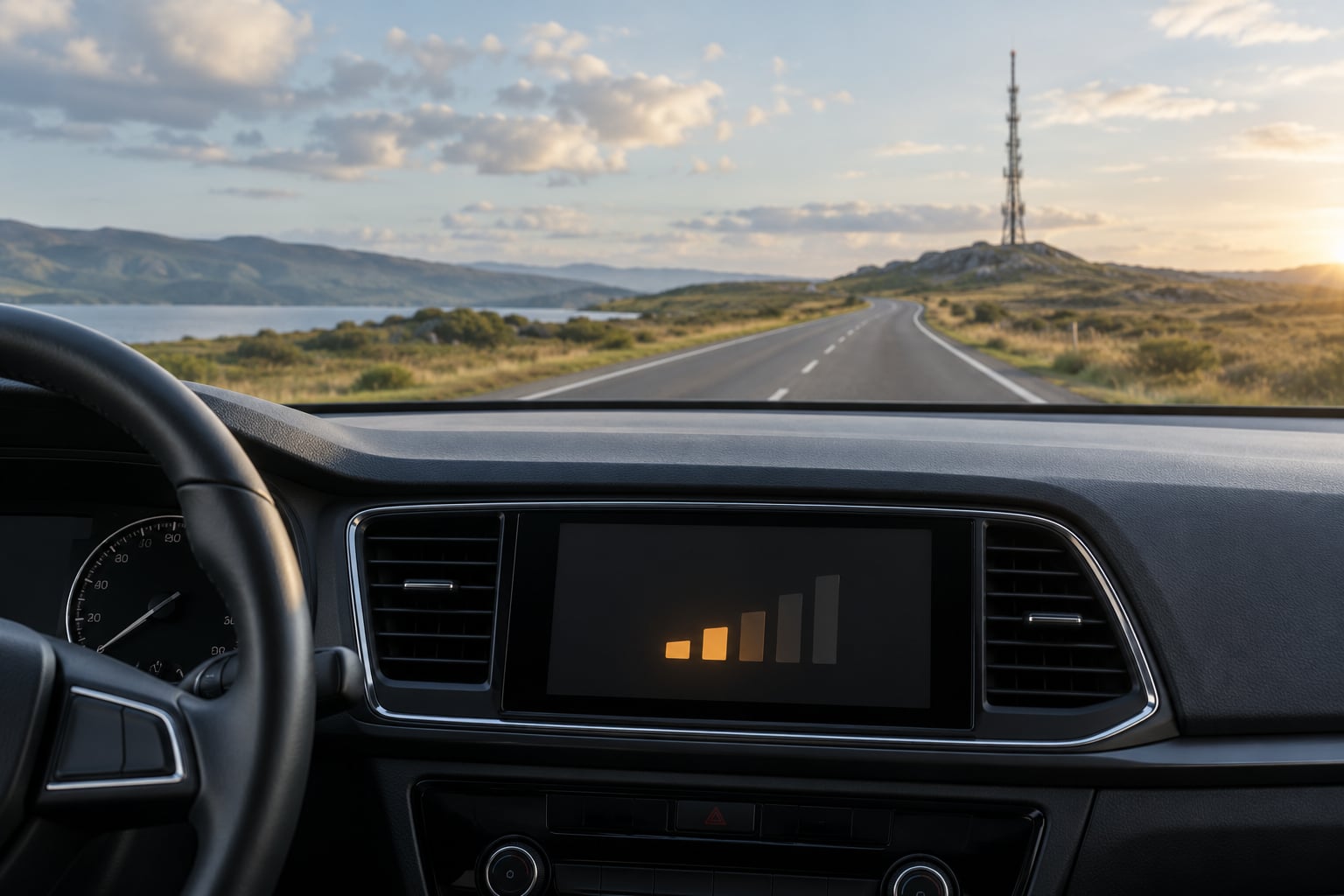
The bars are a reading of signal level, not of sound quality. A full set of bars with distorted, splattery audio means you have plenty of signal and a bad reflection problem. Three bars with clean audio usually means you are in a weak spot but the station is still decoding well. Zero bars with no sound means the receiver has lost the station entirely.
The gap between the two is the interesting part, because it tells you whether the fault is strength or interference. If the bars drop as you drive but recover quickly, that is normal coverage. If they stay high and the audio breaks up, something in the car is generating interference.
Tunnels, underpasses and viaducts
Inside a tunnel your aerial is effectively underground with you. Reception depends on leaky feeder cables or small relay transmitters installed in the structure, and where those exist the radio holds a signal continuously. Where they do not, the radio drops to nothing for the length of the tunnel and then hunts for a station on the way out.
Viaducts and bridges cause shorter, sharper interruptions. Deep cuttings do the same thing over a longer stretch, and this is where you can often watch the bars fall as you approach and climb back as you leave.
How FM, AM and Digital Radio Signals Behave Differently
The band you are listening on changes how the failures show up. FM tends to fade or capture a stronger neighbour, AM suffers static and electrical noise, and DAB either holds or cuts out almost completely.
| Band | How it fails | What it sounds like | Best case |
|---|---|---|---|
| FM | Weak signal fades, and a stronger nearby station captures the frequency | Hiss, then another station’s voice appearing through yours, then silence | Open road with a clear path to the transmitter |
| AM | Absorbed by buildings and by daytime conditions; sensitive to electrical noise | Static, buzzing and crackling, especially with the engine running or a heated rear screen on | Long distances where FM has already faded |
| DAB | Multiplex coverage ends or is blocked; the set holds or drops, it rarely degrades | A moment of silence or a click, then the station again, sometimes on a different local multiplex | Continuous coverage without the inter-station noise FM gives |
| Online streaming | Signal follows the mobile network rather than a transmitter | Buffering, dropouts where coverage is thin | Urban and motorway areas with solid mobile data |
DAB is the one drivers find most surprising, because it sounds digital until it does not. An FM set fades gradually and lets you decide what to do. A DAB set either has a decodable signal or it does not, so the same drive can produce silence rather than static, and a handover from one regional multiplex to the next can drop a programme that is not carried locally.
That last point explains a specific UK frustration: a station available in one county vanishes a county over because the service is carried on a different multiplex. The audio is not being blocked by anything in your car. There is simply no local multiplex carrying it, and the set is behaving as designed.
Key radio terms in plain English
Line of sight means there is nothing solid between your aerial and the transmitter. If you can see the mast, or roughly where it is, reception is usually good.
Multipath fading is what happens when a signal reaches your aerial by several routes at once, having bounced off buildings and hills. The versions arrive slightly out of step and interfere with each other, which produces the fluttering, watery sound drivers hate most.
Alternative frequency, or AF, is a station appearing on more than one frequency in the same area. The radio can follow the same station onto the other one to hold your listening.
RDS traffic announcements, or TA, are the short bursts of traffic news that cut across whatever you are listening to. Traffic and news interrupts are opt-in behaviour, not reception failure.
A DAB multiplex is a bundle of several stations broadcast together from one set of transmitters. Multiplexes are regional, so station availability changes at regional borders.
Why the Radio May Change Stations by Itself
The difference between losing a station and being moved to another one
This is the distinction most drivers cannot make, and it changes the diagnosis. Losing the station means the signal fell away and the receiver had nothing to lock onto. Being moved to another station means the receiver had alternatives available and selected one, usually because your station dropped below threshold or because a feature triggered a retune.
If the audio breaks up and then a different station appears, you are looking at a coverage problem. If your station comes back mid-sentence and the clock has been reset to a strange timezone, you are looking at data the station is sending.
That clock behaviour has its own thread on r/radio, where drivers describe a station that resets the time on their car display to an impossible offset whenever they tune it. The cause is the station’s own time data rather than anything on the road, so it happens in the car park as well as on the motorway, and it is a transmitter fault, not a reception fault.
Automatic features that retune on purpose
Alternative frequency following moves you off a frequency when the station is available elsewhere nearby and the other one is clearer. It is helpful in cities and mildly annoying if you would rather hold a preset.
RDS region retuning tells the radio which regional service to follow, which is why some sets jump to a neighbouring transmitter’s version of the same station name when you cross a county line or drive onto a motorway with regional RDS.
Traffic and news interrupts hand your speakers to another station carrying a bulletin, then hand them back. Drivers on car forums describe these as the most irritating switch of all, because the interruption rarely concerns the road they are on.
Scan and seek behave differently depending on the head unit. Some continue scanning after a weak station and land somewhere unexpected. Some treat a briefly interrupted station as dead and drop the whole preset list.
Steering wheel controls and voice assistants account for a surprising number of reported faults. A nudge of the volume roller mapped to the next track, or a phone call ending near a steering wheel button, will retune a radio in a way that looks exactly like a reception problem.
Electric cars add their own thread to this. Owners report stations switching unexpectedly and suspecting the connectivity fallback, when in many cases the pattern matches the same road sections other drivers report. When several brands report losing the same stations on the same stretch, coverage is the more likely explanation.
What Can You Do When Radio Stations Change as You Drive?
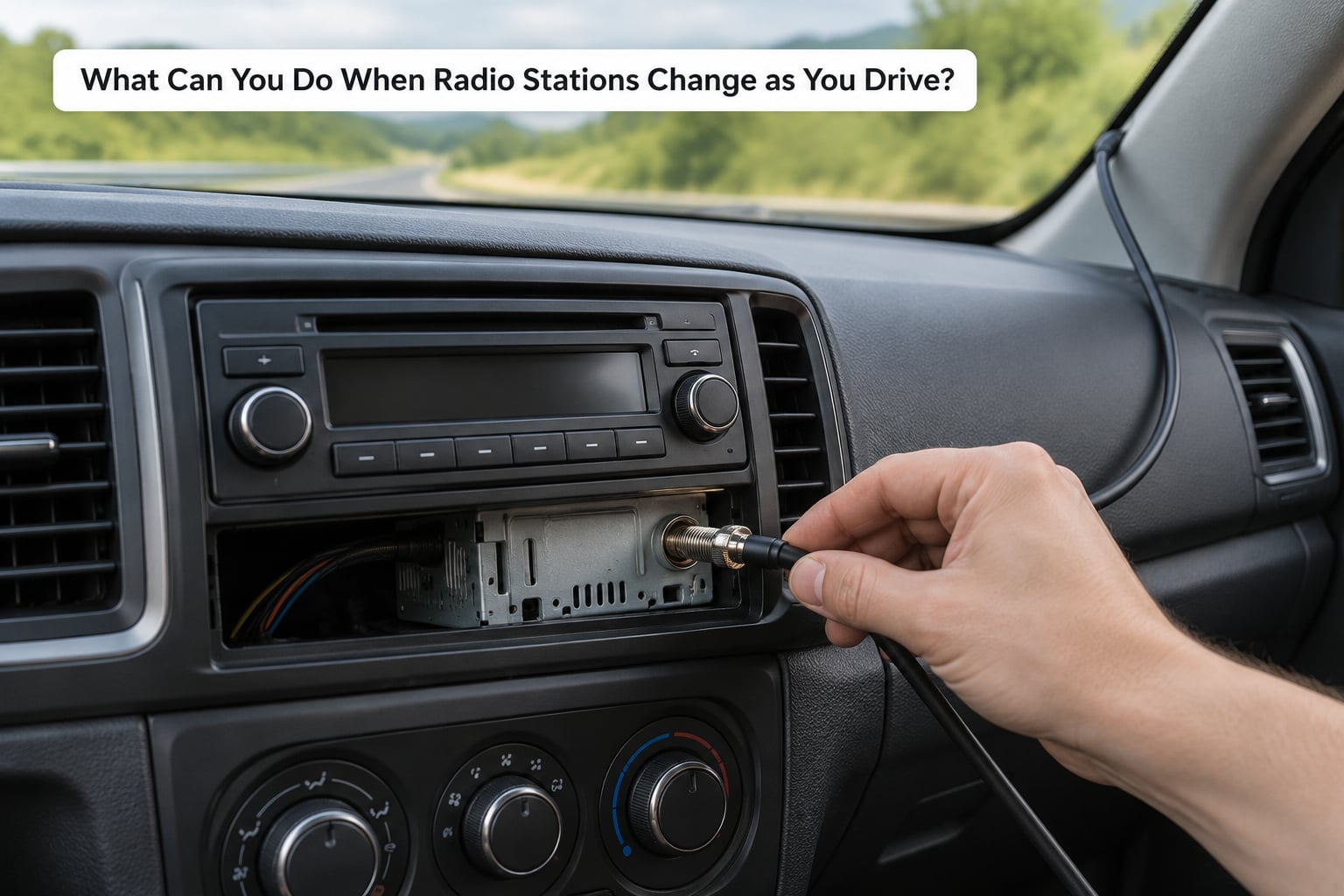
Work through this in order, cheapest setting change first, aerial last. Most of it takes minutes once you have the manual open.
Turn off the interrupts first. In the audio or radio settings, disable traffic announcements and news interrupts. This removes the switch that annoys most drivers and costs nothing.
Turn off AF following. The same menu usually holds alternative frequency and region following. Switching these off tells the radio to stay where you put it, which means you keep your station and sometimes keep its distortion too.
Check whether the set is retuning on its own or doing it for you. Try the station while parked in the same spot twice. If it misbehaves when stationary, it is not the signal.
Check the aerial. Look at the mast and base for damage, especially after a car wash, a tree strike or anything that lifted the car on a ramp. Push the connectors firmly back together and make sure nothing is pinched where the aerial enters the wing or roof.
Check the aerial amplifier fuse where your car has one. Many cars feed the roof aerial through a small powered amplifier with its own fuse. Loss of that feed is a common fault in cars that have been wet or repainted, and the symptom is weak reception across every band at once.
Use the band the route suits. DAB holds a clean signal right up to the edge of coverage, while FM degrades gradually and sounds worse before it goes. On motorways, switching to DAB until it drops and back to FM after is a common working habit among long-distance drivers.
Check coverage before a long drive. Broadcasters publish coverage maps for their networks, and a quick check tells you which stations to expect where you are going, so a change at a county border stops being a surprise.
Be careful with signal boosters. A booster amplifies whatever reaches the aerial, including noise and interference, so an antenna amplifier cannot create coverage that does not exist and can make weak reception worse. If reception is poor everywhere, check the aerial and the wiring before adding amplification.
Aftermarket head units need attention. They usually have smaller, worse-placed aerials than factory equipment, and generic ones may rely on a glass-mounted or stick-on aerial that performs poorly. A properly fitted roof or boot-mounted aerial and a real aerial cable make a noticeable difference.
When a Station Change Signals a Bigger Problem
Normal reception changes come and go with the landscape. Faults do not follow the landscape.
| Symptom | Likely cause | What to do |
|---|---|---|
| Switching happens at the same spot on every journey | Coverage gap or a shadowed transmitter | Accept it, check a coverage map, try the other band |
| Switching on open roads with no obstacles for miles | Losing a distant station, aerial fault or amplifier fuse | Check the aerial and its fuse |
| Every station weak, on every band, everywhere | Aerial connection, amplifier or aerial fault | Inspect the aerial, connectors and amplifier feed |
| Reception improves with the engine off | Electrical noise on AM, or charging system noise | Useful diagnostic, worth mentioning to an auto electrician |
| Interference that rises when heated rear screen, wipers or a phone charger are on | Electrical noise coupled into the aerial | Switch each item off one at a time to identify it |
| Static persists with the engine off and the set parked | Transmitter fault or a weak station, not your car | Nothing to fix locally; the station side will resolve it |
The engine test is the one most people have never tried and it settles a lot of arguments. If reception clearly improves with the engine off, you have an electrical noise problem rather than a coverage problem, and that belongs with an auto electrician rather than a radio shop.
Persistent switching with the car parked, on the same station, in the same place, is a head unit or wiring issue. A radio that will not hold a station at all on a good day is not experiencing difficult radio waves.
Frequently Asked Questions
Why does my radio station change when I drive over a hill?
A hill blocks the line of sight between your aerial and the transmitter, so the signal drops below the level the radio can decode. When that happens the set either finds the same station on another frequency, picks whatever else is broadcasting strongly nearby, or goes quiet. You normally get the signal back within a second or two of cresting the hill.
Is it normal for an FM station to switch to another station while driving?
Yes, it is normal, especially on motorways and at the edge of a transmitter’s coverage. FM can also capture a stronger station sharing or adjacent to your frequency, which is why a familiar sound becomes someone else’s voice. If it happens once in a while on a known route, it is coverage. If it happens constantly, including while parked, check the aerial.
Why does my radio lose stations in the city but work on open roads?
Buildings, viaducts and dense street layouts absorb and reflect radio signals, and the reflected copies arrive out of step and interfere with each other. On open roads there is usually one clear path to the transmitter, so reception improves. Losing stations in town while they work in the countryside is a strong sign the car aerial is healthy.
Can a bad car antenna cause frequent station changes?
It can. A loose connector, a damaged mast, water in the aerial base or a failed aerial amplifier all reduce what reaches the head unit, which makes weak reception look like coverage trouble. The tell is weak signal across every band at every location, including while parked, rather than only on a particular stretch of road.
Should I rescan my radio every time it changes stations?
No. Rescanning rebuilds your stored presets and rarely fixes reception, and on some head units it discards settings you had configured. Rescan after a software update, after the battery has been disconnected, or if presets have been lost. For station changes while driving, adjust the traffic interrupt and alternative frequency settings instead.
Can an electrical accessory in the car interfere with AM radio?
Yes. AM is far more sensitive to electrical noise than FM, so a heated rear screen, wiper motor, alternator, LED lamp or a cheap phone charger can all be heard as buzzing and crackling. Switch each accessory off in turn and listen. Interference that comes and goes with engine running points at the charging system, which is worth having checked.
What to Do First
Note where it happens. If the switch always lands on the same bridge, hill or county border, it is coverage and no repair will change it. If it happens while parked, or on open roads with nothing to block the signal, look at the aerial, its connectors and any amplifier fuse.
In the meantime, turn off traffic and news interrupts and alternative frequency following, then tune the station back in manually. Those two settings remove most of the switching drivers complain about, and they cost you nothing but a menu change.
For anything persistent, have the aerial and wiring checked by a qualified automotive-audio or auto-electrician specialist. They can measure what is actually reaching the head unit, which is the one thing a list of guesses cannot do.