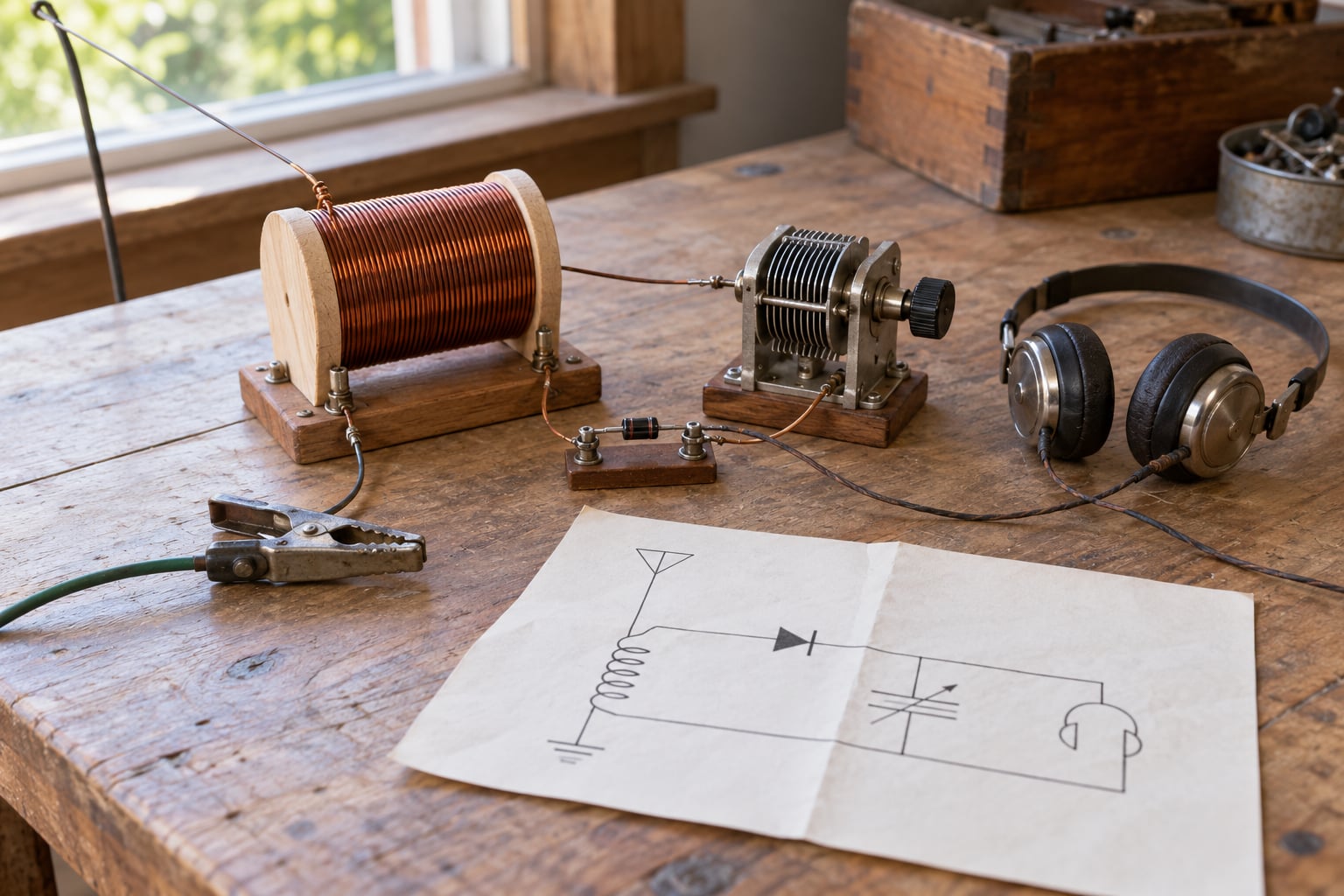
A crystal radio works by catching the energy in radio waves in the air and converting it directly into audible sound, with no battery and no external power source anywhere in the circuit. A wire antenna gathers the faint alternating current from a station, a coil and variable capacitor select that one frequency, a crystal diode rectifies the carrier, and a high-impedance earphone makes the sound. That is the entire machine.
Radio receivers fall into two families, and the difference is where the energy comes from. A passive receiver runs only on the power that reaches its antenna, so it is quiet and local. A powered receiver takes energy from a battery or the mains and spends it on amplifiers that make the sound loud, selective and hi-fi. A crystal set is the purest example of the first kind.
Below is the signal chain in order, from the wave in the air to the sound in your ear, followed by what each part does and how to fix a set that stays quiet.
Table of Contents
- How a Crystal Radio Works
- The Parts of a Crystal Radio
- How the Signal Travels Through the Circuit
- Why a Crystal Radio Uses AM Signals
- What Happens During Tuning
- Why Crystal Radios Need a Good Antenna and Ground
- What the Crystal Diode Actually Does
- Basic Troubleshooting for No Sound or Weak Stations
- Frequently Asked Questions
- Conclusion
How a Crystal Radio Works
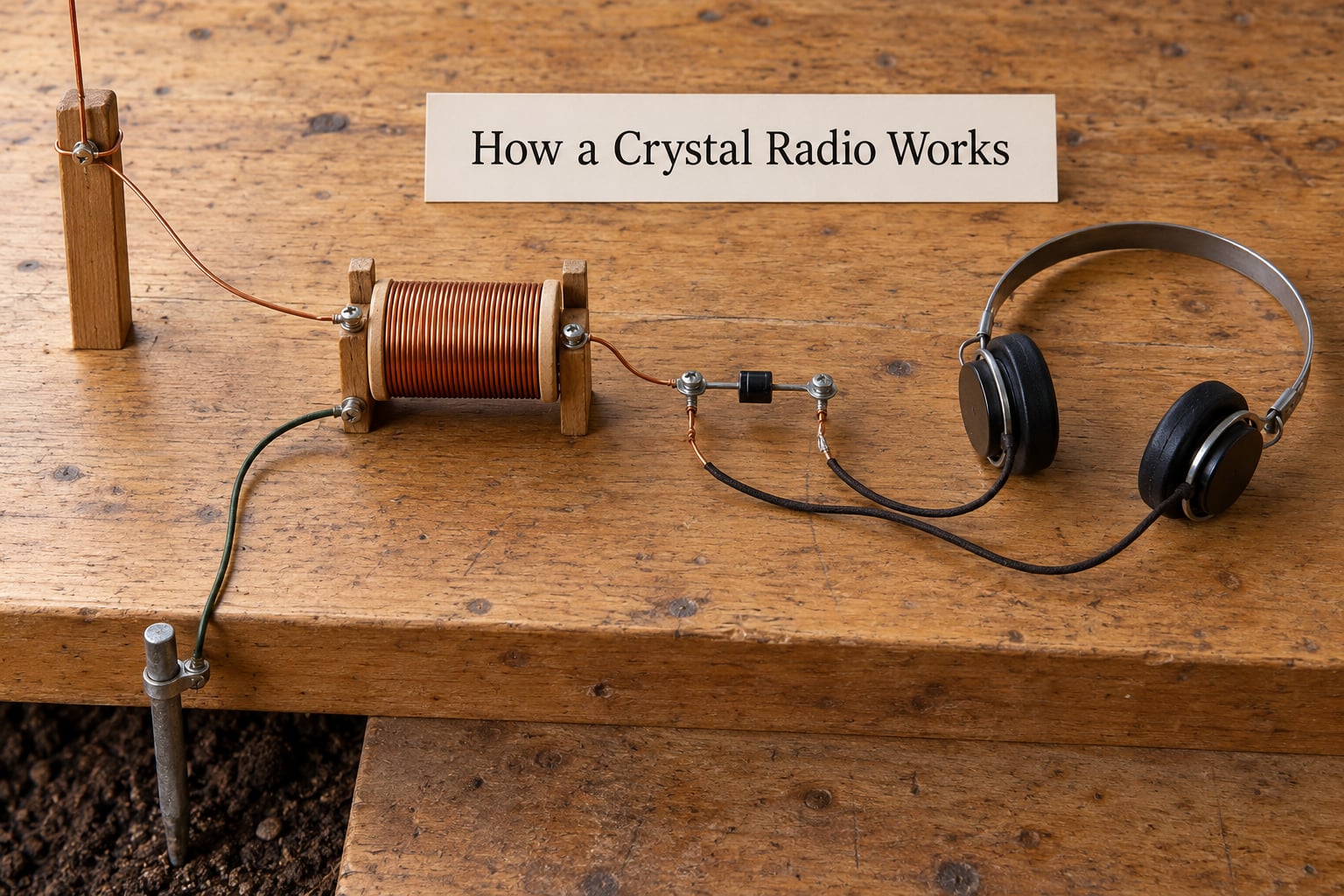
A crystal radio receives radio waves with an antenna, selects one station with a tuned circuit, converts that selected signal with a crystal diode, and produces a faint audio signal with no external power at all. The energy it plays comes from the transmitter, roughly 25 miles away in a typical AM setup, arriving at your antenna as microwatts or less.
Four stages do all the work, and you can follow the signal through them in order.
- Catching the signal — the antenna and ground convert an electromagnetic wave into a tiny alternating current.
- Selecting a station — a coil and variable capacitor resonate at one chosen frequency and ignore the rest.
- Translating the wave — the crystal diode rectifies the radio-frequency signal and recovers the audio pattern riding on it.
- Hearing the sound — a high-impedance earphone turns the recovered pulses into audible sound.
Two objections come up immediately, so they are worth answering up front. There is no amplifier anywhere in a crystal set, and the sound really is very quiet. A loudspeaker needs far more power than the circuit can deliver, so a crystal set is listened to through tight-fitting earpieces rather than a speaker in a room.
That is the whole trick, and it is worth understanding because a modern receiver does exactly the same four things, just with amplifiers and filters in between. Learning the order of those stages makes every more complicated radio easier to read later.
The Parts of a Crystal Radio
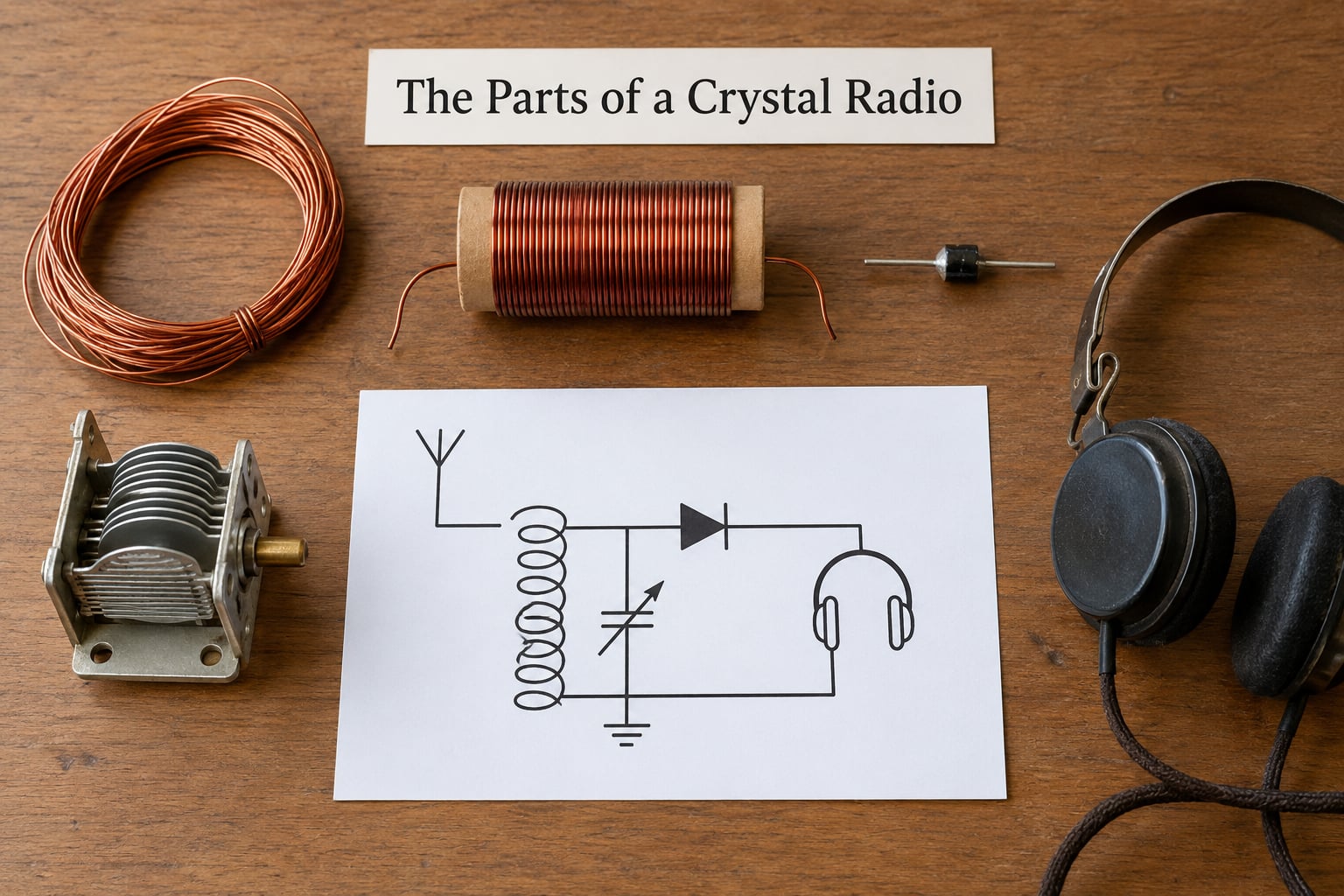
A basic crystal set needs five working parts and two optional ones: an antenna, a ground, a tuned circuit, a detector diode and a high-impedance earphone, with a bypass capacitor and an amplifier as useful additions. Nothing else is required, which is why these sets are still popular with beginners and school projects.
| Part | What it does | Why the set needs it |
|---|---|---|
| Antenna | Converts the incoming radio wave into a small alternating current | Without a long outdoor wire, there is no signal to receive at all |
| Ground | Completes the circuit and returns current through the earth | Poor ground is the single most common reason a set is silent |
| Tuning coil | Stores magnetic energy and forms one half of the resonant circuit | Sets the frequency range the circuit can be tuned across |
| Variable capacitor | Varies the capacitance across the coil to change the resonant frequency | Your only control; it is the tuning dial |
| Crystal detector diode | Rectifies the radio-frequency signal and recovers the audio | Conducts one way only, which is what separates sound from a buzz |
| High-impedance earphone | Converts the audio pulses into sound | A low-impedance earbud loads the circuit and kills the signal |
| Bypass capacitor (optional) | Shorts leftover radio-frequency current around the earphone | Keeps the RF out of the audio path, giving cleaner speech |
| Small amplifier (optional) | Adds gain after detection | Turns faint headphone audio into something a room can hear |
That table is the shortest possible shopping list. A kit that contains a coil, a variable capacitor, a germanium diode, a high-impedance earphone and clip leads is enough to build a working set before you think about an antenna.
How the Signal Travels Through the Circuit
The journey from air to ear has four handoffs, and it helps to keep two different kinds of electricity apart as you follow it. Radio frequency is the carrier wave itself, swinging far too fast to hear. Audio is the slow pattern of strength and weakness that rides on top of it.
- Wave to current. The wave arriving at the antenna pushes charges back and forth along the wire and into the ground, creating an alternating current at the carrier frequency of every station in range at once.
- Current to one station. The coil and capacitor accept energy efficiently at their resonant frequency and resist other frequencies, so the current that survives is dominated by the station you tuned to.
- Carrier to audio. The diode passes current on only one half of each cycle, so the fast carrier drops away and the slow strength pattern is left behind as a varying direct current.
- Current to sound. That varying current flows through the earphone coil, pulling the diaphragm in and out at audio rate, and you hear the programme.
Point three is where the whole design lives. A rectifier is not an amplifier; it cannot make the signal bigger. It only strips away the half of the wave that carries no information, and what is left is the envelope, which is the actual audio.
Why a Crystal Radio Uses AM Signals
Crystal sets work on AM because amplitude modulation puts the audio in the size of the wave, and a passive one-way diode can read size easily. An FM signal instead holds the audio in the frequency of the wave, which needs a discriminator and a limiter to decode. A simple circuit with a single diode cannot do that.
Picture an AM carrier as a fast ripple whose height is being squeezed and stretched by the voice and music. When the voice is loud, the ripple grows; when it pauses, the ripple shrinks. That outline traced across the top of the wave is the envelope, and the envelope is what you want.
- Point A: during a pause in speech the ripples are small.
- Point B: on a loud syllable the ripples are tall.
- Point C: between words the height drops again, and the pattern repeats.
The diode’s job is to follow that outline instead of the ripples, because the ear hears the outline and ignores a 1,000 kHz carrier completely. The diode’s own response, which squares the signal rather than slicing it neatly, is why the audio comes out slightly distorted at low signal levels.
That also explains why a crystal set cannot hear FM, and why it struggles with the digital stations many AM frequencies now carry. A digital broadcast encodes the audio as data symbols that are far more complex than a varying height, so a passive envelope detector has nothing to read.
What Happens During Tuning
Tuning changes the resonant frequency of the coil and capacitor pair by moving a variable capacitor, and each dial position makes the circuit respond most strongly to one station. The relationship is simple: f equals one over two pi times the square root of L times C. Bigger coil or bigger capacitor, lower station. Smaller, higher station.
Because the circuit has a preferred frequency rather than an exact one, it also responds a little either side of it. That spread is the bandwidth, and it is governed by the Q factor, a measure of how sharply the circuit defines its own frequency. A high Q gives clean separation between stations. A low Q smears several carriers together into a jumble.
Your earphone and diode both load the circuit and pull the Q down, which is why a simple set often lets two stations overlap. The standard fix is impedance matching: tapping partway down the coil, or using a loose coupler, so the low-impedance earphone draws less current from the tuned circuit and the resonance stays sharp.
If the set changes station when you touch the knob, the capacitor is often wired rotor to the wrong side of the coil. Moving your hand adds capacitance and shifts the tuning. Repositioning the wiring usually makes the knob feel solid again.
Why Crystal Radios Need a Good Antenna and Ground
A crystal radio needs a long, high antenna and a solid ground because every milliwatt lost in a poor connection is a milliwatt you cannot hear. The two halves work as a pair: the antenna collects the wave, and the ground gives the current somewhere to return to, completing the circuit.
An inverted-L antenna, with a long horizontal run and a short vertical drop, is the usual choice for the AM broadcast band of roughly 540 to 1700 kHz. The longer the wire and the higher it sits, the more it picks up. Lengths near a quarter wavelength at your target frequency work best, and a few hundred feet of wire strung high above a roof is a dramatic improvement over a wire in an attic.
If you cannot run a proper earth ground, a counterpoise works well: a set of radial wires a quarter wavelength long laid on the ground beneath the antenna, or a short ground lead to an unpainted cold water pipe. Keep the lead short and thick, and scrape paint off metal pipe before clamping to it.
Nearby metal matters as much as distance. A roof, a chimney or a metal fence close to the wire will detune it and steal signal. Move the antenna clear of anything you can, and keep it away from other wires running parallel to it.
One safety point deserves stating plainly. A long outdoor wire is effectively a lightning rod, and bringing it into a house unguided is how people get hurt. Use a proper antenna lightning arrestor and a heavy-gauge ground conductor down to an earth stake, and follow the guidance for masts and aerials if you are unsure.
What the Crystal Diode Actually Does
A crystal diode is a one-way valve for electricity: it conducts strongly in one direction and almost not at all in the other, and that asymmetry is what turns a radio wave into sound. The original crystal detector was a wire, a cat’s whisker, resting on a piece of galena, which is lead sulfide. A modern germanium diode does the same job in a glass case and is far more repeatable.
Because a germanium diode needs only about 0.3 volts to conduct, where a silicon diode needs roughly 0.6, a weak signal can push current through germanium and never reach the threshold for silicon. That is why silicon diodes, which are cheap and plentiful, produce a crystal set with no sound at all.
| Detector | Forward voltage | Adjustment needed | Practical note |
|---|---|---|---|
| Galena with cat’s whisker | Very low, point contact only | Constant, and lost easily by vibration | The original detector; sensitive and fragile |
| Germanium 1N34A | About 0.3 volts | None | The usual modern choice for a first set |
| Silicon | About 0.6 volts | None | Too high a threshold for weak signals |
| Schottky | Low, and very fast | None | Works, but costs more than a germanium diode |
Polarity matters too. A germanium diode conducts in one direction only, and if the band marking faces the wrong way the set will be silent or faint no matter how good the antenna is. If a crystal set is reversed out, flip the diode and listen again.
Contact quality is the other variable. A dirty coil tap, a loose clip lead or a corroded ground looks fine and behaves terribly. Clean the ends, tighten the connections, and you may find the difference is the whole station appearing.
Basic Troubleshooting for No Sound or Weak Stations
Builders say it is not hard to build a crystal radio, it is hard to make one work well. Silence is the normal first result, and it usually comes from one of the same handful of causes.
Nothing at all, no sound of any kind
- Check the earphone first. A 2000 to 8000 ohm moving-iron headset is what these circuits need; modern low-impedance earbuds will not work at all.
- Confirm the diode orientation and try reversing it if you are unsure of the band.
- Test the earphone on a 1.5 volt cell by scraping one lead against the other until it clicks, or hold one lead and tap the second on a metal surface.
- Check that the bypass capacitor is not wired straight across the earphone, which shorts the audio away.
Faint, distorted or scratchy sound
- Improve the ground before anything else. A counterpoise or cold water pipe connection beats a doubtful earth stake.
- Lengthen or raise the antenna, keeping it well away from metal and parallel wiring.
- Use a tap partway down the coil, or a loose coupler, to stop the earphone loading the tuned circuit.
Two stations at once, or the set detunes when touched
- Move the tap point up the coil for better selectivity, at the cost of volume.
- Check that the variable capacitor rotor is connected to the coil side of the circuit, which reduces the hand-capacitance effect on the knob.
- Keep your hand off the tuning knob while listening to judge the station properly.
One expectation to set before you start: reception is local. A set will usually pick up AM stations within about 25 miles, and how many you hear depends on the distance to your nearest transmitter. Anyone still building these today is doing it to hear what a period listener heard, and plenty find that the first clear voice out of the headphone is the moment the whole thing suddenly makes sense.
Frequently Asked Questions
Does a crystal radio need a battery?
No. A crystal set is a passive receiver: every bit of power that reaches the earphone was collected by the antenna from the station’s own transmission. A strong local AM station can be audible with microwatts arriving at the wire, far less than a battery could supply usefully. Add an amplifier and a small battery, and you get volume, but the receiving principle never needed power.
How far can a crystal radio receive?
For AM broadcast, think local rather than regional. A good antenna and ground will typically bring in stations within about 25 miles, and which ones depends on how close the nearest transmitter is. Distance to the transmitter matters more than the set’s construction. Shortwave and ham bands can also be tuned, but they need a different coil and capacitor values.
Are crystal radios hard to build?
Soldering one is easy. Making one work well is the hard part, and most first attempts produce silence rather than a clear failure you can diagnose. The two things that decide your luck are the ground connection and the earphone impedance, not the circuit itself. Start with a kit containing a germanium diode and a high-impedance headset and you will usually hear something the same evening.
What is a crystal diode used for?
It is used to rectify, which means turning the radio-frequency signal into a usable direct current by letting it flow one way only. In a crystal set that strips the carrier away and leaves the audio envelope behind, so a high-pitched wave you cannot hear becomes sound you can. The original version was a cat’s whisker wire touching a piece of galena crystal; modern germanium diodes like the 1N34A do the same job reliably.
Can a crystal radio receive FM or modern digital stations?
Not with a simple crystal detector. FM holds the audio in the frequency of the wave and needs a discriminator and a limiter, which is more circuitry than a passive set can carry. Many AM frequencies now broadcast digital audio, where the signal is encoded data rather than a varying carrier height, and a one-way diode has nothing to read. A regenerative or transistor receiver handles those signals.
Why is my crystal radio silent?
Work down this list in order: test the earphone on a 1.5 volt cell, confirm the diode points the right way or flip it, check the ground connection, and make sure the earphone is a high-impedance 2000 to 8000 ohm type rather than modern earbuds. Then check the antenna is long, high and clear of metal. Silence from a silicon diode is also common, since it needs more signal voltage than germanium does.
Conclusion
The shortest way to hold the whole thing in your head is four stages: an antenna and ground catch the wave, a tuned circuit picks one station, a crystal diode turns the carrier back into audio, and a high-impedance earphone makes the sound. Nothing in that chain needs a battery, because the transmitter is supplying the power and the antenna is collecting it.
To start, build the simplest version: one coil, one variable capacitor, a germanium diode, a proper ground and a high-impedance headset. If it stays quiet, the ground and the earphone are the two things to check before you touch anything else.