Answering why vintage radios sound warm comes down to one line: a warm reproduction leans on the lower and middle frequencies, softens harsh high ones, and adds a small amount of even-order harmonic distortion, so voices and instruments come across fuller and rounder rather than thin and clinical. Vintage sets land there for physical reasons, not just because of nostalgia, and once you know which parts of the signal chain do the work you can hear each one separately.
I have spent a lot of evenings with old sets on the bench and the honest summary is this: no single component creates the effect. Tubes contribute some of it, the speaker and cabinet a lot more, and the broadcast chain probably contributes most of all. The expectation in your head finishes the job.
This guide covers that signal chain piece by piece, then gives you a repeatable way to test your own ears rather than take anybody’s word for it, including the honest measurement-versus-perception argument that runs underneath most of this debate. Updated for 2026.
Table of Contents
- What Makes Vintage Radios Sound Warm?
- The Main Causes of the Vintage Radio Sound
- 1. Vacuum tubes generate gentle, mostly even-order harmonics
- 2. One full-range driver, no crossover network
- 3. Bandwidth limits put a ceiling on the top end
- 4. The output transformer rolls off the deep bass
- 5. A raised noise floor becomes part of the texture
- 6. The cabinet and the room finish the picture
- 7. Expectation colours everything
- How Do Vacuum Tubes Create a Warm Sound?
- Do Old Speakers Make Radios Sound Warmer?
- Why Limited Bandwidth Changes the Character of Music
- What Role Does the Cabinet and Room Play?
- Warmth, Detail, and Accuracy: What Are You Actually Hearing?
- How to Hear the Difference for Yourself
- Frequently Asked Questions
- Does the age of a radio matter for how warm it sounds?
- How can I make a modern radio or speaker sound warmer?
- Are tube radios better for listening to music?
- Do you need to let a tube radio warm up before listening?
- Should I get rid of the hum and crackle in a vintage radio?
- Why does my vintage radio sound muffled?
- Conclusion
What Makes Vintage Radios Sound Warm?
Warmth is a perceptual description, not a measurement. On the frequency-response side it shows up as energy in the low mids, a gentle top-end roll-off, and a slower transient response than a modern speaker gives you. On the distortion side it means the amplifier adds small amounts of harmonics rather than either adding nothing or tearing the waveform apart.
None of those numbers come with a sticker that says “warm”. A perfectly flat measurement and a distinctly warm-sounding set can exist in the same room, which is exactly where most of the argument between enthusiasts lives.
The Main Causes of the Vintage Radio Sound
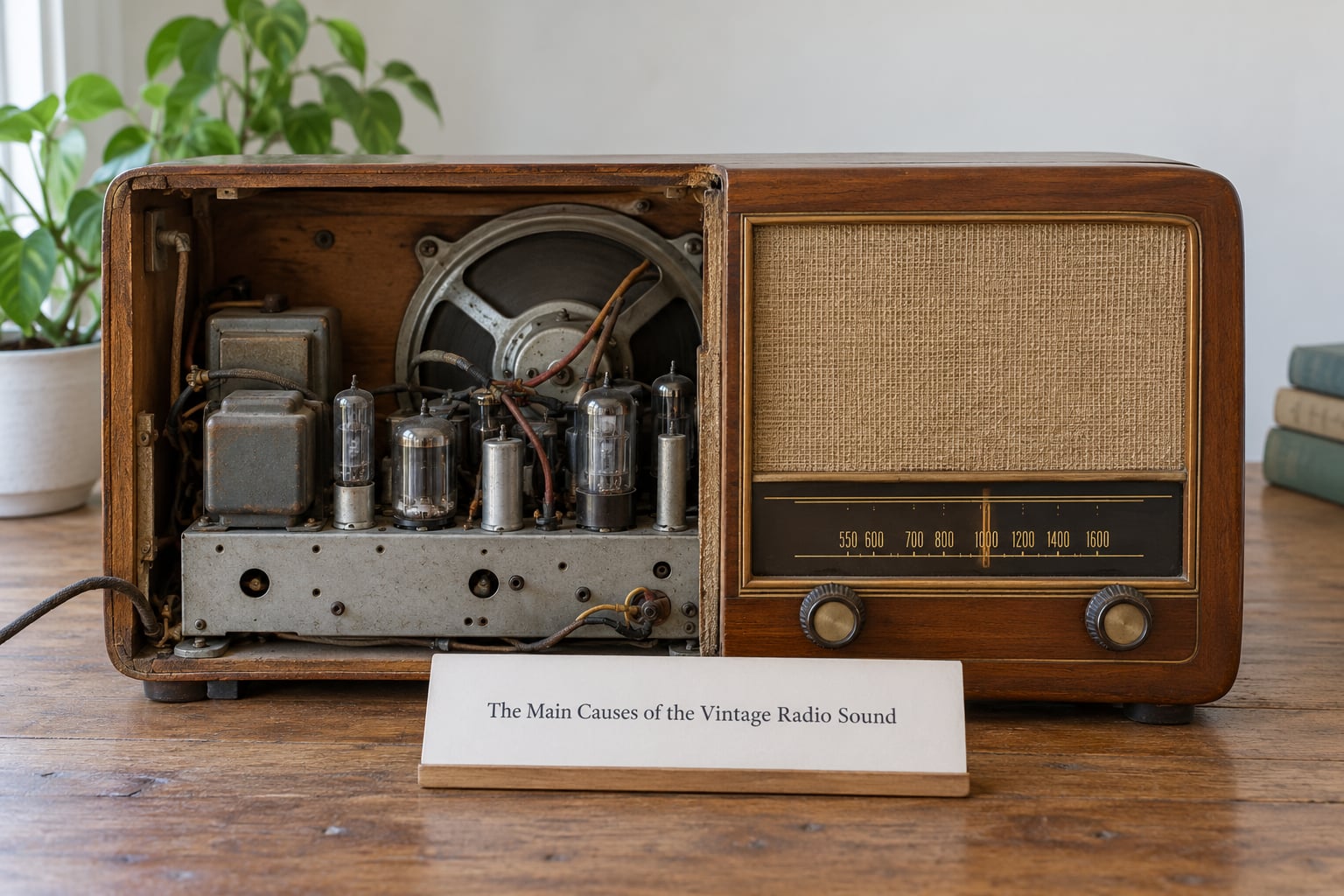
Seven things combine, and pulling on any one of them changes the character without changing the fidelity ranking.
1. Vacuum tubes generate gentle, mostly even-order harmonics
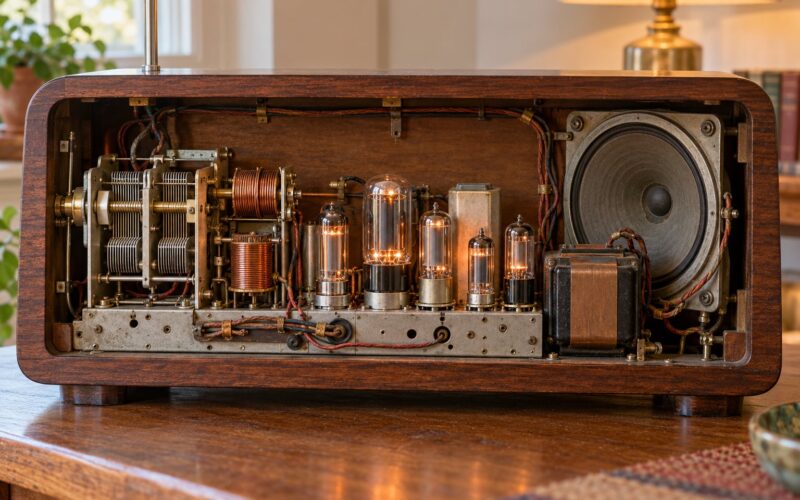
A triode or pentode output stage driven past its comfortable input level bends the waveform asymmetrically, which generates second and fourth harmonics alongside the fundamental. Even-order harmonics sit at musically related octaves and fifths, and ears tend to read them as fullness rather than edge.
2. One full-range driver, no crossover network
A typical tabletop set drives a single 4-inch or 5-inch paper-cone speaker across the whole audio range. There is no crossover dividing low from high, so no phase shift at a junction frequency and no lobing around one. The result is a smooth, continuous midrange that stereo separates never had.
3. Bandwidth limits put a ceiling on the top end
AM broadcasts carry roughly 3 kHz of audio and FM of the era about 15 kHz. Whatever the receiver can pass, it cannot exceed. The ceiling removes sibilance and cymbal splash, and a voice with the top knocked off reads as softer and more intimate.
4. The output transformer rolls off the deep bass
A small iron transformer with a limited core, plus a voice coil whose impedance climbs at low frequency, produces a steep bass roll-off, often down below 150 Hz. Members on antiqueradios.com point at exactly these parts, undersized output transformers and undersized coupling capacitors, as the real determinants of how far down a set goes.
5. A raised noise floor becomes part of the texture
Hiss from the front end, 50 or 60 Hz hum from the power supply, and occasional crackle from loose connections or a tired capacitor all sit inside the programme at low level. Many listeners stop hearing them within a few minutes, and a few listeners argue they are part of what they came for.
6. The cabinet and the room finish the picture
A small wooden or Bakelite box is a resonator as much as an enclosure, and nearfield listening at arm’s length from a four-inch driver gives a bass weight no free-standing speaker of that size manages.
7. Expectation colours everything
Listen to the same station on a good modern system and a warm tabletop set, and part of what you register as warmth is the association between that sound and a specific room, a period, a person. That is not a trick on your part, but it is not a component either.
How Do Vacuum Tubes Create a Warm Sound?
Tubes create warmth by distorting gently rather than efficiently. The transfer curve of an output triode bends rather than corners, so a loud passage rounds off instead of shearing, and the level stops climbing while the harmonic content keeps building. That behaves a little like compression with a musical bias, and it is why a small tube set can sound bigger than its power rating suggests.
Here is the part enthusiasts argue about. On the Quora thread about cheap tube amplifiers, the consensus answer was that budget and expensive sets work on fundamentally the same principle, so the tone comes from the topology rather than the bill. That is fair as far as it goes.
What tubes are not is automatically warm. Run a triode stage with deep negative feedback and a wideband signal and the distortion drops to a level nobody calls warm. Conversely, the perceived effect includes a lot of what happens after the valve: the transformer, the speaker, and the level at which the receiver is actually being pushed.
So the honest version is that valves contribute one harmonic colour to a chain that is already band-limited and single-driver. Remove the tubes from a valve radio and put a small solid-state amplifier in its place, keeping the same cabinet, speaker, and broadcast, and most listeners report very little change. The whole package is what people mean when they say vintage radios sound warm.
Do Old Speakers Make Radios Sound Warmer?
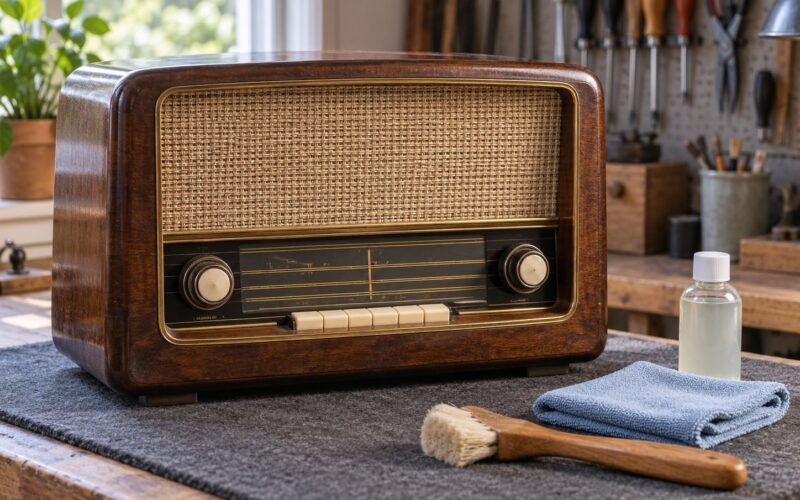
Yes, and this is usually the biggest contributor. A single paper-cone driver behind grille cloth, working in a box a fraction of the size of a modern bookshelf speaker, produces a full, soft and slightly boxy presentation that no matched modern two-way at the same size manages.
Four things are happening at once. The cone is light and undamped, so midrange energy comes through with a slower, softer attack. There is no crossover, so nothing is rolled off at the junction between the range handled by the bass and the range handled by the treble. The cabinet itself adds a resonance peak in the low mids, which is the boost most people call warmth. And the top end falls away well before the driver stops producing it.
Some of that is design, some is damage. A 1950s set with dry paper capacitors, a corroded grille, or a voice coil that has gone stiff will sound worse, not warmer, and the classic complaint on restoration forums is a shrill set that needs a recap and a proper alignment. Members there also note that vintage FM sets need correct alignment to compete with modern PLL tuners, so an old set is not automatically more faithful at reception either.
Why Limited Bandwidth Changes the Character of Music
Band-limiting works as an instrument. The intermediate-frequency filter in a valve radio is a narrow bandpass, and on AM it passes audio only up to somewhere between 2 and 4 kHz. Everything above that is gone before it reaches the speaker.
For speech the effect is a gentle one. Sibilance lives between 4 and 8 kHz, so a talk radio voice through an AM chain sounds rounder, which many listeners describe as easier to listen to for a long stretch. For music the ceiling is more noticeable, since cymbals and hi-hats lose their edge and guitars stop sounding glassy.
FM was designed for more, and mid-century FM sets generally pass audio up to about 15 kHz, so an FM-tuned tube set sounds fuller than the same set on AM. Even then, the receiver’s own filtering, the IF transformer response, and any tone control cut on the chassis pull the ceiling down further. A sharp treble cut on an old console is often the biggest single tonal shaper on the panel.
This is also why the same set on a modern digital source sounds less like itself. Swap AM for a lossless file and the band-limiting disappears along with the character it created, and the little speaker’s weaknesses come forward instead.
What Role Does the Cabinet and Room Play?
More than most people expect. Cabinet design controls the low-mid resonance that gives a small set its apparent size, and the room decides what happens next.
Nearfield listening is the practical part. Sit within a couple of feet of a four-inch driver and the bass response you hear is different from the same speaker across the room, because the driver has time to move air at low frequencies before the reflected wave arrives to cancel it. A tabletop set is effectively always played nearfield, which is part of why it sounds fuller than its specifications suggest.
Resonance is the other half. Small cabinets have a natural box resonance in the low mids, and grille cloth and internal baffles shift it around. Designers of the era tuned that resonance deliberately, and later collectors who stiffen everything and re-dress a set in dense foam can flatten the exact thing they were chasing.
One practical tip if you are comparing sets: change one variable at a time. Same programme, same station, same volume, same listening position, one set swapped. Moving a set across the room or playing louder on one of them will convince you of anything.
Warmth, Detail, and Accuracy: What Are You Actually Hearing?
Warmth and accuracy sit at opposite ends of the same scale. Every factor listed above that adds fullness removes something: the transformer roll-off takes bass extension, the ceiling takes treble detail, the cabinet resonance takes flatness. You are not getting extra, you are choosing which details go missing.
That trade suits certain material. Voices, jazz, blues, folk and acoustic material are mostly midrange information, and a chain that emphasises the midrange gets closer to the character of the source while hiding what it would otherwise reveal. It also suits long listening sessions, because a band-limited, softly-transient chain does not fatigue the way a bright one can.
It suits nobody who wants to know what is actually on the recording. Cymbal detail, low bass definition, the space around a vocal, the difference between two master versions: those are precisely the things a warm chain rounds off. If you are trying to judge a mix, a live recording, or a piece of hi-fi, a modern reference is the more honest instrument, and that is a reasonable position for the sceptics on Audio Science Review to take.
The measurement-minded members of that forum have made a sharper version of the point. Their argument is that many 1960s and 70s amplifiers were not voiced warm at all, that their frequency response is flat within normal tolerance, and that the warmth people remember came from tone controls, loudness switches and the mastering of the era rather than from deliberate design. One contributor there went so far as to say every 1970s amplifier he had measured was unvoiced.
The same forum offers a more generous reading, and it is the one I find more useful. Warmth in that decade was a rational response to abrasive vinyl-era recordings rather than a fashion, and the same contributor notes that manufacturers themselves moved toward brighter, CD-ready voicing as the decade went on. Whether the gear was warm by intention or by context, the listener heard warm, and the listening habits of thirty years still shape what we expect from a radio.
How to Hear the Difference for Yourself
Run this as an experiment rather than an opinion. Five steps, about twenty minutes, and you will know more than any forum thread tells you.
- Pick one station or track. Something you know well, ideally speech and music both, so you can hear the band-limiting and the midrange separately.
- Match levels properly. Not by eye. Use the same familiar programme and adjust until loudness feels equal, then leave it alone. Most warm-versus-bright arguments are volume arguments.
- Keep the chain identical. Same speaker, same headphones, same position in the room. The only thing that changes between passes is the radio.
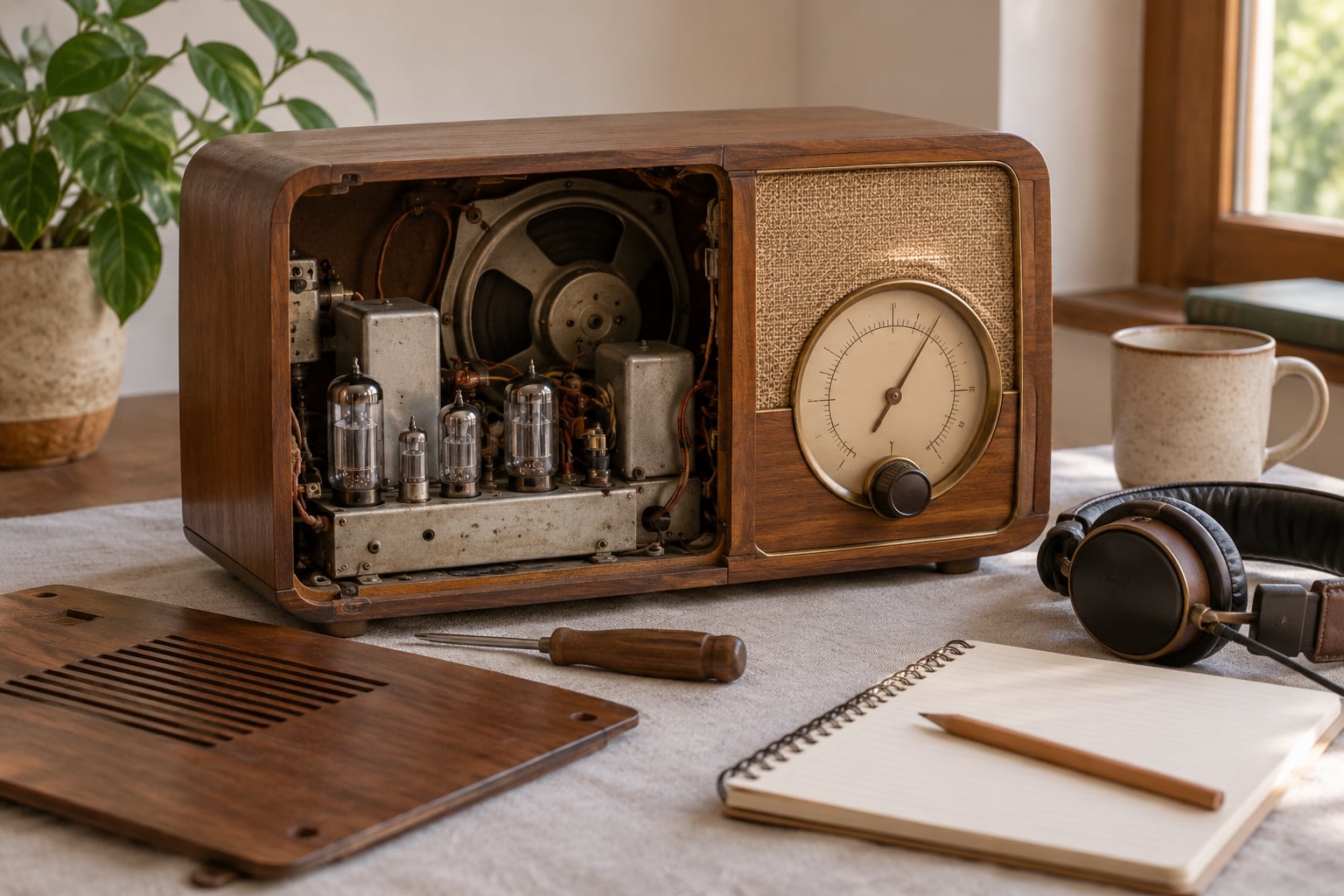
- Take notes on four things. Vocal clarity, how much bass you can define, how hard the top end feels, and whether you notice hiss, hum or crackle.
- Go back the other way. Switch back to the modern reference and repeat the notes. Second impressions are where the character either shows up or quietly disappears.
Then try the other direction, because it is the more useful half. Play your digital source through a modern system and pull the top end down gently with a graphic EQ, around 3 to 6 kHz, and lower the very low frequencies slightly. Add a little of your own before you decide whether anything is missing. Several of the tonal moves these radios make are cheap to imitate, and the point of the exercise is to find out which ones you actually care about.
A word on the warm-up, since people ask about it constantly. Audio usually appears within about ten seconds of switch-on, reaches full level somewhere around thirty seconds, and keeps drifting for far longer as the chassis warms and the capacitors settle. A hobbyist who replaced a 1930s console’s electronics with a Bluetooth module said the thing he missed was not the tone at all, but the slow power-up, the tube glow, and the volume rising over half a minute. That delay is part of what listeners are describing, even when it is not a frequency response.
If your aim is accuracy rather than atmosphere, use a modern receiver as the reference. If your aim is to understand why a 1950s table set gets people to sit and listen, do the experiment above and pay attention to what you stop noticing.
Frequently Asked Questions
Does the age of a radio matter for how warm it sounds?
Age matters less than design. A 1940s set and a 1960s set from the same maker can be miles apart, because the loudness switch, the treble control and the driver size changed constantly. What matters far more is whether the set is complete, aligned and in working order. A neglected set with dried capacitors and a stiff voice coil will sound thin and shrill, and its age will not rescue it.
How can I make a modern radio or speaker sound warmer?
Pull the top end down with a graphic equalizer, roughly 3 to 6 kHz, trim a few hertz of the very lowest bass, and leave the low mids alone. That recreates the band-limited, midrange-forward part of the vintage signature for almost nothing. The harder parts to fake are the soft transient response of a single small driver and even-order harmonic distortion, which is why a tube headphone amplifier or a valve output stage still has an audience.
Are tube radios better for listening to music?
Better is doing a lot of work in that question. Tube radios compress gently and hide recording harshness, which makes them forgiving and often more pleasant for long sessions. They are also worse for judging what is actually on a record, because that same compression and roll-off remove detail. For voices, jazz, blues and talk radio, most people prefer them. For assessing a mix, use something modern.
Do you need to let a tube radio warm up before listening?
Give it a minute before judging it. Sound usually appears within about ten seconds and reaches full level around thirty, then drifts subtly as the chassis warms. If a set sounds harsh or thin straight from cold, wait before deciding anything. Restorers also recommend bringing old sets up slowly on a variac so capacitors reform rather than short out.
Should I get rid of the hum and crackle in a vintage radio?
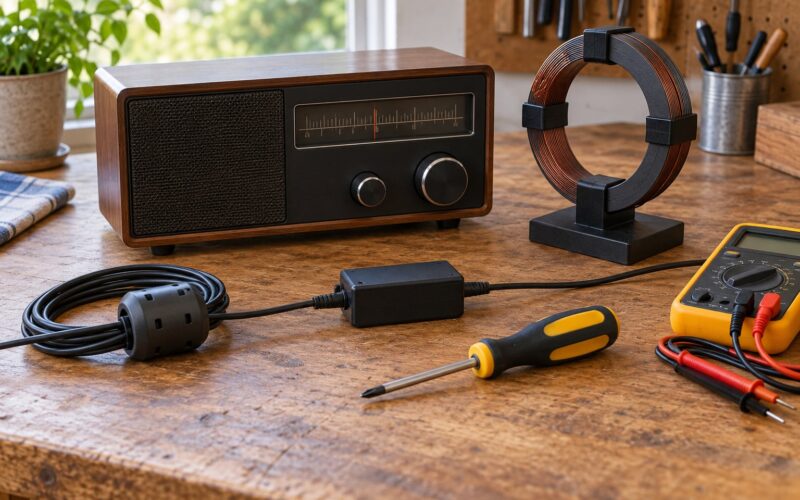
Fix hum and crackle, because both are faults, and leave a little of the residual hiss. Continuous low-level noise is normal for an analog chain, and many listeners stop hearing it within minutes, so a completely silent set can feel oddly lifeless. A hard hum at 50 or 60 Hz or an intermittent crackle usually means a supply or connection problem worth chasing.
Why does my vintage radio sound muffled?
The usual causes are a treble control turned down, a worn grille cloth, a tired IF filter or a set that needs alignment. Narrow-bandwidth AM programming is also legitimately muffled, and that is the chain working as designed. If FM reception is weak and distorted, alignment is the first thing to check, since vintage tuners drift badly without it.
Conclusion
So why vintage radios sound warm comes down to a handful of ordinary engineering decisions: valves that distort gently instead of cleanly, one small full-range driver with no crossover, a signal path capped at 3 kHz on AM, an output transformer that gives up the deepest bass, a raised noise floor, a resonant cabinet played at close range, and an expectation shaped by decades of listening.
Start with the obvious test. Put a station you know on a vintage set, then play the same programme through a modern system at a genuinely matched volume, and write down what changed in the vocals, the bass and the top end. Once you have heard the parts separately, you can decide which of them you actually want, and whether to look for it in old hardware or dial it in on something you already own.