Antenna length decides how efficiently a radio turns an incoming signal into something the receiver can use, but a longer aerial is not automatically better. Reception also depends on where you put the aerial, what surrounds it, and how the set is built. This guide, updated for 2026, works through the length rules and shows you how to test changes safely at home.
An FM, DAB or AM set in the same room can behave completely differently from one building away, and the reason is usually the aerial and its position rather than the receiver. Once you understand how length maps to wavelength, most reception problems stop being mysterious.
Table of Contents
- How Antenna Length Affects Reception
- Antenna Length and Radio Wavelength
- Why Length Behaves Differently on Each Band
- What Happens When You Change the Length?
- Choosing the Right Length for FM and AM
- Why the Antenna’s Position Matters
- How to Test Antenna Length Safely
- Longer, Shorter, or Just Right?
- Common Reception Problems and What They Mean
- Which Type of Antenna Should You Use?
- Safety and Equipment Considerations
- Frequently Asked Questions
- Conclusion
How Antenna Length Affects Reception
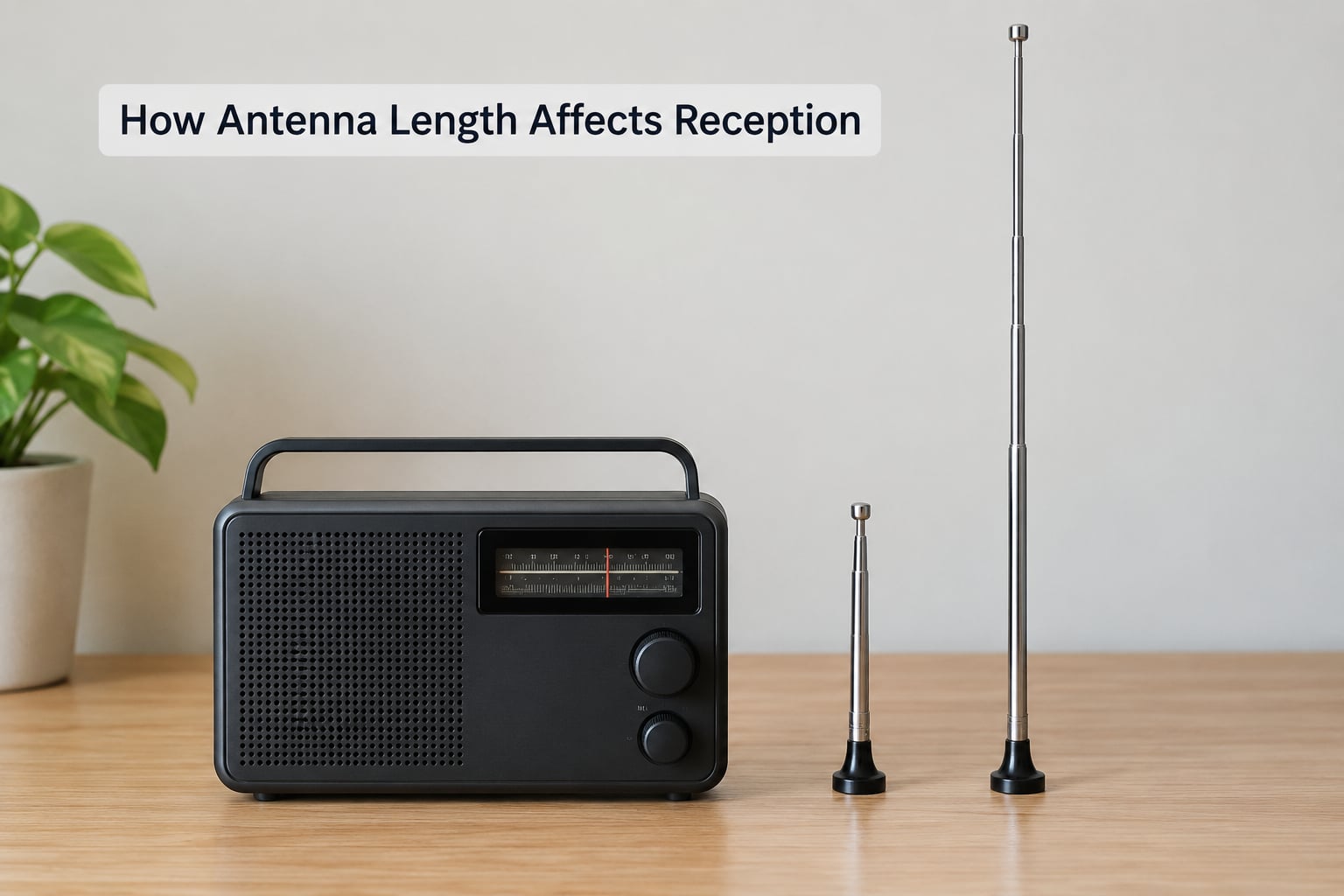
Antenna length affects reception because a radio wave is a repeating electric field, and a conductor only converts that field into a usable signal efficiently when its length is a simple fraction of the wave’s wavelength. Match the length to the frequency and the induced currents build up cleanly. Get it wrong and much of the signal is lost before the receiver ever sees it.
The practical version: an aerial cut for one band is largely wasted on another. A 75 cm whip is a reasonable quarter-wave element for the middle of the FM band, and a hopeless aerial for medium wave, where the matching length runs to tens of metres.
That is the whole mechanism. Everything else on this page is about the ways length gets confused with the other things that matter.
One word of caution before you go further. Reception and transmission are related but not identical. A length that is ideal for pulling a weak signal into a receiver is not automatically the length you would use for pushing a strong signal out of a transmitter, and a great many of the confident claims on the internet mix the two up. You are on the receiving side of this equation.
Antenna Length and Radio Wavelength
Wavelength is the distance travelled by one complete cycle of a wave, and it shortens as frequency rises. For radio, the arithmetic is simple: divide 300 by the frequency in megahertz and you get the wavelength in metres.
Wavelength (metres) = 300 / frequency (MHz)
From that one line you can build every length you need. A quarter-wave monopole (a whip standing on its own) is a quarter of the wavelength. A half-wave dipole is half of it, and is normally quoted as a total length made of two elements. Divide the wavelength by four and the divide-by-two numbers fall straight out of the same division.
| Band | Frequency | Wavelength | Quarter-wave whip | Half-wave dipole (total) |
|---|---|---|---|---|
| FM broadcast | 88–108 MHz | 3.41–2.78 m | 85–69 cm | 1.70–1.39 m |
| DAB Band II | 174–240 MHz | 1.72–1.25 m | 43–31 cm | 86–63 cm |
| 2 m amateur | 144 MHz | 2.08 m | 52 cm | 1.04 m |
| 2.4 GHz Wi-Fi | 2400 MHz | 12.5 cm | 3.1 cm | 6.2 cm |
| CB | 27 MHz | 11.1 m | 2.8 m | 5.6 m |
| Shortwave | 3–30 MHz | 100–10 m | 25–2.5 m | 50–5 m |
| Medium wave | 530–1600 kHz | 566–187 m | 141–47 m | 283–94 m |
Read those as starting points, not orders to cut wire. A thin wire aerial also has an end effect: the physical length that resonates is a few per cent shorter than the textbook figure, which is why a quarter-wave whip for 100 MHz is usually measured nearer 71 cm than 75 cm. A fatter element needs less shortening than a hair-thin one.
There is a memorable shortcut for the same maths: divide 72 by the frequency in megahertz to get the length of each side of a half-wave dipole in metres. It is a rounded, slightly conservative version of the same division, and it survives because it is easy to do in your head. Be careful with it, though. The number you see quoted as 468 over the frequency in megahertz is the same dipole measured in feet, and plenty of articles mix the two units up.
Working it through for 100 MHz: the wavelength is 300 divided by 100, so 3 metres. A quarter-wave whip is 75 cm. A half-wave dipole is 1.5 m in total, or two 75 cm elements joined at the middle. That is the whole calculation, and it is enough to plan almost any aerial you will meet in the home.
Why Length Behaves Differently on Each Band
The same physical aerial can be excellent on one band and close to useless on another, because the fraction of the wavelength it represents changes completely as you move up or down the spectrum. An aerial built for 2.4 GHz is a few centimetres long; the same wire at medium wave is a fraction of a useful wavelength.
How Antenna Length Affects Reception by Frequency
On FM and DAB, quarter-wave lengths are short enough to be convenient. A whip between roughly 70 and 85 cm covers most of the FM band, and the same style of whip shortened to about 30 to 45 cm sits comfortably in DAB Band II. This is why one telescopic aerial can do a reasonable job on both.
Medium wave is where the arithmetic turns hostile. A quarter-wave element for 1026 kHz would need to be roughly 73 metres, which nobody is putting on a kitchen windowsill. Indoor AM sets solve this with ferrite rod or loop antennas, which are small because the loop area does the work rather than a long wire, and the set’s own circuitry is tuned to make them work at those frequencies.
Shortwave sits in between and changes character fast. Doubling the frequency halves the required length, so an aerial that is resonant for 7 MHz at 10 metres is badly off at 14 MHz, where the matching figure is 5 metres. Bands within a metre or two of each other can share an aerial. Bands further apart generally cannot.
This is also why the same set can receive one station perfectly and refuse another on the same band. The difference is often just how many degrees the station sits away from the point the aerial is cut for.
What Happens When You Change the Length?
Changing the length changes how the aerial presents itself to the receiver, and the results are more mixed than most explanations suggest. Resonance matters most, but so do impedance, gain, bandwidth and where the aerial actually sits in the room.
| Change you make | What tends to happen |
|---|---|
| Extend a whip to full length | More signal available, wider usable bandwidth; the improvement often levels off once resonance is passed |
| Shorten a whip | Channel selection can sharpen around the newly resonant frequency, while stations far from it get worse |
| Make it much longer than a quarter wave | Reception can get worse, not better, as it drifts off resonance and gain patterns shift |
| Stand it upright instead of angled | Improves reception for stations in the direction the aerial now points |
| Move it a few centimetres | Noticeable change is possible, especially near metal, wiring or a wall |
| Swap a stubby internal aerial for a long external one | Usually better outdoors, often no better indoors, and sometimes worse if the length fights the receiver’s tuning |
Two threads on electronics and RF discussion boards make the same point in different words: reception can change drastically simply by moving the aerial a few inches, and a longer aftermarket aerial is regularly reported as performing worse than the stubby one supplied with the set. The second result is not a contradiction. A badly matched long aerial can feed the receiver more noise than signal, and an internal wire or loop is matched to the circuitry inside the case.
Signal-to-noise ratio is what your ear actually hears. Length can improve it, but so can moving the set out of a room full of switch-mode power supplies, and so can a cleaner connection. A longer aerial that picks up more interference can leave you worse off than where you started.
Choosing the Right Length for FM and AM
Start with the aerial that came with the set, extended fully. It is already matched to the receiver’s circuitry and to the bands the manufacturer expected you to use, and that matching is worth more than a few centimetres of extra metal.
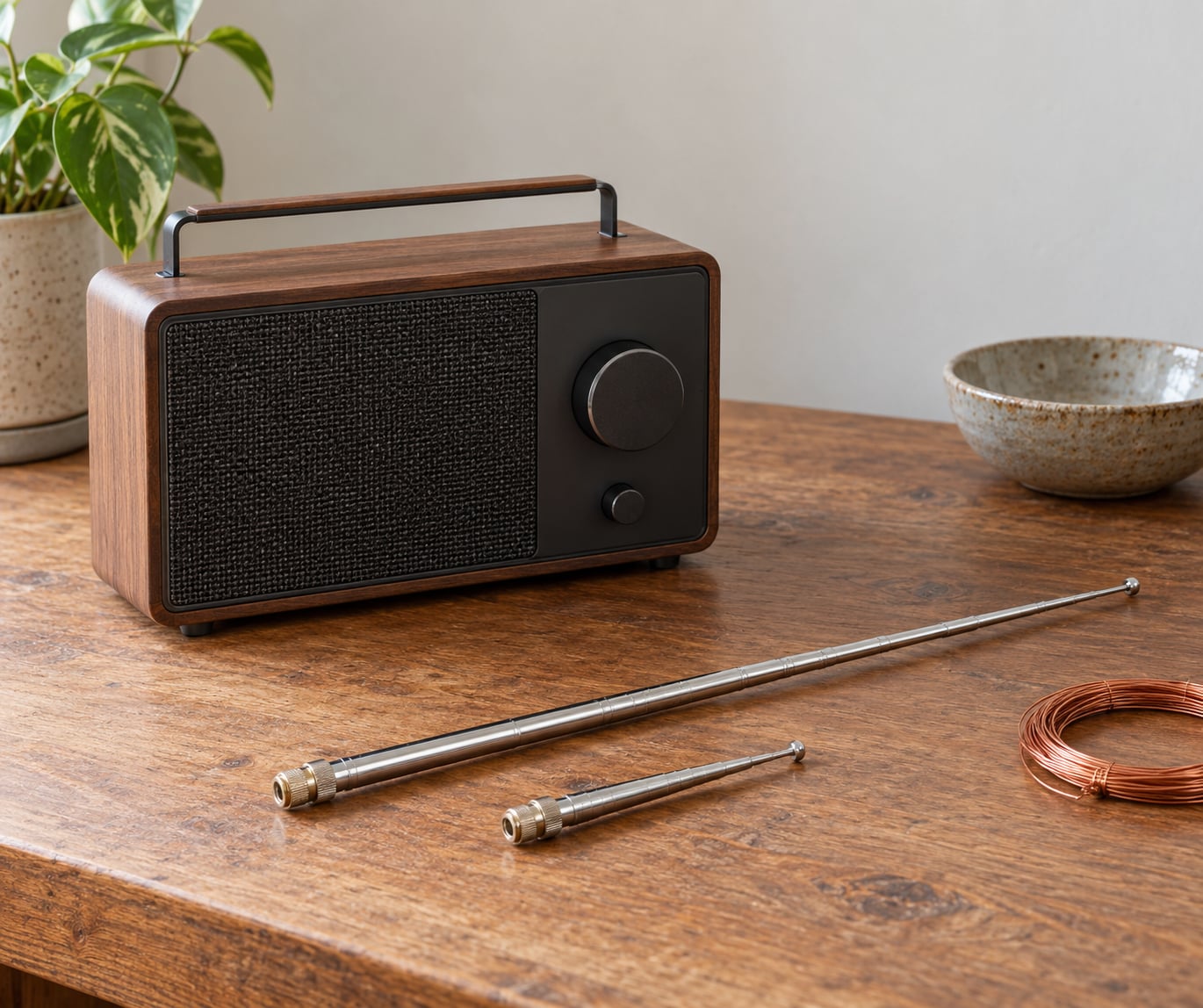
From there, practical starting points. For a portable set, a fully extended telescopic whip in the 70 to 85 cm range suits FM, and 30 to 45 cm suits DAB. For a tabletop set with a screw-on aerial connector, the same quarter-wave lengths work and are often sold as inline or screw-on whips.
For a car radio, 75 to 90 cm is the usual factory whip length, which matches the quarter-wave figure for the middle of the FM band. A stubby aerial on the same car is a deliberately wideband compromise: it keeps the car looking tidy and copes with a wide spread of stations, at the cost of some sensitivity. Users swapping these out report mixed results, which matches the pattern in the table above.
For a hi-fi or kitchen system, the aerial is often just a piece of wire, and the supplied one is usually closer to a full wavelength for FM than a quarter wave. That is not a mistake. A longer element gives a broader usable band, which matters when you want several stations rather than one strong one.
Follow the receiver’s manual where it gives guidance, especially for ferrite rod and loop antennas. These are designed around the set’s internal tuning, and substituting a wire is rarely an improvement.
Why the Antenna’s Position Matters
Position beats length more often than not. A correctly sized aerial in a poor spot will lose to a mediocre aerial in a good one, and moving a set off a metal-framed windowsill or away from a wall can do more than any length change.
Things that spoil reception regardless of length: metal within a few centimetres of the element, mains wiring and switch-mode power supplies, foil-backed insulation, a wet roof or wall, and reinforced concrete. Walls and floors absorb, and a human body close to an aerial changes its behaviour noticeably. Someone leaning over a radio to adjust it can detune it.
Windows are worth their own line. Glass coated with a metallic film behaves like a shield, so a windowsill position can be much worse than the same set on a wooden shelf in the middle of the room. Height helps too, and putting the set on a higher shelf or worktop often beats swapping the aerial.
Two safe comparison tests. First, hold the set in the same spot and turn a quarter-wave whip from vertical to horizontal, comparing a station you receive easily; note which orientation suits the stations you actually want. Second, put the set as high as you safely can and compare it against its usual position. Change one thing at a time, or you will not know what worked.
How to Test Antenna Length Safely
Testing an aerial takes about ten minutes if you change one variable at a time. The point is not to get a laboratory measurement, it is to find out whether a change helped the stations you listen to.
Pick a representative station first. Choose one that receives cleanly at the current setup, and one that is marginal, and use the same two every time.
Record a baseline. Write down what you hear: stereo or mono, clean or hissy, present or dropping out. Signal strength bars on the set are a useful extra record, though the sound is the thing you care about.
Change one variable. Extend the whip fully, or try a different length on an approved connection, or move the set a few inches. Do not alter built-in wiring, and do not cut anything the manufacturer describes as fixed.
Note the result against the baseline, then move the position back or forward and repeat. Reception often varies enough between positions that you need two passes before you believe a length change.
Restore the best setup and leave it there. If nothing improved, the limit is probably coverage or interference, not aerial length, and further fiddling will only give you a worse-looking setup.
Longer, Shorter, or Just Right?
Longer helps when the supplied aerial is retracted, broken, or badly mismatched, and when the extra length brings it onto the frequency you want. It also broadens the band a whip can receive, which suits a set where you want many stations. It stops helping once you pass the useful fraction of a wavelength, and beyond that it can cost you.
Shorter helps in two specific cases. It can sharpen reception around one narrow slice of the band, which is useful for talking to or listening to a single service, and it can solve a physical problem such as a whip that is too long for a drawer or a cup holder.
Just right means the manufacturer’s specified system, extended as intended. That is the option that wins most often, because the receiver was designed and tuned around it. Generic advice cut to a length from an online table will lose to the manual more often than not.
The thread running through all three is that the receiver’s own antenna system matters more than a generic length from a website.
Common Reception Problems and What They Mean
Weak FM usually means weak coverage, a badly placed aerial, or a loose connection at the aerial socket or wall plate. Length is one candidate among several, and rarely the only one.
Noisy AM has a different cause. At night the medium-wave band picks up distant stations that share frequencies with local ones, and the result is that familiar pulsing, splashing and fading between stations. Moving the set does more here than changing length, because the problem is interference rather than weak signal.
Interference in the FM band usually comes from inside the building: LED lighting, HDMI cables, switch-mode supplies, and chargers near the aerial. A longer aerial can pick up more of it, which is one reason a big external whip is not automatically better indoors.
Mono instead of stereo often means the signal is strong enough but has too much noise for the receiver to lock the stereo subcarrier, or that a nearby transmitter is overloading the front end. A stronger, cleaner signal at the same length fixes the first; nothing at the aerial fixes the second.
Nearby-station overload shows up as a station you cannot tune out, or one station appearing on several positions. That is a receiver sensitivity problem, and a bigger or longer aerial can make it worse.
Faulty connections, weak transmitter coverage, electrical noise and unsuitable antennas all produce the same complaints as wrong length. Treat length as one lever among several rather than the explanation.
Which Type of Antenna Should You Use?
The type you use matters as much as the length, and each design suits a different job. Match the type to the set rather than to the length you want.
| Type | Best for | Watch out for |
|---|---|---|
| Telescopic whip | Portable and tabletop FM and DAB sets | Must be extended fully; collapsing it is the most common cause of “my radio broke” |
| Internal wire or loop | Handheld and pocket sets | Tuned to the set’s circuitry, and easy to detune with your hand |
| Ferrite rod | AM and medium wave in portable sets | Highly directional; rotating it changes which stations you hear |
| Loop aerial | AM reception indoors where a long wire is impossible | Needs a decent area, often a frame near a window |
| Wire dipole | Fixed installations where you can mount it high and clear | Needs two elements and somewhere to put them; outdoors beats indoors |
| Wideband FM aerial | Hi-fi systems, kitchen sets, stereos | Deliberately not a quarter wave, so do not measure it against the table and panic |
There is a point at which buying a dedicated antenna will not help, and it is worth naming. If a station is beyond reliable transmitter coverage for your area, no aerial will invent the signal. If the same set receives that station perfectly in another room, coverage is not your problem and neither is length.
A rule of thumb: if the set is portable and already receives your stations, keep the supplied aerial. If it is a fixed system in a poor spot, position is the fix. Buy a better aerial only when the position and the supplied aerial have both been ruled out.
Safety and Equipment Considerations
Adjusting an indoor whip or a loose wire aerial is low-risk work, and doing it correctly will not damage anything. A few things still deserve care.
Follow the manufacturer’s instructions first. They tell you which connectors are approved for external aerials and what impedance the set expects, and they are more reliable than any generic length chart.
Weather resistance matters for anything outdoors. Use aerial-grade cable rather than domestic wire, keep joints above standing water, and fix fittings so wind cannot work them loose. A loose joint on an outside mast is an intermittent fault that looks exactly like a fading station.
Never work on mains-powered equipment while it is connected. Unplug it, and remember that a radio with a built-in amplifier or a set-top box may be earthed through other equipment on the same circuit.
Lightning risk is real for anything connected to an external aerial. That work belongs to a qualified installer, along with roof mounts, towers, masthead aerials and long external cable runs. The same applies to car aerials beyond a simple screw-on whip swap, and to anything involving a mast near an overhead line.
Frequently Asked Questions
Does a longer antenna always give a radio better reception?
No. Beyond roughly a quarter of the wave’s length, extra metal stops adding much and can start working against you by drifting off resonance, narrowing the usable band and picking up more interference. Length matters most when the supplied aerial is retracted, damaged or cut for a different band. Once you pass a usable fraction of a wavelength, position and the receiver’s own antenna system decide the result.
Can I use a TV antenna for an FM radio?
Often, yes, with caveats. Terrestrial television aerials in the UK cover a wide range of UHF frequencies that overlap the upper end of the FM band, so they receive FM reasonably well without modification. They are much too long and too broad-band for DAB Band II, and they work at their best mounted high and outdoors. Indoors, an FM set usually beats a TV aerial, because the set’s whip is matched to its own circuitry.
Should an indoor radio antenna point toward the station?
Direction matters, though less than most people expect. A quarter-wave whip radiates and receives equally well in every horizontal direction, so simply pointing it at a transmitter changes little. What does matter is keeping it clear of metal, wiring and appliances, holding it upright, and moving the whole set rather than rotating the aerial alone. Turning the set itself changes the field around the internal wiring as well.
Why does AM sound better than FM at night?
Medium-wave signals travel much further after dark because the ionosphere reflects them back towards the ground, so distant stations that are useless in daylight become audible. The trade-off is interference: those same distant stations share frequencies with local ones, which produces the pulsing, splashing and fading that spoils night-time AM. FM is unaffected by the same mechanism and simply carries on working after dark.
Can an antenna improve reception if a station is far away?
Sometimes, and only within limits. A better-matched or better-positioned aerial raises the signal reaching the receiver, so a station that was just above the noise floor may become comfortable. But there is a hard ceiling: if the station is outside reliable transmitter coverage for your location, the signal simply is not there to collect, and no aerial length will manufacture it. Test position first, because that is free and usually more effective.
Conclusion
Start with the aerial that came with the radio, extended fully. Work out which band is actually struggling, since FM, DAB and medium wave want completely different lengths, then move and rotate the existing aerial before you change its size. Position, height and what surrounds the set usually matter more than another few centimetres of metal.
Only test a different length if the manufacturer allows an external aerial, and change one thing at a time so you know what fixed it. If nothing does, the limit is coverage or interference, and no length will change that.