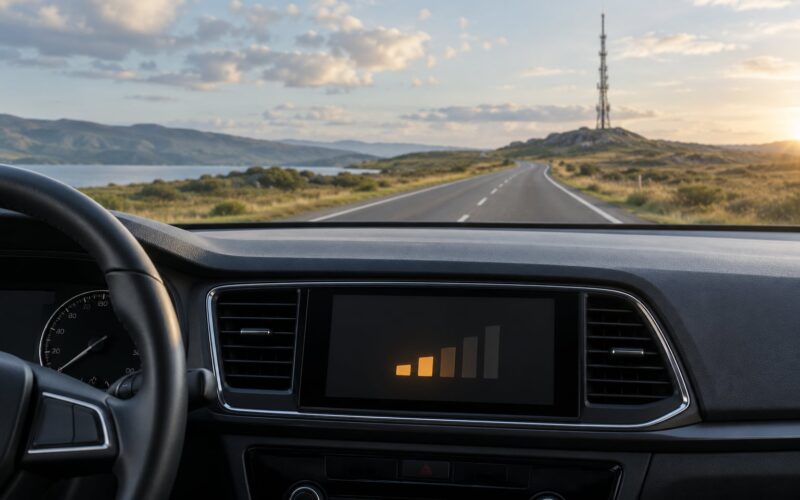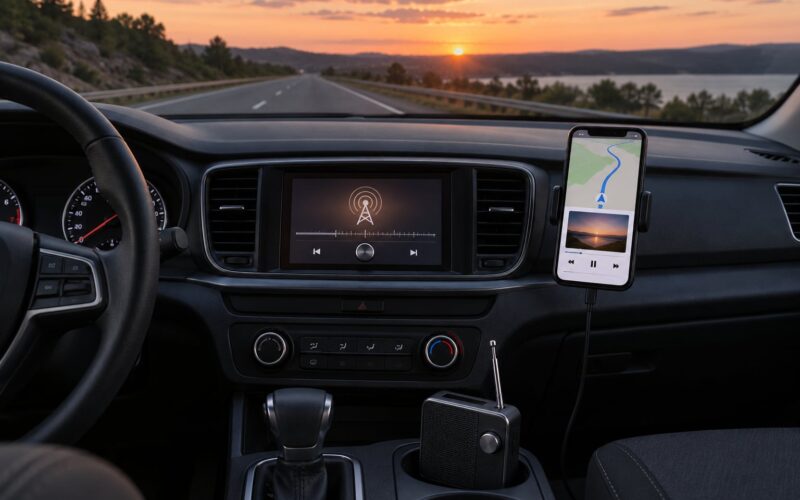
Spotify Radio builds stations around your own listening habits and plays on demand, while traditional radio is a fixed broadcast that every listener in range hears at the same moment. Choose Spotify Radio for endless catalogue depth and full control; keep traditional radio for local information, no data cost and a hand-picked format you do not have to re-choose.
The honest answer is that most people use both without thinking about it. Streaming covers the hours when you are on Wi-Fi and want something specific. The car radio covers the country lane where the signal drops and the battery is already low.
Table of Contents
- Spotify Radio vs Traditional Radio at a Glance
- Music Discovery and Personalization
- Station Variety and Control
- Local News, Sports, and Community Coverage
- Sound Quality and Listening Experience
- Cost, Access, and Device Requirements
- Privacy, Data, and Listening Habits
- Which Should You Choose?
- Frequently Asked Questions
- Is Spotify Radio the same as traditional radio?
- Does Spotify Radio include local news or sports?
- Do I need a Spotify Premium subscription to use Spotify Radio?
- Is traditional radio better for local information?
- Does Spotify Radio use more mobile data than FM radio?
- Can I listen to traditional radio online?
- Conclusion
Spotify Radio vs Traditional Radio at a Glance
| Criterion | Spotify Radio | Traditional radio (FM, AM, DAB) |
|---|---|---|
| Music choice | Any track in a catalogue of millions, plus algorithmic stations | A station rotation of a few hundred to a few thousand tracks |
| Personalisation | Built from your skips, likes, playlists and saved tracks | One shared playlist chosen by the music director or presenter |
| Local content | Curated by the platform, not your area | Local news, traffic, weather, sport and community notices |
| Live programming | Pre-recorded shows in a few cases, mostly playlist-shaped | Live presenters, request shows, phone-ins and interviews |
| Audio quality | Lossy stream at a settable bitrate, needs bandwidth | Consistent broadcast signal within the transmitter’s area |
| Availability | Anywhere with mobile data or Wi-Fi | Anywhere the transmitter signal reaches, nothing else needed |
| Cost | Free tier carries ads; the full experience needs a subscription | Free to receive over the air |
| Privacy | Listening history feeds the recommendation profile | Anonymous reception, no login needed |
| Best for | Discovery, focus listening and control | Commuting, local updates and dead-signal areas |
Music Discovery and Personalization
Spotify Radio is the algorithm’s answer to the jukebox. It reads what you play, what you skip fast, what you save and what you put on repeat, then rebuilds the station around those signals. Two people can tap the same radio button in a car and hear two completely different sets.
That is the core difference in one line: Spotify Radio personalises, traditional radio broadcasts. A station’s music director builds a rotation, schedules it into a music clock, and every listener hears the same song in the same order at the same minute.
How the algorithm decides what plays next
Recommendations come from several inputs working together: the artist’s own catalog, tracks with similar attributes, and your personal library. A 2020 thread on community.spotify.com put it plainly, complaining that the same songs kept returning because the station pulls from your library as heavily as from the genre.
Listeners have also noticed the flip side. One Reddit commenter in r/AppleMusic noted that Spotify surfaced new artists more readily than their old local rock station ever did. Neither tool is perfect. One is too narrow, the other is too wide.
Station Variety and Control
Catalogue size is Spotify Radio’s clearest edge. One Reddit commenter put Spotify’s catalogue at roughly 75 million tracks against the 300 to 500 tracks a single station rotates, or about 2,300 across every genre a station plays.
Control runs alongside that. On streaming you search, skip, rewind, queue and tell the algorithm to back off. Broadcast radio gives you a dial and a volume knob. You hear what the station scheduled, in the order it was scheduled, and there is no skip button.
Where the fixed format actually helps
A repeatable schedule is a feature when you are working, cooking or driving. You stop making decisions and the station keeps the same character all afternoon. A familiar local station becomes background that does not need managing.
The predictable side of radio is also what makes it usable. A request line, a phone-in, a weather bed at the top of the hour — these are things a listener can learn once and rely on. Streaming gives you variety but no ritual.
Local News, Sports, and Community Coverage
This is where traditional radio still wins, and not narrowly. A local FM or DAB station carries the traffic report for your actual roads, the weather for your actual valley, school closures, hospital notices, local election results and the football results nobody else covers.
Emergency information matters most. Broadcast bulletins go out to anyone in the transmitter’s area at once, whether or not they have a phone, a data plan or a signal. That is the single strongest argument for keeping a radio in the car.
Community and student stations add what a platform cannot: programming made by people who live where they broadcast. Listeners argue for them in forums precisely because a real person is choosing the records rather than a model.
Sound Quality and Listening Experience
Streaming gives you control over quality. Higher bitrate means a fuller, more open sound, and you decide whether to spend the bandwidth. Broadcast radio delivers what it delivers within range, with no menu to think about.
Reception is the bigger practical difference. Streaming depends on a mobile connection holding steady. FM depends on a transmitter signal, which in open country often travels further than a phone signal does. On a remote country lane, the radio keeps playing and the stream keeps buffering.
Device support has converged, too. Most cars now have Bluetooth and USB input, and many newer models take a phone signal with USB and play through the system. Either way of listening can end up in the same speakers.
Cost, Access, and Device Requirements
Traditional radio is free to receive, with no account and no subscription. That single fact keeps it in cars, shops and kitchens across the country, and it stays true no matter what happens to any streaming service’s tiers.
Spotify’s free tier exists but carries advertising and limits control, while the ad-free experience sits behind a paid subscription. Treat the subscription as the price of the full version of the service rather than a fee for radio, because radio is only part of what you are paying for.
How to get traditional radio in your car or on your phone
You do not need internet, an app or an account. If the built-in set-up already has an aerial, press the power button and scan the band. That is the whole trick on most cars built since the 1990s.
Where the car lacks a tuner, use the phone as the receiver and send the audio out. Pair over Bluetooth for hands-free control of volume and station, or run a USB cable or 3.5mm aux lead into the system. A USB DAB+ dongle plugged into the same port adds digital stations and better reception on weak FM.
On a phone with no tuner, a streaming app can carry live station feeds over data, which is useful for convenience but gives up the no-signal advantage that broadcast reception has.
Privacy, Data, and Listening Habits
Streaming radio runs on a listening history. What you play, skip and save shapes the next station, and that history is the asset the business is built on. Practices differ between providers and change over time, so read what your own provider says rather than trusting a summary.
Broadcast reception has no equivalent. There is no login, no profile and no record of what you listened to. For a lot of people that is not a selling point; for others in a shared household it is the whole reason the kitchen radio stays on.
Data use in practice
Streaming burns mobile data continuously while it plays, and a phone on a weak connection will spend effort holding the stream together. FM radio uses none, which matters on metered data, abroad, or on a long drive away from towns.
Downloads change the picture for subscribers. Music saved on the device plays back without a connection, which makes streaming radio work offline for the tracks you already have — but not for a live station.
Which Should You Choose?
Pick by situation rather than by loyalty. Most listeners end up with a hybrid setup, and that is the honest recommendation.
If you are a daily commuter with reliable mobile data
Spotify Radio wins. You get through the traffic, the music suits you, and the ads and the local news are both easy to leave behind. Start with the personalised stations and let them learn for a fortnight before judging them.
If you drive long distances through weak-signal areas
Traditional radio wins, and it is not close. Local bulletins, no buffering, no data and no dependence on a phone tower. Keep streaming for when you are parked or on Wi-Fi.
If you want to hear new and less obvious music
Streaming has the depth, but fix the repetition problem rather than giving up on it. Clear your listening history occasionally, seed a station from an artist or track you actually like, and compare against a community station for genuinely hand-picked selections.
If you run a shop, café or small workspace
Traditional radio gives a consistent, recognisable sound for the room and carries local advertising to the people who actually live nearby. Streaming gives you a preset and a subscription instead of a presenter who picks up the phone.
Frequently Asked Questions
Is Spotify Radio the same as traditional radio?
No. Spotify Radio generates stations from your listening history and plays on demand, so you can skip, rewind and reshuffle. Traditional radio is a live linear broadcast on a fixed schedule, chosen by a music director or presenter, with no skip button and no control over what comes next.
Does Spotify Radio include local news or sports?
Not in the way a local station does. Spotify runs national and international shows and music programming, but it does not produce the traffic report, weather bulletin, school notice or regional match result for your area. For genuinely local information, a local FM, AM or DAB station is the source.
Do I need a Spotify Premium subscription to use Spotify Radio?
You can play Spotify Radio on the free tier, but advertising interrupts playback and control is limited. The ad-free experience and offline playback come with the paid subscription. Traditional radio needs no account and no payment at all, which is why it stays free to receive.
Is traditional radio better for local information?
Yes, and it is the clearest difference between the two. Local stations carry live traffic, weather, community notices, emergency bulletins and regional sport for the area they broadcast to. Streaming radio is built around music catalogues and has no equivalent of a local bulletin.
Does Spotify Radio use more mobile data than FM radio?
Considerably more. Streaming uses mobile data continuously while it plays, and FM radio uses none at all. That gap matters on metered data, when roaming abroad, or on long drives through areas where a phone signal is unreliable. Saved music plays back without a connection, but live streams do not.
Can I listen to traditional radio online?
Yes. Most stations offer a live stream through their own site or a radio directory app, and many local stations publish a schedule and presenter details online. That streaming feed needs a data connection, so it does not replace broadcast reception in a dead-signal area.
Conclusion
Spotify Radio is better when you want personal choice, catalogue depth and control over every track. Traditional radio is better when you want local information, a hand-picked format and music that keeps working where mobile data does not.
Decide which of those two priorities matters more this week, set up that one properly, and keep the other as your backup. For most listeners that is not a compromise, it is just a better setup.