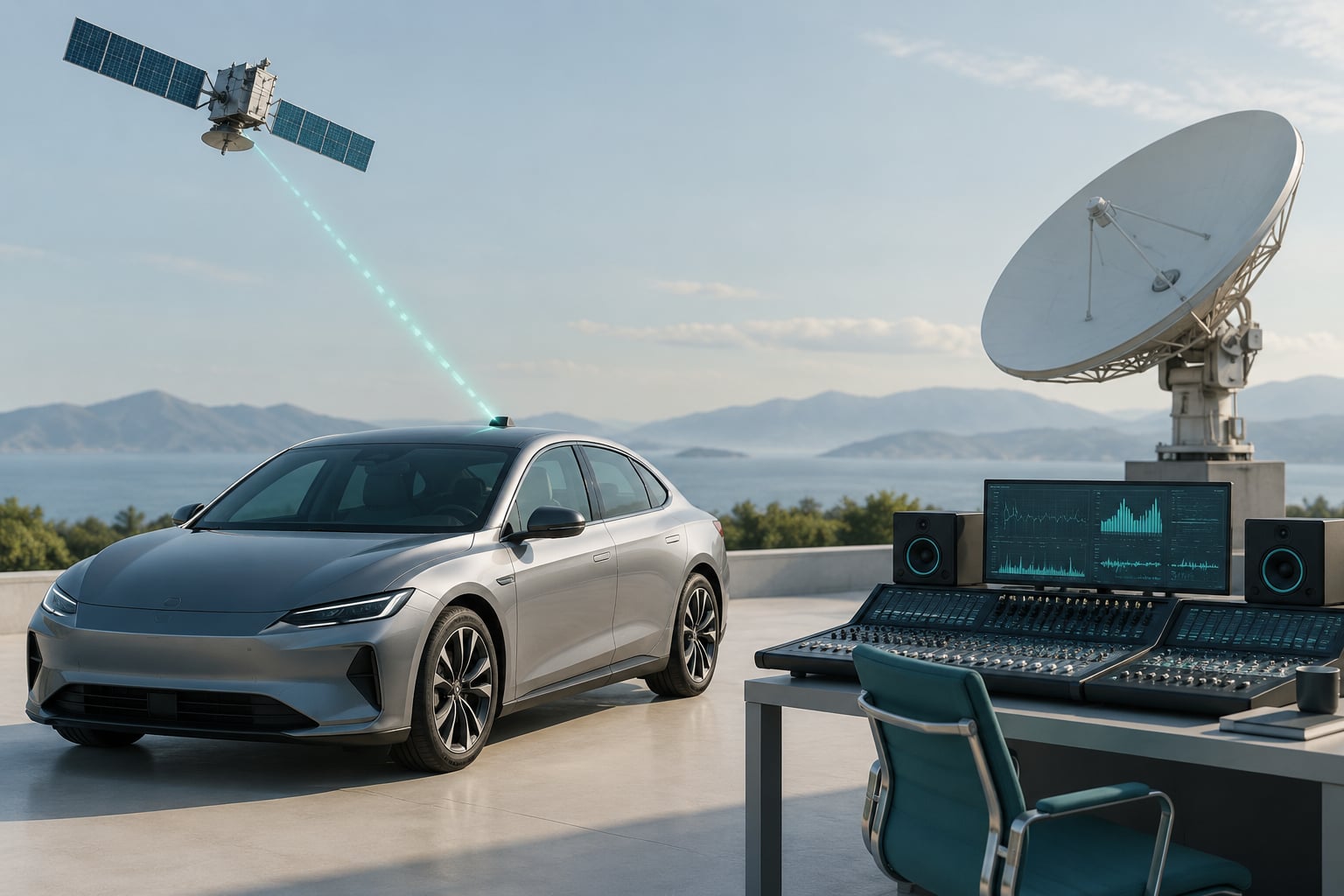
How satellite radio signals reach your car in six hops: audio is recorded and encoded at a broadcast studio, sent up to a satellite about 22,000 miles overhead, and beamed back down either straight to a small antenna on your roof or to a ground repeater that re-transmits it nearby. A receiver under the dash decodes whichever signal is stronger and plays it through your speakers.
That chain is the reason the same station holds together across a 600-mile drive while FM fades out after 30 miles. It is also the reason your satellite radio goes quiet in a tunnel, a multi-storey car park or a dense city centre. Below is each part of the path, what hardware sits at the end of it, and what to check when reception gets weak.
Table of Contents
- How Satellite Radio Signals Reach Your Car at a Glance
- What Is Satellite Radio?
- How the Satellite and Ground Network Deliver Radio
- How Satellite Radio Signals Reach Your Car Step by Step
- What Does the Antenna in Your Car Actually Receive?
- How the Car Radio Turns the Signal Into Sound
- Why Satellite Radio Reception Can Weaken
- Satellite Radio vs FM and Internet Radio
- Frequently Asked Questions
- Conclusion: Start with the Signal Path
How Satellite Radio Signals Reach Your Car at a Glance
The full path, in order:
- Broadcast studio. Audio arrives over a fibre feed and is encoded into a digital stream.
- Uplink and earth station. A ground dish in New Jersey sends that stream up to a satellite in orbit.
- Satellite. The satellite amplifies the signal and beams it back down over North America.
- Terrestrial repeater. Ground-based transmitters re-broadcast the same signal in cities, tunnels and underpasses.
- Car antenna. A low-profile roof antenna catches the satellite signal, or the nearby repeater.
- Receiver and speakers. The head unit compares both sources, decodes the audio and sends it to the speakers.
| Component | Where it sits | What it actually does |
|---|---|---|
| Broadcast studio | New York, Los Angeles, Nashville and a handful of other production centres | Produces the channel audio and hands it to the encoding system |
| Uplink earth station | Ground, connected by fibre to the studios | Aims a high-power microwave beam at the satellite |
| Satellites | Geostationary or highly elliptical orbit, roughly 22,000 miles up | Receive, amplify and rebroadcast the signal across a continent |
| Terrestrial repeaters | City rooftops, tunnels, underpasses, airports | Re-transmit the satellite signal locally where the sky view is blocked |
| Car antenna | Roof, rear glass or shark-fin mount | Captures whichever signal the receiver asks for |
| Receiver | Behind the dashboard, part of the head unit | Decodes the audio and switches sources so you hear no break |
What Is Satellite Radio?
Satellite radio is a subscription digital broadcast service that reaches receivers across North America on frequencies around 2.3 GHz, in a band called S-band. In the United States it is SiriusXM, formed from a merger of Sirius and XM Satellite Radio that completed in 2008.
If you have read older explainers, you will still see XM and Sirius treated as rivals. That framing is out of date. The two companies now run a single network of satellites and repeaters, and the receivers are branded SiriusXM regardless of which company’s satellite is serving you.
It differs from other ways of listening in three practical ways:
- Coverage. One subscription works across the United States, Canada and Mexico, including rural roads where no FM tower is nearby. It does not work in Europe, so it is not a UK option.
- Consistency. The signal does not weaken as you drive away from a transmitter, which is exactly what FM does.
- Cost. It is a paid subscription, and the receiver only decodes channels once the service is active. That is why a satellite-ready head unit can sit silent until someone pays for it.
The honest downside is line-of-sight. FM bounces around hills and buildings because it uses lower frequencies. S-band does not, so anything solid between your roof and the sky cuts the link. The network’s answer is a ground repeater network and a buffering trick, both covered below.
How the Satellite and Ground Network Deliver Radio
Audio from the studio is digitised and compressed, so several channels can share one carrier wave. SiriusXM broadcasts on S-band spectrum: the older Sirius satellites use roughly 2320 to 2332.5 MHz, the XM satellites roughly 2332.5 to 2345 MHz. The high frequency is what buys the wide coverage, and it is also what makes reception fragile in cities.
Up link, satellite, down link
The uplink is a microwave beam from a ground dish to the satellite. The satellite does not process the audio, it receives it, amplifies it by a large factor and sends it back down in a wide footprint covering millions of square miles. The receiver never talks back. Satellite radio is one-way, downlink only, which is worth remembering when people ask whether the satellite can track where their car is going.
Two orbit designs, one service
The two merged networks inherited different orbit designs, and the difference still shapes in-car reception:
| Orbit design | Altitude | What it means in a car |
|---|---|---|
| Geostationary, used by the XM heritage fleet | About 22,000 miles, fixed position over the equator | Always in the same place in the sky, but can sit low on the horizon toward the edge of the coverage footprint |
| Highly elliptical, used by the Sirius heritage fleet | Varies from a few thousand miles to roughly 22,000 miles each orbit | Satellites pass close overhead at times, giving a better angle, but the receiver must switch between them as they rise and set |
That switching is handled in the background by a time-differencing scheme: one satellite’s transmission is deliberately held about five seconds ahead of another, so when the receiver changes source mid-orbit it has audio already buffered and the change is inaudible. The same buffer covers short obstructions such as a bridge or a tunnel exit.
The ground network that fills the gaps
A terrestrial repeater is a ground transmitter that listens to the satellite feed and rebroadcasts it locally at low power. Tunnels and underpasses get their own small repeaters so drivers do not lose the channel for the length of the structure. Cities get rooftop repeaters that fill the dead angles created by tall buildings.
The practical takeaway, which surprises most drivers, is that a lot of city satellite radio arrives from a tower rather than from space. If your signal is good on a motorway and weak between two towers downtown, that is the network doing its job, not a fault in your car.
What the current fleet looks like
The newest spacecraft is SXM-11, the fifteenth satellite launched for SiriusXM, which has finished in-orbit testing and gone into service after SXM-9 and SXM-10 before it. It orbits at about 22,000 miles with a large unfurlable S-band reflector roughly 30 feet across, and the company reports more than 200 million equipped vehicles across North America. Newer hardware and a higher elevation angle are the stated reasons in-car reception improves fleet by fleet.
How Satellite Radio Signals Reach Your Car Step by Step
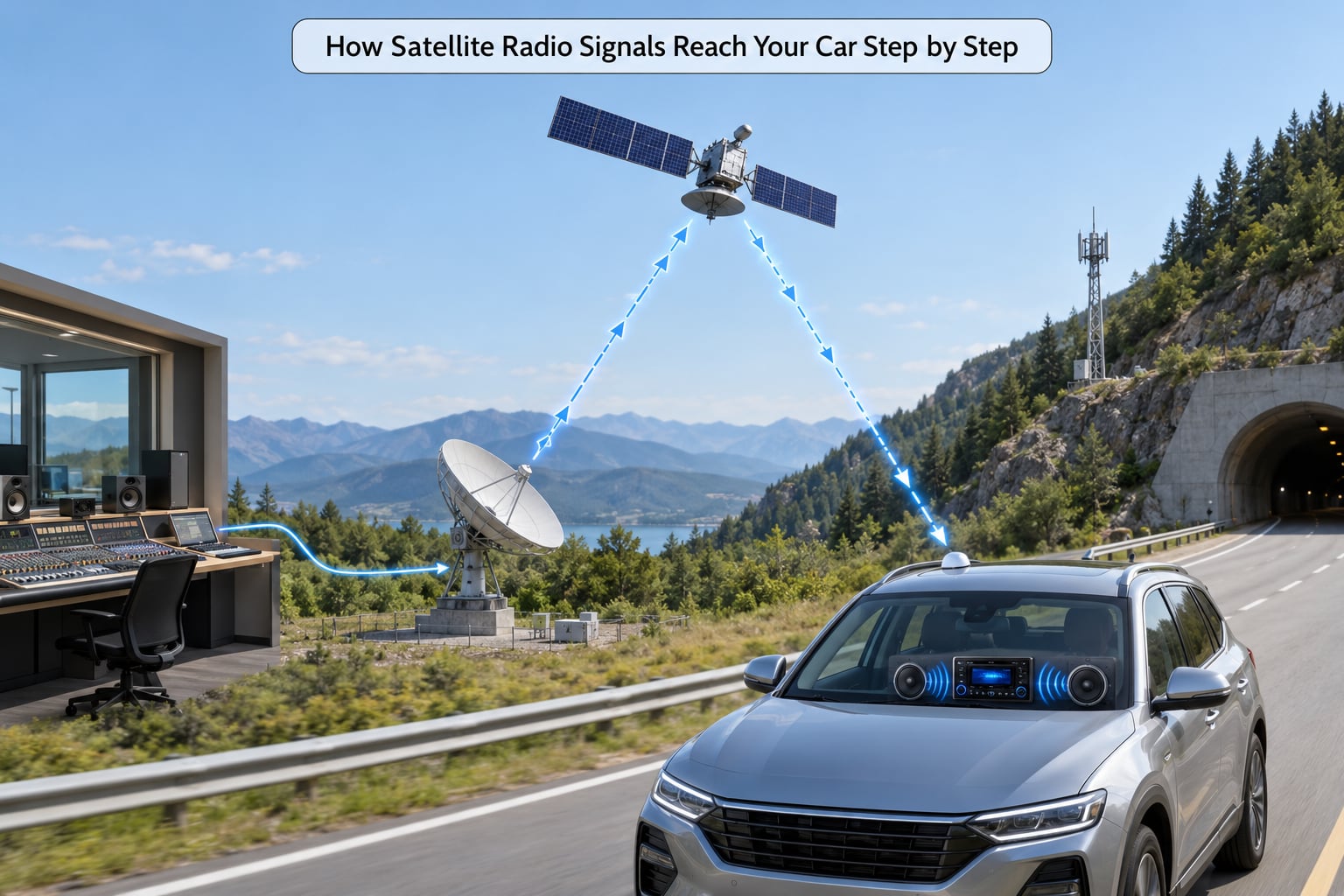
Here is the whole chain, with the hardware named at each hop.
- The studio. A host, a microphone and a mixing desk produce the channel. Digital audio is encoded and compressed into a continuous data stream, then carried by fibre to the network’s broadcast operations centre.
- The uplink earth station. A large dish on the ground converts the stream into a microwave beam pointed at the satellite currently serving North America. Only a handful of these stations exist, and they are heavily protected sites.
- The satellite in orbit. At roughly 22,000 miles up, the satellite receives the beam, amplifies it and broadcasts it back down across a footprint covering much of the continent.
- The down link, direct or relayed. Your car’s antenna can usually see the satellite directly. Where it cannot, a terrestrial repeater has already received the same feed and is re-broadcasting it a few miles away.
- The car antenna. A small flat antenna, often no bigger than a dinner plate and usually sitting on the roof or behind the rear glass, picks up whichever source the receiver is currently using.
- The receiver and tuner. The head unit demodulates the signal, corrects errors, decompresses the audio and selects the channel you asked for. When direct and repeater signals are both present it blends or switches between them.
- Audio output. The decoded stereo signal goes to the amplifier and out through the speakers. From that point it is ordinary car audio and behaves exactly like any other source.
Steps one to four happen before your car is involved at all. Everything from the antenna inward is your side of the deal, which is why the same subscription works in a hired car and fails in a specific vehicle with a damaged antenna.
What Does the Antenna in Your Car Actually Receive?
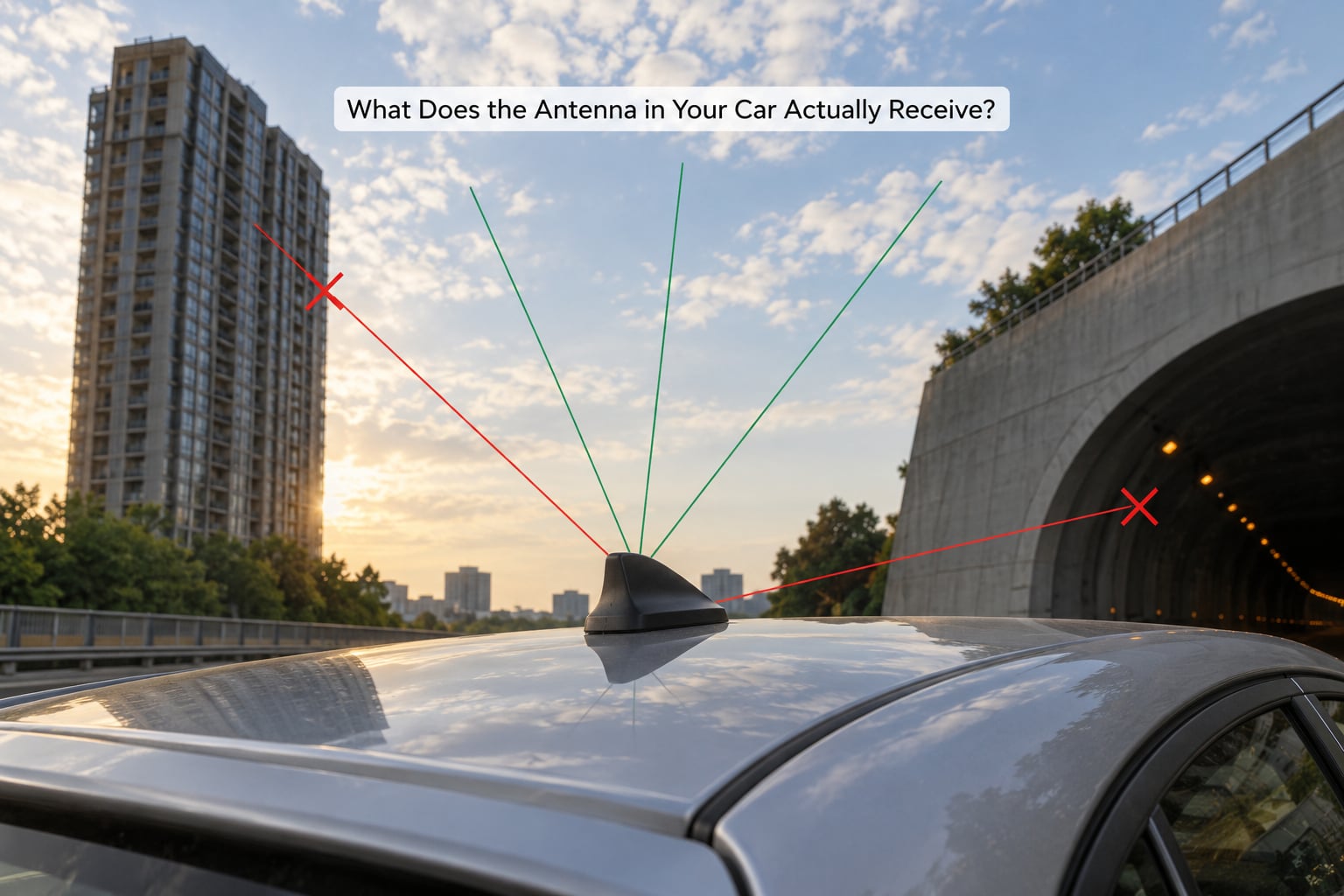
The antenna is the part most owners never think about, and the part that decides whether reception is good. It is a small phased-array receiver tuned to S-band, designed for a metal roof rather than a glass one.
Several things follow from that design:
- It needs sky. The satellite sits low enough in the sky that buildings matter. A downtown street with 40-storey towers on both sides is close to a worst case.
- A metal roof helps. The roof acts as a ground plane, which improves gain and cuts interference. Many cars use a shark-fin or sail-fin housing behind the rear glass on models with less roof metal, and reception is usually acceptable but not exceptional.
- Nearer vehicles hurt. A wall of parked cars or a tanker beside you at a junction is enough to drop a marginal signal.
- It receives, it does not transmit. Nothing is sent back to the satellite from your car. If someone tells you the satellite radio in your vehicle reports where you are, they are describing something else.
What the antenna cannot do is fix a physical fault. A lift-truck strike, a stone chip, a roof rack fitted without the correct fixings or a failed amplifier module all produce the same symptom: no signal at all, or a display that searches forever.
How the Car Radio Turns the Signal Into Sound
Turning a radio wave into music takes four steps inside the head unit: tuning, decoding, selecting and processing.
Tuning is automatic. On power-up the receiver looks for the satellite signal, works out which satellites are in view and locks to the strongest. Decoding turns the raw bits back into compressed audio frames, using error correction to repair the small losses that occur in marginal conditions. Channel selection is the mapping from the channel number on your display to the right audio stream inside that stream. Processing then handles volume, tone, noise reduction and the fade between satellites.
What you can actually see and control
Most drivers interact with only a handful of things: the audio source button, which usually cycles through FM, AM, SiriusXM and any source plugged into USB or Bluetooth; the channel list, sorted by channel number, name, artist or category; the display showing artist and track title sent as data alongside the audio; and traffic or weather alerts by region, delivered the same way as the music.
That data channel is worth knowing about, because it explains something people notice. SiriusXM knows which channel you are tuned to in order to send the right song title, but a subscription radio receiver cannot be used to send anything back.
Why Satellite Radio Reception Can Weaken
Most weak-signal complaints fall into a handful of causes, and checking them in order saves a lot of guessing.
Obstruction. Tunnels, underpasses, bridges, multi-storey car parks and dense city blocks are the classic cases. A short one is hidden by the buffer. A long one is not.
A garage or covered driveway. There is no satellite visible from underground and usually no repeater inside the structure, so the radio goes silent while FM next door keeps playing. This is the single most common question on car forums and the answer is always the same: the FM band reaches you because it bounces, S-band does not.
Antenna damage or a poor mount. Intermittent fading reported by owners across several car forums often traces to a loose or corroded antenna base rather than the network. A roof-mounted unit that has been knocked, or one refitted after a roof repair, is worth checking first.
A receiver that was never activated. A head unit marked satellite ready may have the antenna and the wiring but no active subscription, in which case it will show no signal indefinitely. Owners report paying for a subscription after a software update before noticing the receiver module was never fitted.
Short-term network or satellite events. Occasionally a satellite is taken out of service for maintenance or a network feed is interrupted. SiriusXM usually switches the affected channels to another satellite or feeds them from the ground, so you see nothing, but a brief interruption is possible.
The order I would check in is: is the antenna physically sound and properly mounted, is the unit actually active, does the problem follow the car to a different car, and does it follow the car to a different place. That last question separates a vehicle problem from a network one in about a minute.
Satellite Radio vs FM and Internet Radio
| Feature | Satellite radio | FM radio | Internet radio and streaming |
|---|---|---|---|
| Typical coverage | Continental North America, rural roads included | Local transmitter, usually tens of miles | Anywhere with mobile data or Wi-Fi |
| Signal in a tunnel | Relays and buffering cover short structures, not long ones | Usually drops out | Works if the phone keeps data in the tunnel |
| Audio quality | Consistent digital audio across the whole network | Varies with distance and interference | Highest quality, but codec and connection dependent |
| Data used | None, audio arrives over the air | None | Continuous, can be several hundred megabytes an hour |
| Subscription | Paid monthly or annual | Free, advertising supported | Free with ads, or paid with ads removed |
| Equipment needed | Antenna, receiver and active subscription | An ordinary car radio | A phone, a data plan and a connection to the car |
| Available in the UK | No | Yes | Yes |
Read it as a trade-off rather than a ranking. Satellite radio wins on consistent audio over distance and on being independent of your phone. Streaming wins on channel choice and on working anywhere with a connection. FM is still the simplest thing in the car, which is why it does not feel like a contest most days.
Frequently Asked Questions
Do satellite radios need a clear view of the sky?
Yes. The S-band signal does not bend around obstacles, so the antenna needs a reasonably open view of the sky in the direction of the satellite. Open motorway driving, farmland and suburbs are fine. Deep street canyons, tunnels and underground car parks are not. That limitation is the reason the network also uses ground repeaters and a short audio buffer.
Why does my satellite radio lose reception in a parking garage?
Concrete and soil block S-band signals completely, and a garage roof sits between your antenna and the satellite. Longer structures also carry no repeater, so the receiver has nothing to lock onto and falls silent. An FM radio in the same spot keeps working because FM waves bounce off walls and floors. Drive out and it returns within seconds.
Can satellite radio work outside the United States?
The North American satellite radio networks broadcast from satellites serving the United States, Canada and Mexico, so the service does not reach Europe. UK and European drivers who want similar coverage use DAB digital radio, which works well across most of the country, or internet radio through a phone connection. SiriusXM subscriptions are tied to their coverage region.
Does a longer car antenna improve satellite reception?
Not usually. The factory roof or shark-fin antenna is designed and tuned for the frequency band the receiver uses, and swapping it for a longer mast antenna aimed at the sky will not add gain. What does help is keeping the original unit clean, properly mounted and free of damage, and avoiding metal roof racks that sit directly above it.
Why does my satellite radio work but internet radio does not?
Satellite audio arrives over radio waves from space and needs no mobile data, so it plays anywhere with a view of the sky. Streaming needs a continuous data connection, and that is lost in underground car parks, lifts and rural areas with no bars. If your phone plan has a data cap that has run out, streaming stops while the satellite channel carries on.
Conclusion: Start with the Signal Path
The path is short once you know it: studio, uplink, satellite, down link or repeater, roof antenna, receiver, speakers. Everything before the antenna belongs to the network, and everything from the antenna inward belongs to your car.
So when reception gets weak, start at your side of that line. Check the antenna is clean and firmly mounted, confirm the receiver is genuinely active rather than just satellite ready, and then judge whether the problem follows the car or the place. If the same spot silences every car, it is the geometry of the buildings, not your equipment.