Here is the short answer to how FM frequencies are spaced in the United States: FM broadcast stations sit on a fixed grid that starts at 88.1 MHz and steps up by 200 kHz, or 0.2 MHz, all the way to 107.9 MHz. That is why your dial shows 88.1, 88.3, 88.5 and skips every even number in between.
The rule is not arbitrary. Each station gets a slice of spectrum wide enough to hold the whole FM signal, and the slices are laid down edge to edge with a small unused margin so neighbouring stations do not crash into each other.
Everything else you notice about FM — the odd decimals, the static between stations, the way a strong signal takes over from a weak one — falls out of that one spacing decision.
Table of Contents
- How FM Frequencies Are Spaced on the Dial
- What Do kHz and MHz Mean?
- Why Do US FM Stations Use Frequencies Such as 101.1 and 101.3?
- How Wide Is an FM Channel?
- Does 200 kHz Spacing Prevent Stations From Overlapping?
- How Do FM Station Numbers Work in Other Countries?
- Why Do FM Stations Sound Better at Very Close or Very Distant Locations?
- How Can You Find and Tune an FM Station?
- FM Frequency Spacing: Key Facts at a Glance
- Frequently Asked Questions
- Why are FM stations usually on odd-numbered frequencies?
- Can you tune an FM station between 101.1 and 101.3 MHz?
- Why does an FM station disappear when I move near another station?
- Are FM frequencies spaced 100 kHz or 200 kHz apart?
- What is the highest frequency on the US FM radio band?
- Does a wider FM channel mean the station has better sound quality?
- Conclusion
How FM Frequencies Are Spaced on the Dial
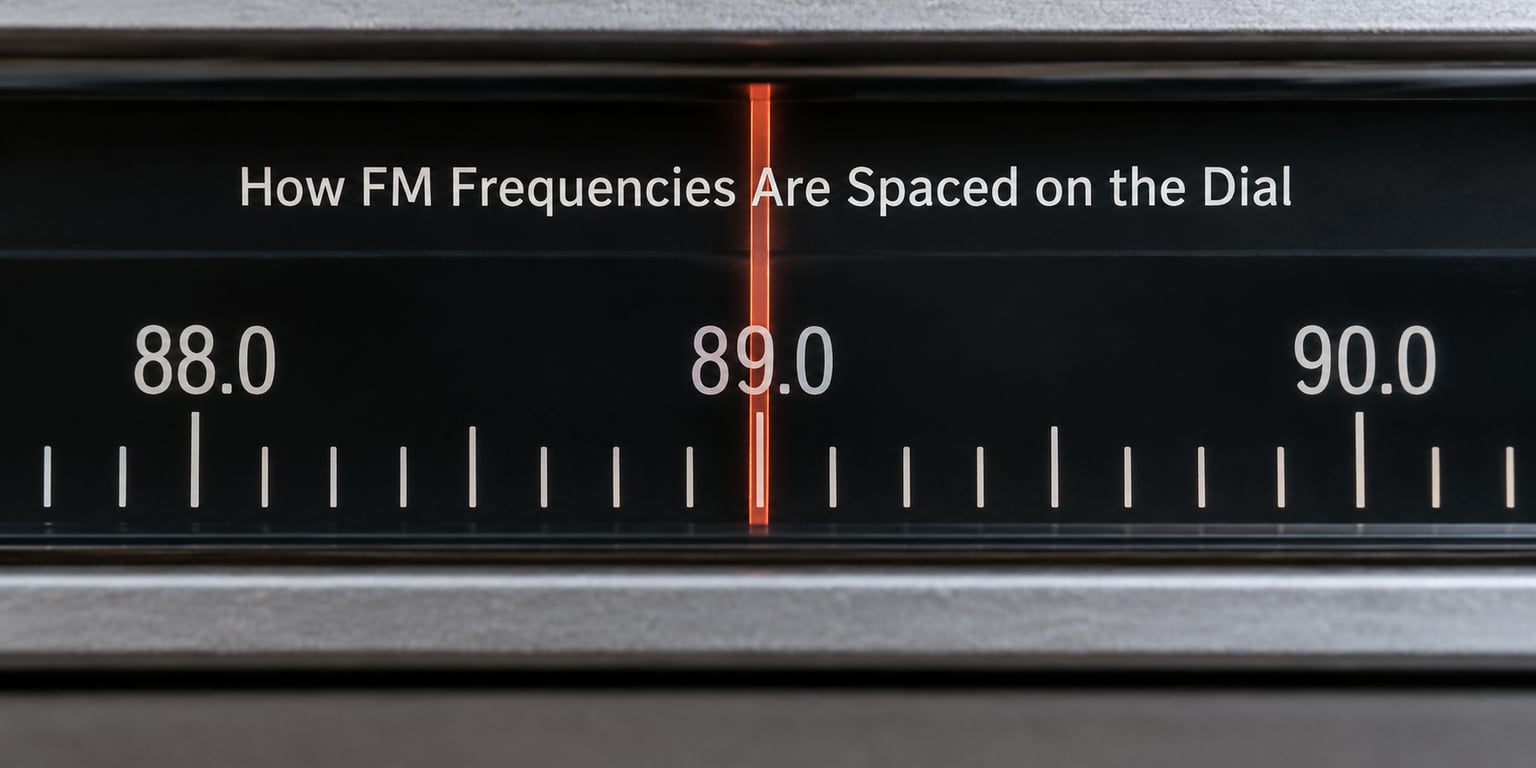
FM channel spacing in the US and Canada is 200 kHz. The band opens at 88.1 MHz and the last channel sits at 107.9 MHz, which gives exactly 100 channels. Engineers call that fixed set of positions the channel raster.
Counting up from 88.1, the next slots are 88.3, 88.5, 88.7, 88.9, then 89.1 and so on. A station is licensed to transmit only at the centre of its slot, which is why dial positions always carry an odd tenth and an odd hundredth.
Not every slot has a station on it. In most markets you will find a couple of empty positions, often at the top or bottom of the band, simply because no one applied for that frequency or the licence went unused.
The US regulatory text for this is short and worth quoting, because it is the whole rule: channels for FM broadcast stations begin at 88.1 MHz and continue in successive steps of 200 kHz to and including 107.9 MHz. That comes from 47 CFR 73.310, the FCC’s technical definitions for FM broadcasting.
What Do kHz and MHz Mean?
Both units describe the same thing, frequency, just at different scales. A megahertz is a million cycles per second, and a kilohertz is a thousand. One MHz is therefore 1000 kHz, which is how a dial position and a channel width end up in different units.
When you read a station frequency, you are reading MHz. When you read how far apart the stations are, you are reading kHz. 101.1 and 101.3 are two MHz readings that are 0.2 MHz apart, and 0.2 MHz equals 200 kHz.
| Quantity | Value | Same thing in other units |
|---|---|---|
| One FM channel step | 200 kHz | 0.2 MHz |
| US FM band | 88.1 to 107.9 MHz | 100 channels of 200 kHz |
| UK and European band | 87.5 to 108 MHz | 205 channels of 100 kHz |
| Station carrier deviation | 75 kHz either side of centre | 150 kHz peak to peak |
| AM channel step in the US | 10 kHz | 0.01 MHz |
FM is also a VHF band. Very high frequency covers roughly 30 MHz to 300 MHz, so the FM broadcast band sits comfortably inside VHF Band II, the same neighbourhood used by air ambulance radios and amateur transceivers.
Why Do US FM Stations Use Frequencies Such as 101.1 and 101.3?
Because the channel centres land halfway between the round numbers. The band is divided into 100 kHz slices, and each 200 kHz channel takes two of those slices, so its centre always falls on the odd tenth of a megahertz.
Think of the band as a ruler marked in 100 kHz divisions. Slice one is 88.0 to 88.1, slice two is 88.1 to 88.2, and so on. A station sits in the middle of two slices rather than on a division line, which puts its centre at 88.1, then 88.3, then 88.5.
This is the answer to the most common FM puzzle. Search results are full of people asking why radio stations only sit on odd numbers, and the answer is simply that the band edges fall on round numbers while each station is centred half a channel above the line below it.
Here is how that raster looks once you map each position to the FCC channel number used on paperwork and engineering diagrams.
| Centre frequency | FCC channel | Note |
|---|---|---|
| 87.9 MHz | 200 | Reserved non-commercial educational slot |
| 88.1 MHz | 201 | First commercial channel |
| 89.1 MHz | 206 | Five channels per MHz |
| 90.1 MHz | 211 | |
| 91.1 MHz | 216 | Top of the reserved band |
| 92.1 MHz | 221 | |
| 94.1 MHz | 231 | |
| 96.1 MHz | 241 | Mid-band |
| 98.1 MHz | 251 | |
| 100.1 MHz | 261 | |
| 101.1 MHz | 266 | Your worked example |
| 103.1 MHz | 276 | |
| 105.1 MHz | 286 | |
| 107.1 MHz | 296 | |
| 107.9 MHz | 300 | Last channel on the band |
One detail worth knowing: 87.9 MHz is a real FM assignment sitting below the commercial band, reserved for non-commercial educational stations. It falls inside the television channel 6 range, which is why almost no ordinary FM radio in North America will tune to it.
How Wide Is an FM Channel?
The 200 kHz slot is the space allocated to a station. The signal actually occupies a narrower slice in the middle of it, which is what the broadcasting rules call occupied bandwidth.
Inside the slot you find the carrier at the centre, frequency modulation of up to 75 kHz either side of it, a 38 kHz subcarrier added for stereo, and the subcarrier group carrying station names and traffic data. Add the highest audio frequency and Carson’s rule tells you how much spectrum the whole thing needs.
| Part of the signal | What it does | Size |
|---|---|---|
| Carrier | Carries no audio of its own, it is the reference the receiver locks onto | Sits at the centre frequency |
| Deviation | The audio is carried by swinging the carrier up and down | 75 kHz either side of centre |
| Audio bandwidth | The highest audio tone the station actually transmits | 15 kHz |
| Stereo subcarrier | Holds the left-minus-right signal above the audio band | 38 kHz |
| Data subcarrier | Carries station name and traffic reports | 57 kHz |
| Occupied bandwidth | Total spectrum the signal takes up under Carson’s rule | About 180 to 200 kHz |
| Channel slot | The allocated piece of the band around that signal | 200 kHz |
Carson’s rule simply adds the peak deviation to the highest audio frequency and doubles the result. With 75 kHz of deviation and 15 kHz of audio that lands at 180 kHz, which fits comfortably inside the 200 kHz slot and leaves the guard band you need either side.
Does 200 kHz Spacing Prevent Stations From Overlapping?
Spacing is the first line of defence, not the only one. The channel slots give each station a defined lane, the transmitter filters keep its emissions inside that lane, and the receiver adds selectivity so anything outside it gets rejected.
The gap between the occupied signal and the edge of the channel is the guard band, and it exists for a practical reason: real filters are never perfect, so broadcasters leave margin rather than pushing right up to the boundary.
What capture effect has to do with it
Capture effect is why an FM receiver you tune slightly off centre still sounds clean rather than noisy. Once the wanted signal is strong enough relative to anything on the same frequency, the receiver simply ignores the weaker one, so you go from mush to full audio within a fraction of a megahertz.
That is also why adjacent-channel problems are so much worse than co-channel problems. Two stations on the same frequency fight it out and capture lets one win cleanly. Two stations 200 kHz apart are a different story: both are close enough to pass through the receiver’s filters, and you get the fluttering, pumping noise that listeners describe as one station mixing into another.
The 10.7 MHz image frequency quirk
Most FM receivers are superheterodyne sets that convert the wanted station down to a fixed intermediate frequency, usually 10.7 MHz. The local oscillator that does the conversion also produces a signal that can leak out and be picked up by another receiver nearby.
Because the oscillator sits 10.7 MHz above the frequency you have tuned, a set on 88.1 MHz has an oscillator near 98.8 MHz, which lands right on the 98.7 FM slot. A thread on radiodiscussions.com traced a puzzling case of one station blanketing another to exactly this effect.
It is a nice illustration of how spacing creates the numbers that make receiver quirks visible. The odd decimals are not decoration; they are the fixed points that the 10.7 MHz arithmetic lands on.
How Do FM Station Numbers Work in Other Countries?
Spacing is not a global standard. The 200 kHz raster is the North American plan, and most of the rest of the world uses a different grid, which is why a car radio that works perfectly at home can sound wrong when you drive abroad.
| Region | Band | Channel spacing | Notes |
|---|---|---|---|
| United States and Canada | 88.1 to 107.9 MHz | 200 kHz | Odd decimals, 100 channels |
| UK, Europe, much of Asia and Africa | 87.5 to 108 MHz | 100 kHz | Even positions such as 88.8 exist here |
| Italy | 87.5 to 108 MHz | 50 kHz | Finer grid, needs a capable receiver |
| OIRT band, Eastern Europe and Russia | 65.8 to 74 MHz | 25 to 30 kHz | A different band entirely |
| Japan | 76 to 90 MHz | 100 kHz | Imports need a converter |
The European 100 kHz plan is the one UK listeners meet most often. Positions like 88.8 and 89.5 are perfectly normal there, which is why a traveller with a locked-out American head unit can miss a perfectly good station.
Italy’s finer grid and the old OIRT spacing are special cases, but they explain why a modern digitally tuned receiver often steps in 50 or 100 kHz increments rather than jumping straight from one 200 kHz slot to the next.
Why Do FM Stations Sound Better at Very Close or Very Distant Locations?
Being near a transmitter is not always better. Sit right next to one and the signal can be so strong that the receiver’s own circuits are stretched, producing overload, crackle and distortion that sounds worse than a moderate signal a few miles away.
At the other end of the scale, stations on the same frequency reach you from far away through tropospheric ducting or Sporadic E propagation, arriving by two different paths. The two copies interfere with each other and you get the fast flutter that listeners often mistake for wind on the antenna.
That is why engineers keep the same channel out of a market wherever possible. Reusing a frequency too close together is called co-channel interference, and in practice it means two stations on 98.1 serving overlapping areas, which sounds like two programmes talking at once rather than one station fading.
What interferes with an FM signal
- Other stations on nearby channels when one is far stronger than the other
- The same station arriving by two propagation paths, causing flutter
- Nearby electronics that leak RF, including poorly shielded gear and switched power supplies
- Overload from a strong local station sitting on an adjacent channel
- Receiver image responses tied to the 10.7 MHz intermediate frequency
- Aerial faults, loose car roof connections and long runs of thin cable
How Can You Find and Tune an FM Station?
Most tuning problems come down to expecting a frequency that does not exist on the local raster. A few habits make it quick.
- Read the display to three decimals if your radio offers that. 101.30 is the same as 101.3, and it confirms you are looking at a real channel rather than a memory of one.
- Use the seek or scan function to sweep the band, then press select to stop on what you want. Presets store the exact frequency rather than a position on a scale.
- If a station fades as you drive, note whether the display reads 0.0 rather than 0.2. A receiver sitting 100 kHz off centre will still produce sound, just bad sound.
- Check the region setting on the head unit. Many import or aftermarket radios are locked to their home country’s band plan and will refuse 87.5 MHz or skip European even positions.
- Look for station names appearing on the display. Broadcast FM sends those names over the data subcarrier, while HD Radio stations sit on a sideband next to an analogue channel and may only appear on a compatible receiver.
- If nothing is on at all in your area, an internet stream or DAB+ digital radio may simply be the realistic option.
One oddity to expect: pressing down past 88.1 MHz on a North American set does nothing, while 87.9 MHz sometimes responds on receivers that include the reserved educational channel. It is not a fault and usually nothing is transmitting there.
FM Frequency Spacing: Key Facts at a Glance
Here is the whole rule set on one page, which is handy for anyone reading this on a phone in a car park full of overlapping stations.
| Fact | Value |
|---|---|
| US and Canadian FM band | 88.1 to 107.9 MHz |
| Channel spacing | 200 kHz, or 0.2 MHz |
| Number of channels | 100, numbered 201 to 300 |
| Reserved slot below the band | 87.9 MHz, channel 200 |
| UK and European band | 87.5 to 108 MHz at 100 kHz spacing |
| Peak deviation | 75 kHz either side of centre |
| Occupied bandwidth | About 180 to 200 kHz |
| Audio bandwidth carried | 15 kHz |
| Stereo subcarrier | 38 kHz above the carrier |
| Receiver intermediate frequency | 10.7 MHz |
| AM comparison, US | 10 kHz spacing on 530 to 1700 kHz |
Set against AM, the contrast is stark. AM stations sit 10 kHz apart on the medium wave band and fit about 100 channels into the same span that gives FM a single one, which is part of why AM audio sounds narrow and FM sounds wide.
Frequently Asked Questions
Why are FM stations usually on odd-numbered frequencies?
Because each 200 kHz channel is centred between two 100 kHz divisions of the band. The grid is marked in 100 kHz steps starting at 88.0 MHz, and a station sits in the middle of two divisions. That puts its centre at 88.1, then 88.3, then 88.5, so the last two digits are always odd. It is why 88.2 and 88.4 do not exist as channels in North America.
Can you tune an FM station between 101.1 and 101.3 MHz?
Not on a standard channel. There is no station licensed to 101.2 MHz in North America because that sits on the boundary between two 200 kHz channels. Tuning there gives you the worst of both, a mixture of two carriers rather than clean audio. If you are in Europe, 101.2 MHz may be a perfectly valid station on the 100 kHz grid, so the answer depends on which band plan your country uses.
Why does an FM station disappear when I move near another station?
A very strong local signal on a nearby channel can overload the receiver’s front end, and the gain collapses so the station you wanted drops out. The same thing happens on the same frequency in reverse, where capture effect makes the stronger station simply win. Moving the aerial away from the offending transmitter, or using a weaker antenna with an amplifier closer to it, usually restores the quieter station.
Are FM frequencies spaced 100 kHz or 200 kHz apart?
In the United States and Canada it is 200 kHz, giving 100 channels between 88.1 and 107.9 MHz. The UK, most of Europe and much of Asia use 100 kHz spacing across 87.5 to 108 MHz, so even positions such as 88.8 MHz are normal there. Some countries use finer grids still, with Italy at 50 kHz and parts of Eastern Europe historically using about 30 kHz.
What is the highest frequency on the US FM radio band?
107.9 MHz, which is FCC channel 300 and the last slot on the 200 kHz raster. The next step of 0.2 MHz would put a station at 108.1 MHz, outside the broadcast allocation, so the band stops there. UK and European sets run to 108.0 MHz, which is a different band plan rather than an extension of the US one.
Does a wider FM channel mean the station has better sound quality?
No. A wider slot would only mean more unused spectrum. What determines audio quality is how well the station uses the 200 kHz it already has: clean 15 kHz audio, full 75 kHz deviation and a low noise floor all matter far more than channel width. That is why some stations fill the same 200 kHz slot and sound thin while others sound excellent.
Conclusion
FM frequencies are spaced on a 200 kHz channel raster that starts at 88.1 MHz and ends at 107.9 MHz in the US and Canada, which is why every dial position ends in an odd decimal. Start with 101.1 MHz as the example: the next slot is 101.3 MHz, exactly 200 kHz higher, and 101.2 is not a channel at all.
If a station sounds wrong, tune back to the exact odd decimal before anything else. Most complaints about FM quality turn out to be a receiver sitting 100 kHz off centre or an overloaded front end near a powerful transmitter, not a spacing problem.