
Music recommendation algorithms learn your taste by watching what you play, skip, save and repeat, then finding other listeners whose habits look like yours and recommending what they kept. It is a continuous loop, not a finished profile, and every skip or save you make nudges it.
Most people assume the software reads their mind. It does not. It keeps a running tally of behaviour, converts that tally into numbers, and ranks candidates against those numbers hundreds of times a day. Understanding the loop matters because the actions you think teach it something and the actions it actually weights are not always the same.
I have watched the same thing happen on a radio playlist switch. Two weeks of listening quietly reshapes the recommendations, and most of that reshaping comes from behaviour nobody consciously chose. This guide walks through the whole chain, from the signals a service collects to the levers you actually control.
Table of Contents
- What Are Music Recommendation Algorithms?
- What Data Do Recommendation Systems Collect?
- How Music Recommendation Algorithms Learn Your Taste
- Why Does a Recommended Song You Did Not Request?
- How Does Your Feedback Change Future Recommendations?
- How Do Mood, Time, and Listening Context Matter?
- How Do Algorithms Group Listeners with Similar Taste?
- How Much of Your Taste Can the System Infer?
- How Do Recommendation Algorithms Affect Music Discovery?
- Can You Change or Reset Your Recommendations?
- What Privacy Choices Should Music Listeners Make?
- Frequently Asked Questions
- How do music streaming services know what I like?
- Does skipping a song mean an algorithm thinks I dislike it?
- Why does a music app keep recommending similar artists?
- How can I discover music outside my usual streaming recommendations?
- How do I reset personalized recommendations on a music streaming service?
- Conclusion
What Are Music Recommendation Algorithms?
A music recommendation algorithm is a set of machine-learning models that rank songs by how likely you are to finish one, save it or play it again. Major streaming services all run some version of them, and they power the personalised playlists rather than the hand-built editorial lists.
Two kinds of recommendation sit side by side inside most apps. Editorial playlists come from real people: a curator listens to submissions, builds a story and writes a blurb. Automated recommendations come from models trained on listening data, so the list is different for you every time you open it. You can usually tell which is which from the artwork, but the difference matters, because only the second kind is a prediction.
Most major services now mix both. Editorial teams seed playlists for new releases, and the ranking system decides where each track sits inside the personalised version. Radio play follows a third logic entirely: a human music director balances requested songs, familiar hits and unfamiliar material inside a fixed hour.
So when you ask how music recommendation algorithms learn your taste, the honest answer is that they never read a preference list. They read patterns in what your thumb does.
What Data Do Recommendation Systems Collect?
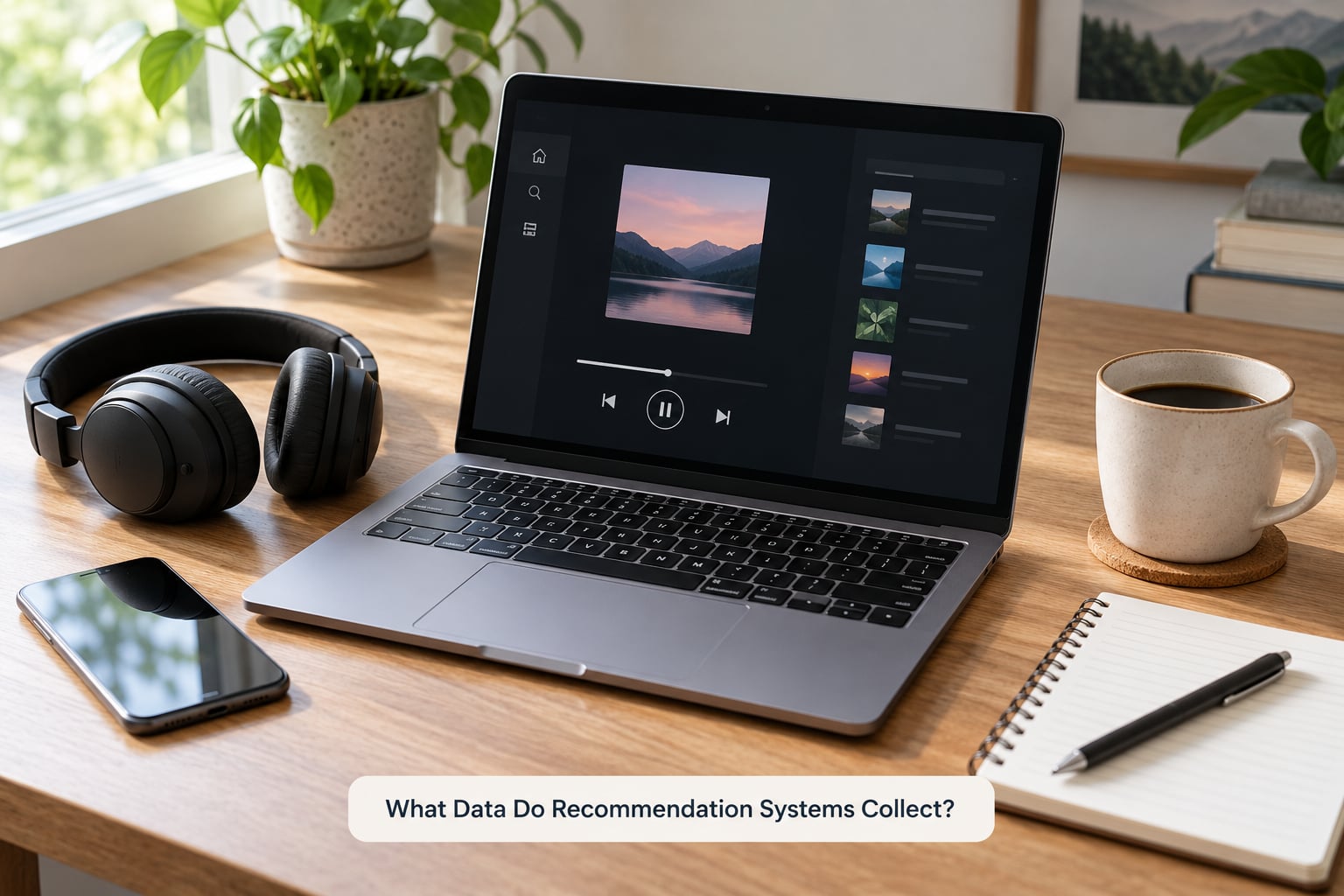
Data splits into two families. Explicit feedback is a deliberate act: liking a song, saving it to your library, adding it to a playlist, following an artist, marking a track as not interested. Implicit feedback is everything you did not mean to signal: starting a track, abandoning it twenty seconds in, replaying one you have heard fifty times.
Most weight in modern systems sits with implicit feedback, simply because there is far more of it. You skip hundreds of tracks a week and actively rate a handful.
| Signal | Type | What the model reads from it |
|---|---|---|
| Play started | Implicit | Weak positive interest in the track and its neighbourhood |
| Partial listen, then skip | Implicit | Mild negative; stronger if it repeats on the same track |
| Full listen to the end | Implicit | Clear positive, much stronger than simply starting a song |
| Immediate replay or loop | Implicit | One of the strongest positives available |
| Save to library | Explicit | Intention to return; treated as a strong long-term signal |
| Add to playlist | Explicit | Positive plus a hint about listening context |
| Like or thumbs up | Explicit | Strong positive, and often boosts similar content for weeks |
| Dislike or not interested | Explicit | Strong negative, usually applied to the track and similar tracks |
| Searches and rejected results | Implicit | What you looked for, plus what you scrolled past |
| Listening time of day | Context | Morning focus versus late-night listening |
| Device and session | Context | Phone commute, kitchen speaker, long desktop session |
| Location | Context | Travelling and local context where the service has permission |
Some of that is genuinely useful. Knowing you play instrumental hip-hop at 7am instead of metal at the gym is not surveillance, it is just accurate personalisation.
Other signals sit closer to the uncomfortable line. Precise location and voice assistant transcripts are not needed to rank a song, and each service draws that line differently. We will come back to that at the end.
How Music Recommendation Algorithms Learn Your Taste
The full loop has seven stages, and they repeat every time you press play. Here is the sequence that answers the question directly.
- Collect signals from plays, skips, saves, searches and context.
- Build a taste profile, a numeric fingerprint called an embedding that places you in taste space.
- Generate candidates from your library, similar sessions, editorial seeds and new releases.
- Score each candidate against your fingerprint, using both behavioural and musical similarity.
- Rank and filter the shortlist, removing duplicates, filtered artists and anything you rejected.
- Serve the list, letting a small share of experimental picks slip in.
- Update your fingerprint from what you did with that list, then start again.
Step seven is the one that matters most over time. Nothing about your profile is fixed, so a single afternoon of playing something unusual leaves a mark that takes weeks to fade.
How Does the System Turn Listening Behavior into a Taste Profile?
An embedding is a long list of numbers summarising what someone sounds like they like. Picture a listener who plays 1970s soul repeatedly, skips anything with harsh distortion, and saves late-night jazz before bed. The system reads three separate patterns rather than one label.
Soul tracks lift the 60s and 70s part of the profile and pull in similar artists. Skipping metal repeatedly pushes guitar-heavy modern rock down the ranking. Saving jazz adds a quieter, slower mood for evening listening, and because it is a save rather than a play, it carries extra weight as long-term intent.
The same listener then gets a bright morning playlist, a calmer evening one, and occasional guitar suggestions that they usually skip off. Nothing about that is a conscious taste category. It is four or five overlapping patterns pointing in the same direction.
How Do Songs, Artists, and Listeners Get Matched?
Two matching methods do most of the work, and they read completely different things.
| Method | What it reads | Strength | Weakness | Where it appears |
|---|---|---|---|---|
| Collaborative filtering | What listeners with similar behaviour play | Finds songs no one has described yet | Weak on brand new music with no history | Autoplay, Daily Mix, Flow, discovery feeds |
| Content-based filtering | Metadata and audio features of the track | Works immediately, even for a new release | Drifts toward more of what you already like | Similar-artist buttons, artist pages, seeded playlists |
| Hybrid | Both, plus editorial and context signals | Balances discovery with relevance | Harder to explain, easier to tune | Most modern recommendation systems |
Content-based systems rely on metadata such as genre, era, key and tempo, plus audio features measured from the raw signal: danceability, energy, valence, acousticness, instrumentalness and loudness variance. Natural language processing also reads playlist titles and descriptions, which is how a curated list’s editorial framing reaches the model.
Collaborative systems compare behaviour instead. Two people who save the same obscure 1994 album belong to the same corner of taste space, even if one listens only on a laptop and the other in a car. That method finds tracks nobody labelled, which is exactly why it fails on a song nobody has played yet.
Why Does a Recommended Song You Did Not Request?
Because a system that only played confirmed favourites would bore you within a week. Every serious recommender reserves a slice of each session for things it thinks you might tolerate but have not asked for.
There are several reasons a song appears unbidden. Exploration means deliberately testing something with a small chance of appeal. Novelty pushes unknown tracks into the list so they can gather their own signal. Session continuity means a track queued three deep still has influence after you hit play on something else. Availability shapes it too, since tracks in your region catalogue or your plan can rank higher.
And there is a commercial layer. Services tend to promote content that starts well, because a playlist that stalls halfway gets abandoned. Playlists and newer releases often get that early boost for a reason.
One strange recommendation is not evidence the system has you figured out. It is one data point in a loop that runs on partial information.
How Does Your Feedback Change Future Recommendations?
Immediate feedback and long-term preference get treated very differently, and this is where most listener frustration comes from.
A skip is cheap and noisy. People skip while making toast, during adverts, or because a track landed mid-song. So a single skip carries a mild negative, and the weight climbs only if you keep skipping the same record. A save carries far more, because people rarely save something they have no intention of hearing again.
Then there is repetition. Playing the same album for a week is a stronger signal of current intent than it is of core taste, which is why services keep some sessions from rewriting the long-term profile entirely.
So the useful rule is simple. Decide deliberately: skip what you do not want, listen through what you might, save what you actually want back. Listening only to your own library teaches the model much less than the mix you feed it.
How Do Mood, Time, and Listening Context Matter?
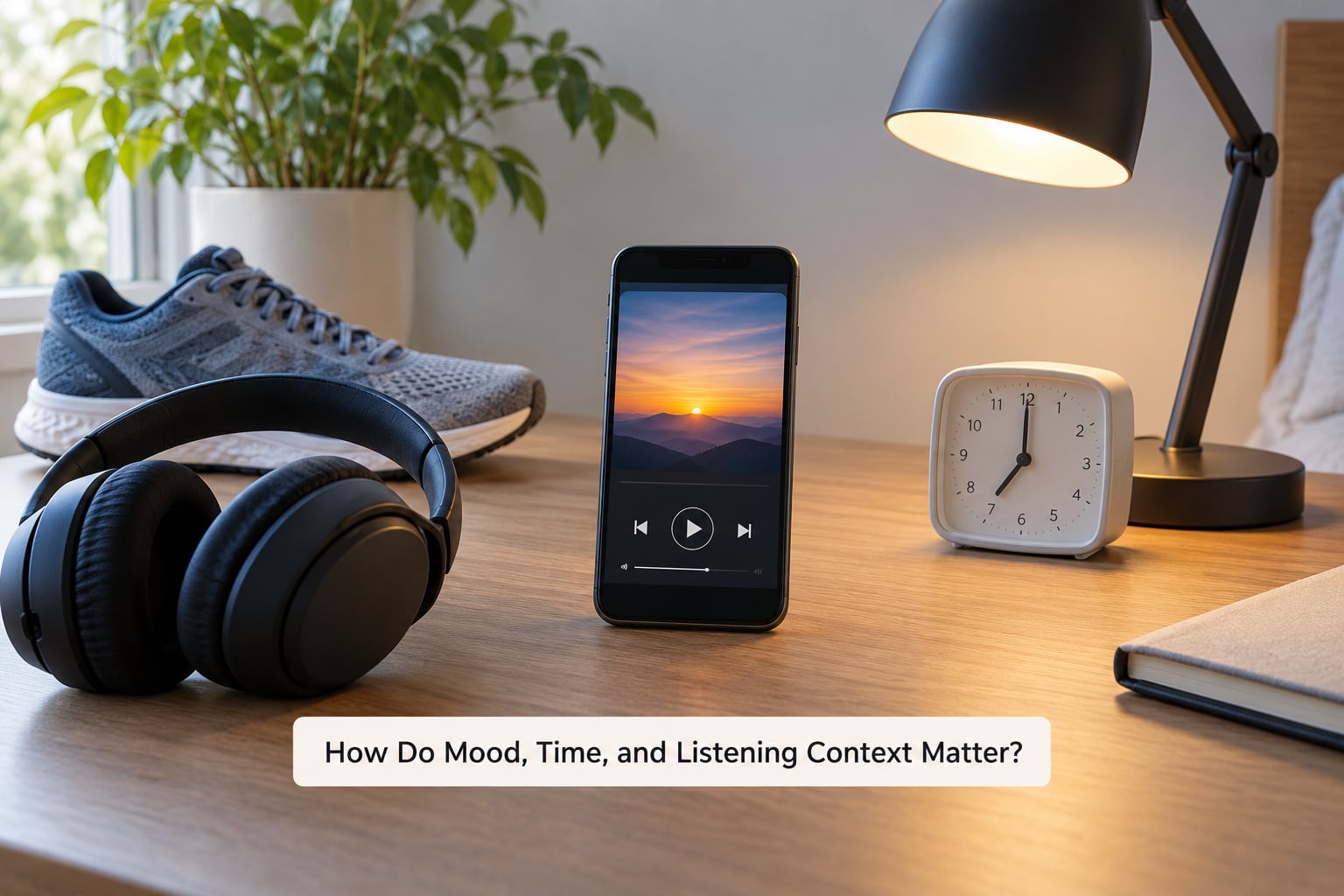
The same person wants upbeat music on a run and something quiet at a desk, and the system knows it. Time of day, session length and device are cheap signals that carry a surprising amount of weight because they change reliably.
Context usually adjusts the current session rather than rewriting your core profile. A 6am session with fast, high-energy tracks and a 10pm session with slower, low-energy music can sit side by side in the same taste profile without conflict.
Location works similarly, and it is the signal most listeners find unsettling. Knowing your music changes in a different city is defensible. Knowing exactly where you were when you pressed play is a different category of information, and it is worth remembering when you decide what permissions to grant.
Some listeners like the context switching. Others find that a commute playlist built on location feels like surveillance with good timing.
How Do Algorithms Group Listeners with Similar Taste?
Collaborative filtering builds a map of listeners rather than songs. Two accounts land in the same area when their listening histories overlap, even if nothing about their accounts matches on paper.
Say two people both play British indie, the same two producers, and a lot of the same late-90s albums. After a month, their recommendation rows start looking near-identical, even though one is 19 and one is 54, in different countries, with completely different jobs. Taste grouping cuts across age and geography more than most people expect.
That cuts both ways. It gets music to listeners who would never find it otherwise, and it means your recommendations quietly drift toward whoever shares your habits, whether or not you would have chosen them as reference points.
It also means moving to a new service is genuinely hard. You arrive with nothing, and for several weeks the system is guessing from whatever you play first.
How Much of Your Taste Can the System Infer?
Less precisely than the confidence of a good playlist suggests. Taste is inconsistent, and the model treats every behaviour as if it meant something.
Contradictions are common. Someone who loves a 1970s concept album at full volume can still skip the same band live. Sparse histories mislead the system badly in the first fortnight. Accidental skips during a phone call get logged like real preferences. Novel tastes get under-weighted because they arrive without supporting history.
Taste also changes. You may have been deep in one scene two years ago and barely listening to it now, but the profile still carries that weight unless enough new behaviour replaces it.
The honest summary is that these systems learn patterns well and intentions poorly. A confident-looking recommendation row is a prediction based on behaviour, not a reading of who you are.
How Do Recommendation Algorithms Affect Music Discovery?
The upside is real. Radio used to mean a small number of human choices, repeated everywhere. A recommendation system puts genuinely unfamiliar music in front of people who would never have requested it, and it does it at a scale no curator could match.
The downside is structural. Systems learn from what worked last time, which pulls toward music already proven with similar listeners. That creates a popularity spiral: popular tracks get recommended, they get played, and that play makes them look more popular still. Small artists with no listening history struggle to enter at all, a problem researchers have linked to reduced diversity in what listeners consume.
The repetition complaint is usually fair. Once a profile settles, the model has good reason to keep serving near-identical tracks, because that pattern performs. Diversity has to be introduced deliberately rather than emerging on its own.
That is why a human-curated local radio playlist still feels different. A music director weighs a request against a new local act against a familiar record, and that judgement is not derived from your listening data.
Can You Change or Reset Your Recommendations?
Yes, and the levers differ in how much they actually move. The most effective steps come first.
- Be deliberate about saves and dislikes. Saves build long-term profile weight; explicit dislikes suppress an artist across similar tracks rather than only the one song.
- Play unfamiliar music fully. Completing something is worth more to the model than a dozen partial plays, and it moves the profile more than repeating familiar tracks.
- Curate playlists by hand. A playlist you build yourself is a strong, clear statement of taste, and many services use it heavily when ranking.
- Break up long unattended sessions. Background listening generates weak, noisy signals. Twenty minutes of deliberate listening teaches more than an evening of radio in the background.
- Use the controls your service provides. Most now offer artist or track exclusions, taste profile screens and refresh buttons, though names and locations move between apps and versions.
- Reset or delete listening history when you want a clean start. This genuinely works: the profile rebuilds from scratch, and expect a few weeks of poor guesses while it settles.
Two things worth sorting out first. A skip does not reliably register as dislike, so use the dislike control if you mean it. And if your complaints are about repetition rather than accuracy, exclusion settings and refresh buttons fix that faster than anything else.
On Apple Music, the long-standing complaint from people switching over is that there is no obvious manual. You teach it by listening, and the answer to the r/AppleMusic question about which signals to use runs through play, save and skip volume rather than a single setting.
What Privacy Choices Should Music Listeners Make?
Personalisation and privacy are a genuine trade-off, not a debate to be won. Turning off everything gives you a service that recommends almost nothing specific. Turning everything on gives you excellent recommendations built from location, voice transcripts and detailed listening logs.
A middle path exists. Most services let you keep recommendation data while limiting precise location and voice-assistant access. It costs you a little contextual accuracy and buys you less location tracking.
Smart speakers deserve particular attention, because they capture voice audio in rooms. Voice assistants also record what you ask while music plays nearby. If that trade is not one you would accept for a convenience feature, turn the microphone off.
Menu paths change often, and features move between app versions. Check each service’s current privacy and personalised-recommendation settings yourself rather than trusting a fixed instruction from an article, including this one.
Frequently Asked Questions
How do music streaming services know what I like?
They watch your behaviour rather than asking you. Plays, partial listens, full listens, replays, saves, playlist additions, skips, searches and context signals such as time of day are all logged, then turned into a numeric taste profile. Recommendations are ranked against that profile. So how music recommendation algorithms learn your taste is mostly a question of which actions carry the most weight: saves, dislikes and replays move a profile far more than a single skip.
Does skipping a song mean an algorithm thinks I dislike it?
Not on its own. Skips are cheap and often accidental, so a single one usually carries a mild negative. Weight builds when you repeatedly skip the same track or artist, which is why a stubborn run of skips does push a song out of your rotation. If you genuinely do not want to hear something, use the dislike or not-interested control instead. That suppresses the artist more widely, across similar tracks.
Why does a music app keep recommending similar artists?
Similar-artist recommendations come mainly from content-based filtering, which reads the music itself: genre, era, tempo, energy, danceability, acousticness and loudness variance, along with metadata and audio features. That method reliably finds tracks that sound alike, which is helpful but inherently repetitive. Discovery feeds work differently, leaning on collaborative filtering and editorial seeds, so switching between them is one way to hear something less predictable.
How can I discover music outside my usual streaming recommendations?
Try four things. Use discovery feeds built on behavioural similarity rather than similar-artist buttons. Search for an artist you already like and follow their connections to collaborators. Build playlists around moods, scenes or decades rather than genres, which pushes the model somewhere new. And check editorial playlists, which are selected by people rather than ranked for you. Hand-built radio playlists from local stations are also a reliable way out of the loop.
How do I reset personalized recommendations on a music streaming service?
Most major services let you delete or reset your listening history, which removes the accumulated profile so it rebuilds from scratch. Expect a few weeks of weaker guesses afterwards. Beyond that, use dislike controls on artists you want gone, adjust the controls offered for excluded artists, and curate a few playlists by hand so the new profile has clear signals. Settings names differ by app and version, so check your service’s current options.
Conclusion
Music recommendation algorithms do not understand your taste, they model your behaviour, and the loop never stops updating. Plays, saves, dislikes and skips carry very different weights, and context decides what a session wants.
Start with the platform you use most. Give clear likes and dislikes, save what you actually want back, listen deliberately instead of letting music run all evening, and check the taste and exclusion controls already sitting in its settings. That is enough to move tomorrow’s recommendations.