To understand how speaker impedance affects sound, start with a definition. Impedance is how much electrical resistance a speaker presents to an amplifier, measured in ohms. A lower number is a harder load: the amplifier has to push more current to move the voice coil.
Impedance is not a quality score. A 4-ohm speaker and an 8-ohm speaker can sound identical if both are well designed, and neither is automatically louder. What changes with impedance is current draw, headroom, distortion behaviour and whether your amplifier stays happy at the volume you actually listen at.
This guide walks through what the numbers mean, how to read an amplifier spec sheet, and how to wire two or more speakers without dropping below the amp’s minimum load.
Table of Contents
- What Is Speaker Impedance?
- How Speaker Impedance Affects Sound
- Why Speaker Impedance Matters for Amplifiers
- Speaker Impedance Ratings Explained
- How to Match Speakers to an Amplifier
- Impedance Matching for Parallel and Series Speakers
- How Speaker Impedance Differs from Sensitivity and Power Handling
- Common Speaker Impedance Mistakes
- Frequently Asked Questions
- Conclusion
What Is Speaker Impedance?
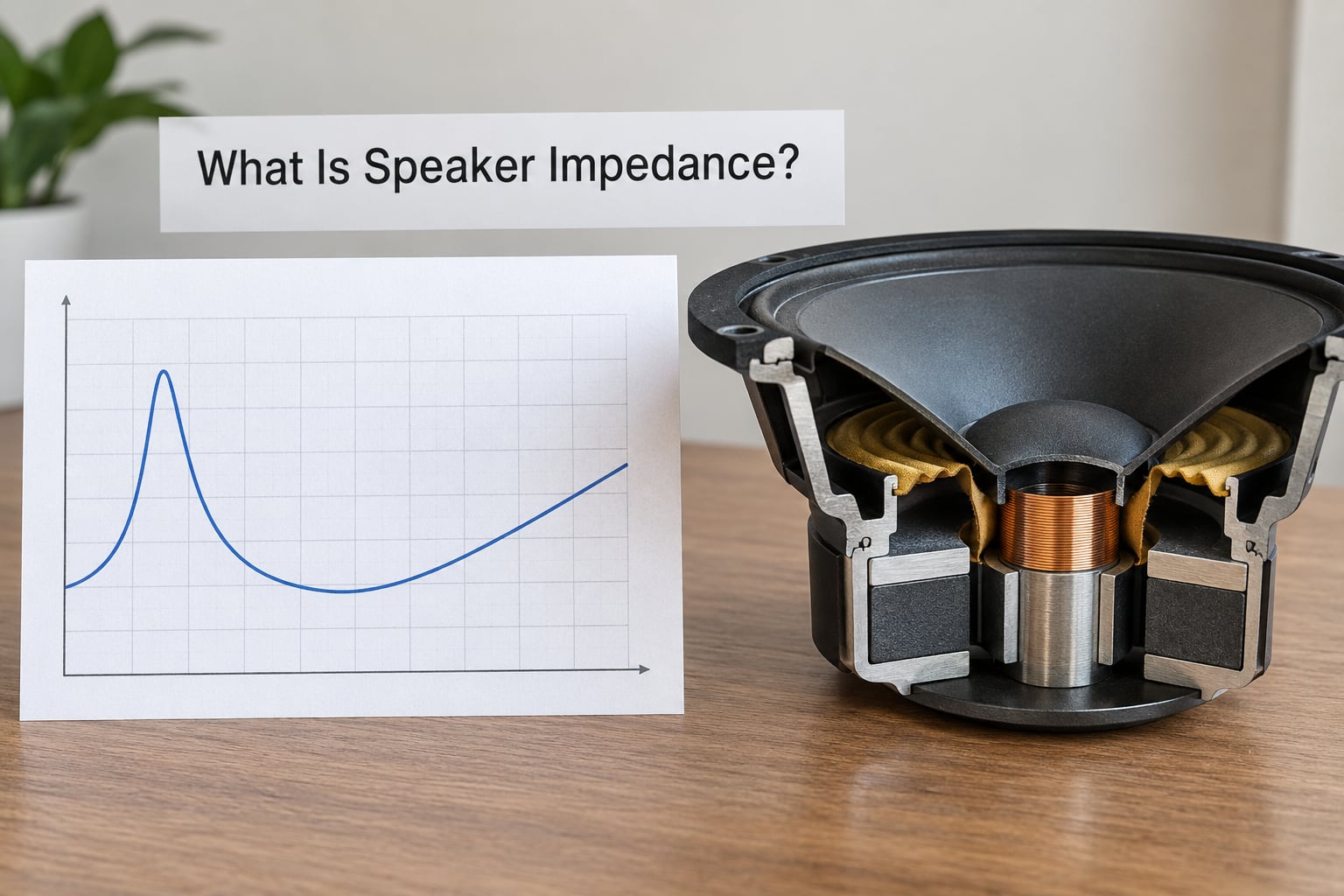
Impedance is the total opposition a circuit presents to an alternating signal, measured in ohms (Ω). A speaker is an electrical load, and impedance describes how hard that load is to drive at each frequency.
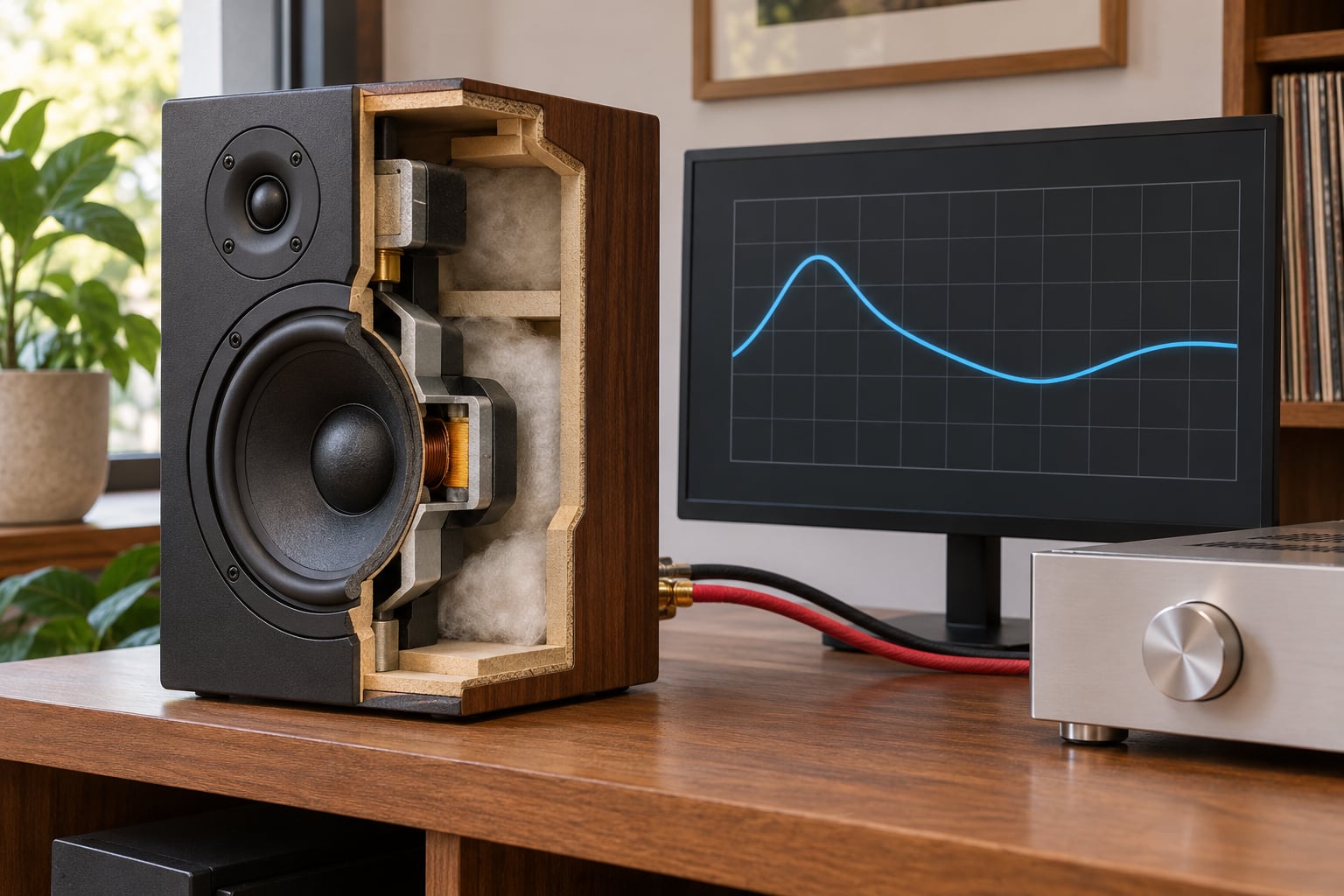
The measurement includes two things. The voice coil wire has plain DC resistance, usually between 3 and 8 ohms depending on the design. On top of that sits reactance: the voice coil behaves like an inductor, and the crossover network adds capacitors and inductors of its own. Those parts react differently at different frequencies, so the total moves.
That’s why an 8-ohm speaker is not a fixed 8-ohm object. It might measure 11 ohms at 80 Hz, dip to 5.5 ohms at 400 Hz, and settle near 8 ohms through the midrange. The number on the box is the nominal rating, a standardised approximation for how the speaker behaves on average.
Standards bodies rate nominal impedance at the point where the speaker draws the most power relative to the lowest impedance dip nearby, then round it. That’s why a speaker labelled 8 ohms can measure 12 at one frequency and 5 at another and still be a perfectly compliant 8-ohm speaker.
How Speaker Impedance Affects Sound
Impedance affects sound mainly through how the amplifier behaves, not through any inherent tonal character of the load.
Ohm’s law does the heavy lifting: voltage divided by current equals resistance. Hold the voltage steady and halve the impedance, and current doubles. Power follows too, so a 4-ohm speaker connected to an amplifier pushes roughly twice the current that an 8-ohm speaker would at the same output voltage.
Where you hear that:
- Maximum volume. An amplifier delivers more current before it runs out of headroom, so a lower-impedance speaker can play louder on the same amplifier.
- Clipping at high volume. Current-limited amplifiers clip early on a low-impedance load. Clipping sounds harsh, compressed and fatiguing long before it destroys anything.
- Bass control. A low-impedance dip in the bass region asks more of the amplifier’s current delivery exactly where demand is highest.
- Protection behaviour. Many receivers sense sustained low impedance and drop into protection, cutting out mid-song.
Where you probably won’t hear it: midrange and treble detail, stereo imaging, anything that comes down to driver design rather than load. A well-matched 6-ohm speaker and a well-matched 8-ohm speaker playing the same amp at the same level sound the same to most listeners.
Why Speaker Impedance Matters for Amplifiers
An amplifier is a voltage source with limits. It can swing a given voltage and supply a given current, and both have ceilings.
When you present a load heavier than the output devices can drive, the amp runs out of current. Voltage collapses on peaks, the waveform flattens, and you get clipping. Run that way for long and the output devices heat up. Most modern amps have thermal and current protection, so the realistic outcome is usually shutdown or distortion rather than a smoking amp.
The spec sheet tells you the limits. Look for a minimum impedance rating, often printed as “4-16 ohms” or “8-16 ohms”, and check the power figures at each impedance. An amp rated 90 watts per channel into 8 ohms and 120 watts into 4 ohms is behaving normally, not promising more power for free.
Read the all-speakers-connected figure too. If the amp quotes 90 watts into 8 ohms with one speaker per channel, the two-speaker figure is usually lower.
Mismatch symptoms to watch for, gathered from long threads on audio and home theatre forums where owners describe the same pattern repeatedly: a faint hum on notes with heavy bass, harshness on drum hits at high volume, protection clicks after a few minutes of loud playback, or an amp that simply refuses to come out of standby.
Speaker Impedance Ratings Explained
Common ratings run from 2 ohms in car audio to 16 ohms and above in studio and public address work. For home hi-fi, 4, 6 and 8 ohms cover almost everything.
| Rating | Where you meet it | What it means for the amp |
|---|---|---|
| 2 ohm | Car audio subwoofers | Heavy current load, needs a 2-ohm or bridged amp |
| 4 ohm | Home theatre, some floorstanders | Standard for car-style loads, most modern amps are 4-ohm safe |
| 6 ohm | Many bookshelf and floorstanding speakers | A gentle load, comfortable on 8-ohm amps |
| 8 ohm | The classic home hi-fi rating | The safest, most widely supported load |
| 16 ohm and above | Studio monitors, PA speakers, some valve designs | Easy on current, often needs more voltage for volume |
Ratings listed as a range, such as “4-8 ohms” or “6 ohms nominal, 3.5 ohms minimum”, are the ones that trip people up. The range describes where the speaker actually sits across the frequency band. The minimum figure is the number that matters for amplifier safety, and it is frequently much lower than the nominal label.
A 4-8 ohm speaker that dips to 3.5 ohms is fine on an 8-ohm-rated amplifier at moderate levels, which is exactly what forum owners report. At sustained high volume the current demand crosses what the amp allows and protection engages.
How to Match Speakers to an Amplifier
Five steps cover almost every case.
- Find the amplifier’s minimum impedance. It’s on the back panel or in the manual, usually as a speaker terminal label or a specification line.
- Find the speaker’s minimum impedance. Look in the manual rather than guessing from the box. Note the nominal rating and the minimum separately.
- Work out the load for your wiring. One speaker per channel usually means the speaker’s own rating. More speakers per channel means calculating it.
- Check channel matching. With two channels driving different speakers, the total load on each channel should be within the amp’s range and close to each other.
- Start low and work up. Begin at low volume with music you know well, then raise it gradually. If you hear protection clicks or sudden harshness, drop the level and re-check the math.
Tube amplifiers need their own rule: pick the output transformer tap that matches your speaker’s nominal impedance. Owners running valve gear describe 4, 8 and 16-ohm taps, and matching the tap is what keeps the valves operating in their intended range.
Powered and active speakers sidestep the problem entirely. The amplifier is built for the drivers inside, so you connect a line-level source and nothing else.
Impedance Matching for Parallel and Series Speakers
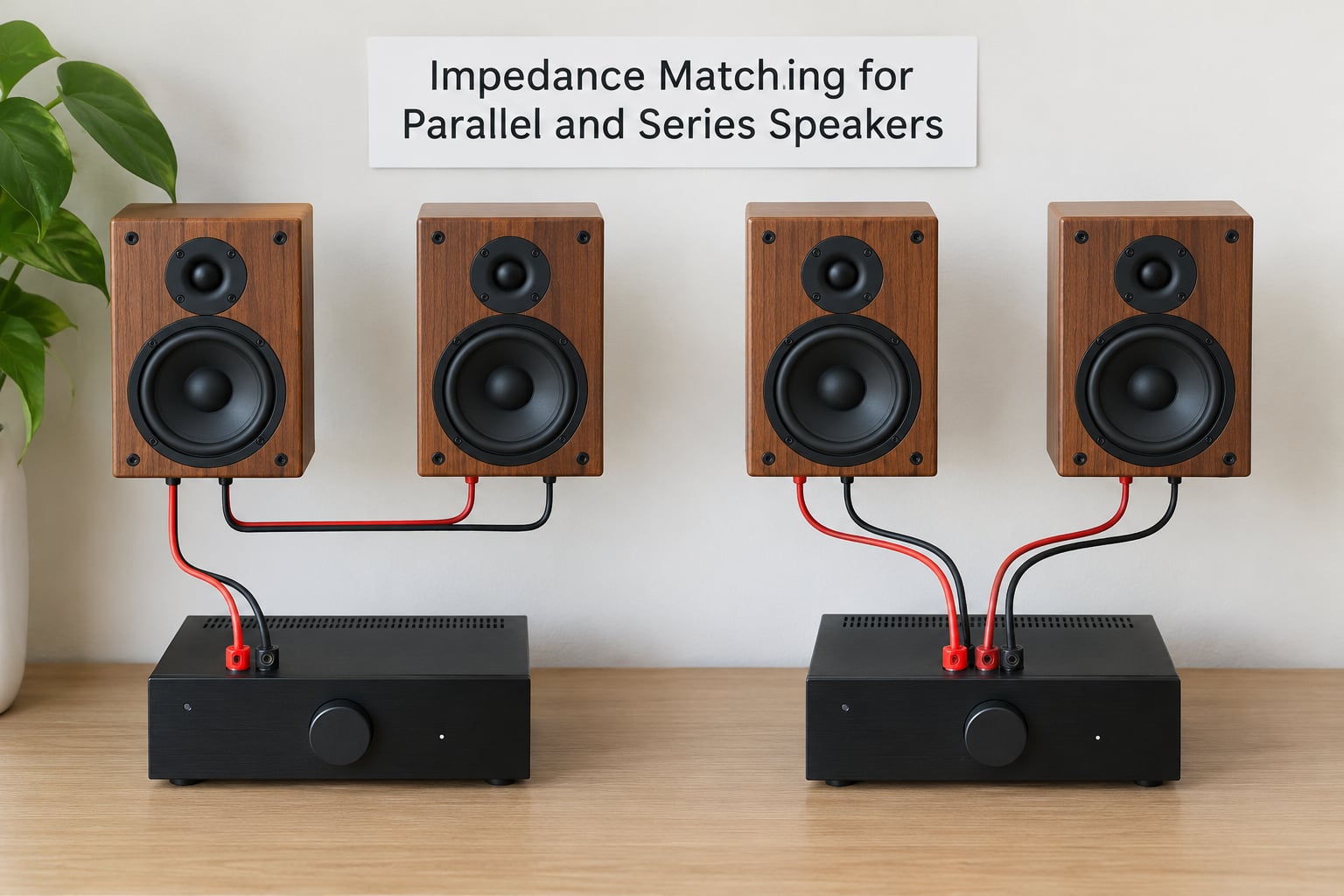
Two speakers can be wired in series (one after the other, positive to negative) or in parallel (both positives together, both negatives together). The total load the amplifier sees changes completely.
Parallel: total impedance = speaker impedance divided by the number of speakers. Two 8-ohm speakers in parallel give 4 ohms. Two 4-ohm speakers in parallel give 2 ohms, which is where car audio people usually stop.
Series: total impedance = speaker impedance multiplied by the number of speakers. Two 8-ohm speakers in series give 16 ohms. Two 4-ohm speakers in series give 8 ohms.
| Combination | Wiring | Load on the amplifier |
|---|---|---|
| Two 8 ohm speakers | Parallel | 4 ohms |
| Two 8 ohm speakers | Series | 16 ohms |
| Two 4 ohm speakers | Parallel | 2 ohms |
| Two 4 ohm speakers | Series | 8 ohms |
| One 4 ohm plus one 8 ohm | Series | 12 ohms |
| One 4 ohm plus one 8 ohm | Parallel | About 2.7 ohms |
The last row is the dangerous one, and it’s the arrangement people stumble into when they mix speaker sets. A 4-ohm and an 8-ohm pair in parallel gives roughly 2.7 ohms, well below what most home amplifiers will drive.
Series wiring is the safe answer for adding a second speaker to an amp that expects a higher load, at the cost of volume. Parallel wiring gives more volume but a heavier load, so it only suits amps rated for the lower figure.
Watch phase too. Wiring one speaker’s positive to the other’s negative in parallel means the two drivers move in opposite directions and cancel at low frequencies. You lose bass rather than gain it.
How Speaker Impedance Differs from Sensitivity and Power Handling
Three numbers appear on every speaker spec sheet, and they describe completely different things.
Impedance is electrical load, in ohms. It tells the amplifier how hard to work.
Sensitivity is efficiency, in decibels at 1 watt and 1 metre. An 88 dB speaker and an 84 dB speaker are both fine; the louder one simply needs less amplifier power for the same level. This is often the number that actually determines how a system sounds loud, and it’s independent of impedance.
Power handling is the maximum power the speaker survives, in watts. A 100-watt speaker connected to a 140-watt-per-channel receiver is not automatically in trouble, because the receiver only delivers what the preamp volume setting asks for.
Two 8-ohm speakers can sound nothing alike: one might be 82 dB sensitive and bass reflex, the other 90 dB and horn-loaded. Identical impedance, completely different loudness and tonal balance. That’s the part that actually shapes the listening experience.
One more figure deserves a mention because few people know what it does. An amplifier’s output impedance is usually well under 1 ohm. Dividing the speaker’s impedance by that number gives the damping factor, a measure of how tightly the amp controls cone movement. Higher damping means bass stops when the music stops; lower damping lets notes ring on slightly.
Common Speaker Impedance Mistakes
Treating 8 ohms as universally safe. It is the easiest load for an amplifier, but a speaker with a deep 3-ohm dip still demands current the amp may not have. Check the minimum.
Ignoring the minimum impedance figure. Nominal ratings are averages; the minimum is the low point the amp has to survive. It is the number that causes shutdowns.
Using too many parallel speakers. Every extra parallel speaker halves the load. Four 8-ohm speakers in parallel is 2 ohms on each channel.
Confusing DC resistance with impedance. A speaker measuring 5.6 ohms on a multimeter tells you the voice coil’s DC resistance, not its rated impedance. Real 8-ohm speakers commonly measure between 5 and 7 ohms that way.
Reading power ratings at the wrong impedance. An amp’s 100 watts into 8 ohms tells you nothing about its 4-ohm figure. Look up both.
Measuring impedance while everything is connected. Turn the amplifier off and disconnect it before checking anything, and never probe a live speaker terminal.
If you want to measure it yourself, a multimeter on the ohms setting with the speaker disconnected gives you DC resistance, which is still useful for spotting a blown driver. Reading a full impedance curve needs an audio interface, a resistor and some measurement software, and for most home systems the manufacturer’s minimum figure is the quicker answer.
How Speaker Impedance Affects Sound in Practice
In a home stereo with one 8-ohm speaker per channel, impedance is the least interesting variable in the room. Turn the volume up and the amplifier behaves predictably all the way to its limit.
Swap in a pair of 4-ohm floorstanders on an 8-ohm-only integrated amp and you’ll hear the difference at high volume rather than at low: the amp works harder, protected bass peaks lose some crispness, and if you push long enough the protection circuit may step in.
With powered speakers you can ignore the topic completely. The matching happens inside the cabinet, where the manufacturer chose the amplifier for the drivers.
Subwoofers are where impedance bites hardest. A single 2-ohm sub on a home receiver expecting 8 ohms will either refuse to play or trigger protection quickly, because subs spend most of their time at the lowest frequencies, exactly where the impedance dips are deepest.
Multi-room and A/B switching adds another layer. Switching one set of 4-ohm speakers in parallel with another set of 4-ohm ones puts 2 ohms on the amplifier. Most receivers handle A and B speaker pairs with their own limit, and it is worth finding it in the manual.
Car audio runs the opposite way from home hi-fi. There, 2-ohm and 4-ohm subwoofers are standard and amps are specified as 2-ohm stable, because lower impedances mean more output from the same amplifier in a car where every watt counts.
Frequently Asked Questions
Does lower impedance mean better sound?
No. Impedance describes the electrical load, not the quality of the driver. A lower number means the amplifier must supply more current, which can allow more volume and may expose an underpowered amp’s limits earlier. Two speakers with the same impedance and different sensitivity can sound nothing alike.
Can I connect 8 ohm speakers to a 4 ohm amplifier?
Usually yes, and it is the safer direction. A higher-impedance speaker draws less current than the amp is rated to supply. Many amplifiers also support a range, printed on the back panel. The reverse case, 4-ohm speakers on an amp rated only for 8 ohms, is the one worth avoiding at high volume.
Why does speaker impedance change with frequency?
The voice coil behaves like an inductor, and the crossover network adds capacitors and other components that respond differently at each frequency. At the resonance point, usually in the low bass, the coil’s reactance cancels its own resistance and impedance peaks. Higher up, the crossover shifts the picture again. That variation is why a nominal rating is only an average.
Is 200W twice as loud as 100W?
No. Doubling power gives roughly 3 decibels more output, which is barely perceptible, especially at low listening levels. To sound twice as loud you need about ten times the power. Impedance affects which power figure you get, but it does not change this relationship.
What’s better, 6 ohm or 8 ohm speakers?
Neither is better. An 8-ohm speaker is the easiest load for an amplifier, and a 6-ohm speaker asks a little more current, so most modern amplifiers drive either without complaint. Choose based on the rest of the specification, especially sensitivity and frequency response, and confirm your amplifier supports the rating either way.
Can I mix speakers with different impedance ratings?
Wiring a 4-ohm and an 8-ohm speaker in series gives about 12 ohms, which is safe on most amplifiers. In parallel the same pair gives roughly 2.7 ohms, below what home amplifiers will drive. Series is the safe combination; parallel needs an amplifier rated for the lower load.
Conclusion
Start with two numbers: the amplifier’s minimum impedance rating and the speaker’s minimum impedance from the manual. Confirm your wiring arrangement, then raise the volume gradually and listen.
Underloading an amplifier is broadly safe; overloading it is what leads to clipping and protection shutdowns. Everything else on this page is detail underneath that one rule, and in 2026 it’s still the first thing to check on any spec sheet.