If you only remember one thing about HD Radio vs satellite radio explained, remember this: HD Radio is free digital broadcasting that piggybacks on local AM and FM towers, while satellite radio is a paid nationwide service delivered from orbit to an antenna on your car. HD Radio wins on local content, uncompressed sound and a zero monthly bill. Satellite radio wins on channel variety, sports, talk and long-distance driving.
Most people compare them as if they do the same job. They don’t, and that mismatch is where most disappointment comes from. HD Radio is closest to a free upgrade to the radio already in your dashboard. Satellite radio is closer to cable TV for audio, with hundreds of channels, long ad breaks on talk, and a bill that arrives monthly.
I’ve spent years writing about in-car audio and listening gear, and the pattern holds: the right pick depends almost entirely on where you drive and what you want to hear. A commuter twenty miles from a transmitter should choose very differently from a long-haul driver crossing four states every week.
Table of Contents
- HD Radio vs Satellite Radio Explained at a Glance
- How HD Radio Works
- How Satellite Radio Works
- Coverage and Signal Reliability
- Stations, Music Programming, and Local Content
- Sound Quality and Features
- Cost, Installation, and Ongoing Fees
- Which Should You Choose?
- Frequently Asked Questions
- So, HD Radio vs Satellite Radio — What Should You Do First?
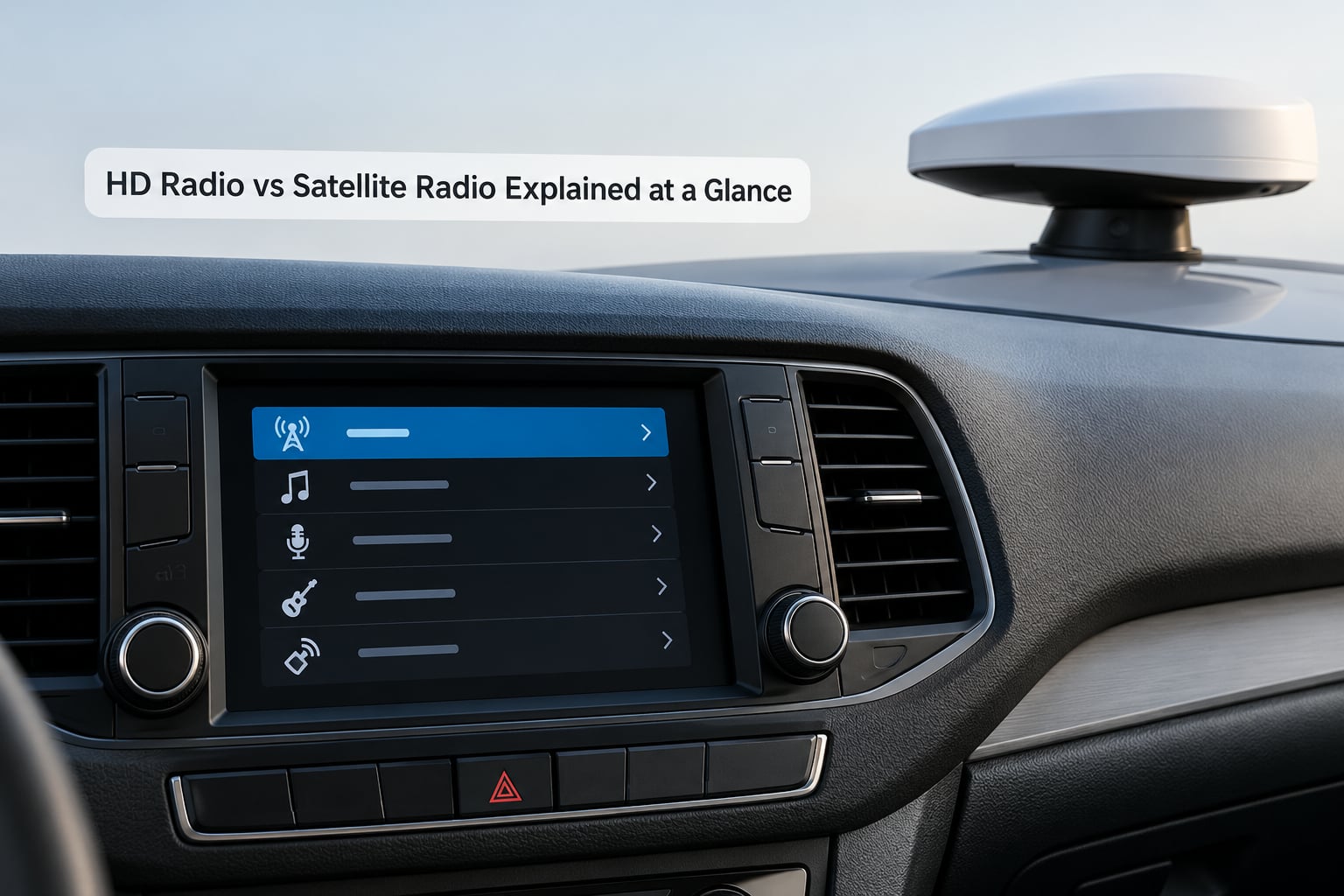
HD Radio vs Satellite Radio Explained at a Glance
| Factor | HD Radio | Satellite Radio |
|---|---|---|
| Signal type | Digital sideband sent alongside the local AM or FM signal from a ground transmitter | Digital audio broadcast from satellites to a vehicle antenna |
| Ongoing cost | None, once you have a compatible receiver | Monthly subscription on a multi-month commitment, or a lower effective rate when billed annually |
| Hardware | Usually built into a new car’s head unit, or an aftermarket tuner for an older car | Tuner plus a roof or glass-mounted antenna; sometimes professionally installed |
| Stations per frequency | Up to four: HD1 to HD4 | Hundreds of channels across the network, no local frequencies |
| Coverage | Regional, based on line-of-sight from each station’s transmitter | Contiguous across the United States and most of Canada and Mexico |
| Audio | Not audio-compressed; clear on a strong signal, falls back to analog at the edge | Compressed for satellite transmission; consistent across the whole coverage map |
| Local content | Yes, it is local broadcasting with extra channels layered on top | Limited to a small number of city channels that repeat wherever you drive |
| On-screen extras | Song title, artist, album art, traffic and weather alerts | Channel and artist info, replay on some channels, sports play-by-play |
| Best for | Daily commuting, local news and music, anyone avoiding a subscription | Long trips, rural driving, commercial-free music, talk and live sports |
One line in that table settles most arguments. HD Radio’s advantage is that the local station you already get for free gets better. Satellite radio’s advantage is that it does not care how far you drive.
How HD Radio Works
HD Radio is a digital broadcast system that runs in the spare space around a normal analog FM or AM transmission. The standard is NRSC-5, and on FM it is usually described as FM-SB, sideband broadcasting. The point of that design was to avoid replacing every transmitter in the country.
Because the digital stream sits next to the analog one, an HD Radio-enabled head unit tunes to 98.7 FM, detects the digital signal, and decodes it. When you drive past the edge of a transmitter’s coverage, the receiver cannot find the digital stream and quietly drops back to the analog signal on the same frequency instead of going silent.
That fallback is called analog blending, and it is the single most under-appreciated feature of the technology. The worst-case scenario is not silence; it is the ordinary FM you would have heard anyway.
What HD1, HD2, HD3 and HD4 actually mean
A frequency that normally carries one analog station can carry up to four digital streams on that same dial position. HD1 is the main program, usually the same feed as the analog station. HD2, HD3 and HD4 are multicast subchannels, and stations use them for genres that do not fit their main format.
In practice you will see a jazz or classic-rock HD2, a news or talk HD3, and occasionally an HD4 that nobody updates. On some newer head units they show up as separate presets; on others they hide behind a long press on the same button. That hardware quirk causes more confusion than anything else in the system.
Why AM in HD does not reach CD quality
An HD Radio signal on FM runs uncompressed at a bitrate that approaches CD audio, and the sound reflects that: deeper bass, cleaner treble, better stereo separation. AM does not get there, because the AM channel simply is not wide enough to carry that much audio data. AM in HD mainly wins by removing static and noise, not by adding detail.
If your daily listening is on an AM band talk station, HD Radio gives you clarity rather than fidelity. If it is on FM, you are hearing something close to CD quality, subject to how good your speakers and cabin acoustics actually are.
How Satellite Radio Works
Satellite radio, in the US almost entirely SiriusXM, works in the opposite direction. Audio is encoded, compressed and uplinked to a small number of geostationary satellites. Those satellites rebroadcast the signal to earth, and your receiver picks it up through a compact antenna shaped roughly like a small shark fin.
Because the signal comes from space rather than a tower, your reception does not depend on population density or terrain. The trade is that you are renting access to a proprietary network. Nobody broadcasts SiriusXM for free, and there is no free-to-air version of it.
What the roof antenna actually does
That fin has nothing to do with receiving broadcast TV. It points at the satellite, gathers a weak microwave signal and feeds it down a coax cable into the tuner. It needs a reasonably clear view of the sky, which is why it usually lives at the front of the roof or behind the windshield or rear glass.
Here is the practical note that reviewers rarely mention: satellite tuners take noticeably longer to wake up than an FM chip does. Listeners on the r/siriusxm forum regularly describe the pause after cold start as the most irritating part of an otherwise good system, especially in winter when the head unit is also running the defroster. It is a small thing, and it is a daily thing.
Coverage and Signal Reliability
Satellite radio wins on raw geography. Once the signal is acquired, it stays essentially continuous across deserts, mountain states and empty counties. That is why long-haul drivers and people in rural areas tend to end up subscribing.
HD Radio wins where you live and drive. Transmitters are placed to follow where people are, so an urban or suburban commute is usually flawless. The weak spots are the ones you hit on the way out of town: a highway curve, a bridge, a wooded section just past the county line.
Satellite radio has its own failure modes. Tall buildings, parking structures, tunnels and dense tree cover can block the antenna, and the audio drops to a brief cutout or silence. In a downtown core, an HD Radio receiver will usually stay solid while a satellite signal flickers.
Weather splits the story too. Heavy rain or snow fades a satellite signal noticeably. HD Radio degrades gracefully because the analog fallback picks up the pieces. Neither service carries audio over your mobile data, so there is no streaming-quality variation to worry about either way.
Stations, Music Programming, and Local Content
This is the strongest argument for HD Radio, and it is not really about sound. HD Radio is local broadcasting that also happens to be digital. Emergency alerts, school closings, high school football calls and the one DJ who knows every regular’s name all come from the same place they always did.
Satellite radio curates hundreds of channels by genre, era and mood. You get commercial-free music, live play-by-play, and talk radio without local commercial clutter. What you get instead of local is national. Some major cities have a handful of local channels, but they repeat the same content whether you are in that city or three hundred miles away.
For a listener who moved to a new town, that difference is stark. Satellite radio will not tell you about the road closure on your commute. A local HD Radio affiliate might.
Is HD Radio on the way out?
It is shrinking, and it is worth being straight about that. Some manufacturers have dropped HD Radio from certain vehicles, several large station groups have sold or retired transmitters, and consolidated ownership has reduced how many subchannels actually get programmed. Search interest in whether HD Radio is dying is real.
None of that makes it a bad choice today. It still ships in a large share of new North American cars, it is the cheapest audio option in the dashboard, and the stations that remain are mostly the well-funded broadcast groups that have no intention of leaving. Think of it less as a growth technology and more as a permanent feature in the same way AM is a permanent feature.
Sound Quality and Features
Ask ten listeners which sounds better and you will get ten answers, usually based on what they grew up with. Ask what the signal is actually doing and the picture gets clearer.
Compression is the real sound difference
HD Radio audio on FM is not compressed at all. SiriusXM audio is compressed so it fits through a satellite link at a practical bitrate. That compression is efficient, and on a strong signal the difference is subtle.
Where it becomes audible is on talk radio and on quieter, more dynamic music. Cymbals and breath can sound slightly smoothed at the top end. For a lot of listeners this is invisible; for others, particularly on a good home system, it is the whole argument. The long-running complaint on car audio forums is that satellite music has thinned out over the years as encoding and channel count were adjusted, while HD Radio has stayed consistent.
There is a second sound factor that beats both formats: the speakers. A factory head unit driving two small door speakers will make an uncompressed signal sound worse than a decent amplifier driving proper speakers. Format matters less than most comparisons assume.
Feature-wise, HD Radio receivers display song title, artist and album art, and many support traffic, weather and emergency alerts that arrive as data alongside the audio. SiriusXM adds replay and pause-live on some channels, voice control and smartphone app connectivity, and it keeps your place across a long drive without buffering.
Cost, Installation, and Ongoing Fees
HD Radio has no subscription. That is the whole economic argument. You buy a compatible receiver once, usually as part of the car, and after that the broadcasts are free to air with nothing to cancel, no contract and no renewal prompt.
Satellite radio is a subscription business. New cars often include a promotional trial period that quietly becomes a paid plan if you do nothing. Plans are structured around commitment length, and paying for a longer term normally lowers the effective monthly rate. Additional accounts, portable use and vehicle-specific add-ons change the total again, so the number in the paperwork is not always the number you will pay later.
Installation is the other line item. A satellite antenna needs a clear mounting position and a coax run, which is a straightforward job on a new car and a bigger one on an older vehicle. Ask a dealer for the full figure, antenna hardware and labour included, rather than the head unit price alone.
Adding HD Radio to an older car
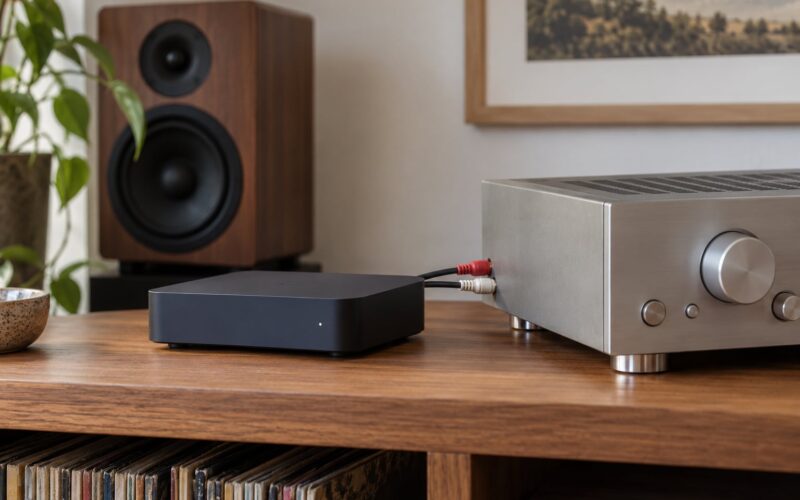
If you love the format but the car predates it, you have three realistic routes. An in-dash unit with a built-in HD Radio tuner replaces the factory radio and gives you the feature permanently. A USB or Bluetooth tuner plugs into an existing head unit and rides on the car’s antenna to receive the same broadcast. A subscription-based app plus an antenna is the third option, and it moves the audio to your phone rather than the car speakers.
The first two need no monthly payment. The third is the one to read the fine print on, because app-based listening services are subscriptions with a free trial attached.
Which Should You Choose?
Match the service to the drive, not to the advertising.
- Choose HD Radio if you drive mostly in and around populated areas, want local news, traffic and weather alerts, care about uncompressed audio, or simply refuse to pay a monthly bill for radio.
- Choose satellite radio if you drive long distances, live far from a transmitter, want commercial-free music channels, follow live sports, or listen to talk radio without local ad breaks.
- Choose both if your car supports both and your budget allows. Nearly every modern factory system carries HD Radio and satellite hardware together, and using the free option for local driving while subscribing for road trips is a reasonable split.
- Choose neither if you commute long distances in a dense city and mostly want your own playlists. Neither service handles a blocked satellite signal or a coverage gap well, and streaming handles both cases better.
Shopping a used car, check whether HD Radio is present before you get excited about the subchannels, and check whether a satellite trial is already running on the head unit. A car that leaves the lot with an active subscription is the most common ownership surprise buyers hit.
Frequently Asked Questions
Is HD Radio better than satellite radio?
It depends on where you drive. HD Radio is better for local content, uncompressed audio, alerts and a zero monthly bill, especially in and around populated areas. Satellite radio is better for long-distance driving, rural coverage, commercial-free music channels, talk radio and live sports. Many cars support both, and plenty of listeners use the free option locally and subscribe for trips.
Do I need a subscription for HD Radio?
No. HD Radio is free to air. You need a receiver with an HD Radio tuner, which is usually built into a new car’s head unit, and after that the broadcasts cost nothing. There is no contract, no renewal prompt and nothing to cancel. If a sales pitch tells you HD Radio requires a paid plan to work, that is wrong.
Why does my HD Radio station cut out when I drive?
Usually you have driven past the edge of that station’s transmitter coverage, where the digital stream no longer reaches you. The receiver then falls back to the analog signal on the same frequency, which sounds flatter and picks up static. Hills, bridges and dense woodland can cause the same effect well inside a coverage area. There is no setting that fixes a coverage gap.
Can I listen to satellite radio without a subscription?
Not to the channels that matter. SiriusXM encrypts its audio stream, so a tuner will tune in and find channels locked without an active subscription. Hardware sometimes has a short promotional period built in, and a new car’s included trial may activate automatically, but that is a limited offer rather than free ongoing access. Antenna and tuner purchase do not unlock the channels.
Does satellite radio work better than HD Radio in rural areas?
Usually, yes. Satellite reception does not depend on local transmitters, so signal stays essentially continuous across open country, mountain states and empty counties. HD Radio depends on line-of-sight from a station’s transmitter, and rural coverage is patchy between towns. Satellite can still be blocked by heavy tree cover, tunnels and tall buildings in built-up areas.
How do I know if my car has HD Radio?
Check the owner’s manual or the audio unit’s specification for HD Radio, HD1 or HD2 support, or simply tune across an FM station. A station with subchannels usually needs a long press or a dedicated HD button to reveal them. On a used car, look for an HD indicator on the radio display and ask the seller to show you the subchannel list before you buy.
So, HD Radio vs Satellite Radio — What Should You Do First?
Start by listening to what you already have. Find an FM station in your area and check for an HD indicator or subchannels; if they are there, that is free local radio with better sound and alerts than you are currently using. If you want it and your car lacks it, price an in-dash tuner or a USB tuner for your vehicle and compare that one-off figure against a year of subscription.
Only look at satellite radio if you regularly drive past the end of your local coverage, or if commercial-free music, talk and live sports are worth a monthly charge to you. For a short daily commute, HD Radio gives you more for free. For the open road, satellite gives you more of everything else.