Short answer: closed-back headphones are the right tool when a microphone is live, and open-back headphones are the better tool when nothing is being recorded. The deciding factor is never fidelity alone, it is whether sound leaking out of your earcups can reach a mic, and whether outside noise can creep in and fool you.
That distinction matters more for radio than for most other listening, because a radio station is a live room with a microphone two or three feet from your mouth. Open back vs closed back headphones for radio is really a question about isolation first and sound second.
Presenters up and down the industry switch from one type to the other and back again, usually after a caller complained about echo on the line. A handful of details, such as the seal of the ear pads and whether your console has a proper cue feed, turn out to matter just as much as the cup design.
Table of Contents
- Open Back vs Closed Back Headphones for Radio at a Glance
- What Is the Difference Between Open-Back and Closed-Back Headphones?
- Soundstage and Imaging for Radio Listening
- Noise Isolation and Sound Leakage
- How Open Back vs Closed Back Headphones Handle Bass and Dialogue
- Comfort, Build, and Everyday Practicality
- Which Should You Choose?
- Frequently Asked Questions
- Are open-back headphones better for radio listening?
- Are closed-back headphones better for listening to talk radio?
- Can I use open-back headphones on a train or airplane?
- Do open-back headphones have better soundstage for radio?
- Should I choose wireless or wired headphones for radio?
- What headphones are best if other people are in the same room?
- Start With Your Listening Environment
Open Back vs Closed Back Headphones for Radio at a Glance
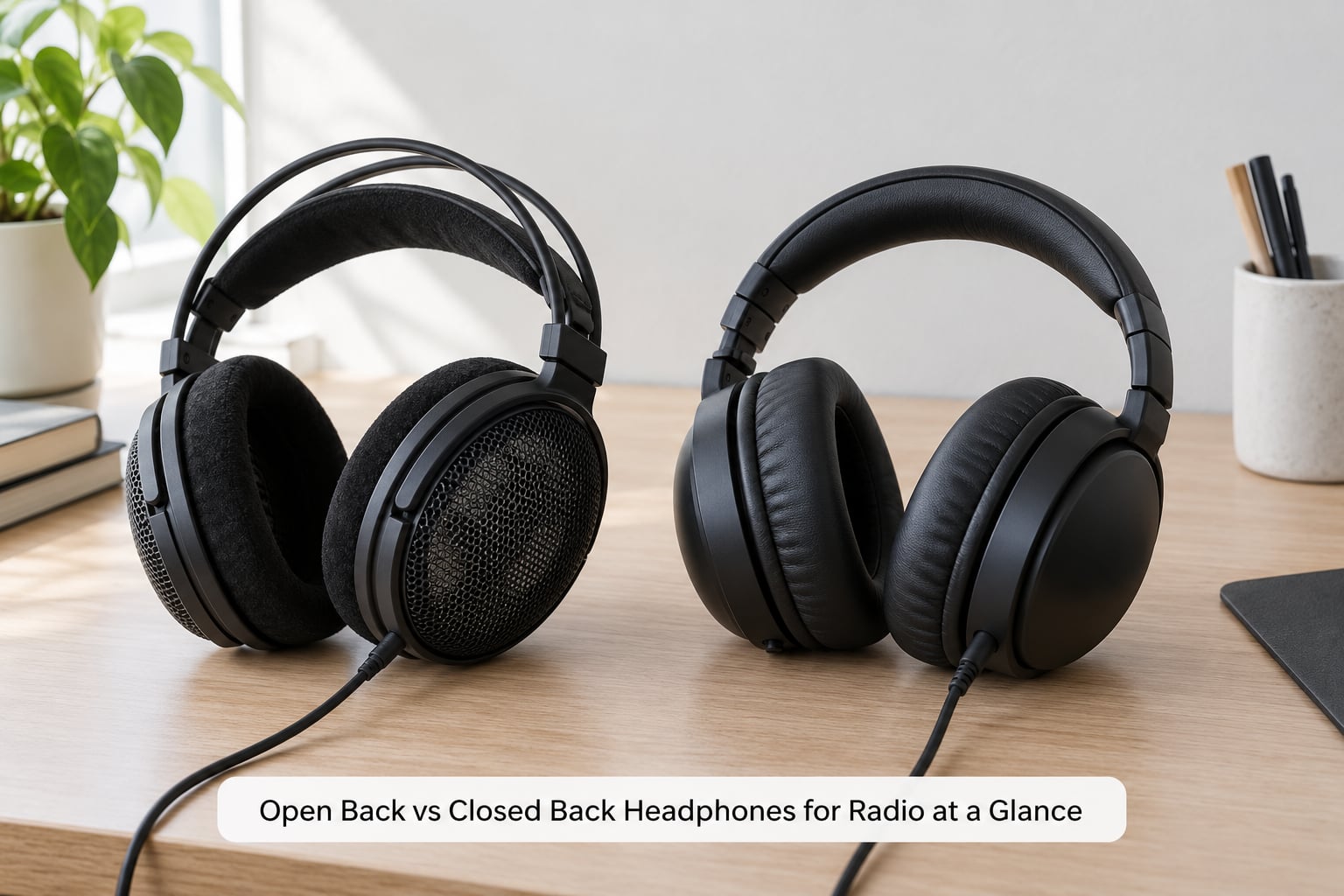
The table below is the short version. Read the verdict column before anything else, because that is where your decision actually lives.
| Factor | Open-back | Closed-back | Verdict for radio |
|---|---|---|---|
| Soundstage and depth | Wide and airy, instruments sit further out | Near and more intimate | Open-back, for listening only |
| Noise isolation | Very little, both ways | Good passive isolation, varies by model | Closed-back |
| Audio leaking to a microphone | Significant, audible on a live mic | Minimal in a treated room | Closed-back |
| Private listening in a shared room | Poor, others hear the programme | Good, nobody else hears it | Closed-back |
| Heat and long-shift comfort | Airflows freely, cooler | Warmer, pads sweat | Depends on your shift length |
| Public transport and air travel | Unusable in most cases | Usable, still not ideal at cruising altitude | Closed-back |
| Monitoring your own voice on air | Not dependable | Reliable, cue is clear | Closed-back |
| Long editing and music sessions | Less fatiguing over hours | Fine, provided pads are replaced | Open-back if the room allows |
Notice what is missing from that list. There is no row for which design is more accurate, because the honest answer is that both can be neutral and measuring well. Row one and row two are about feel and about physics.
What Is the Difference Between Open-Back and Closed-Back Headphones?
The label describes the back of the earcup and nothing else. It is not about wired or wireless, not about the size of the driver, and not about the price of the model.
How an open-back earcup is built
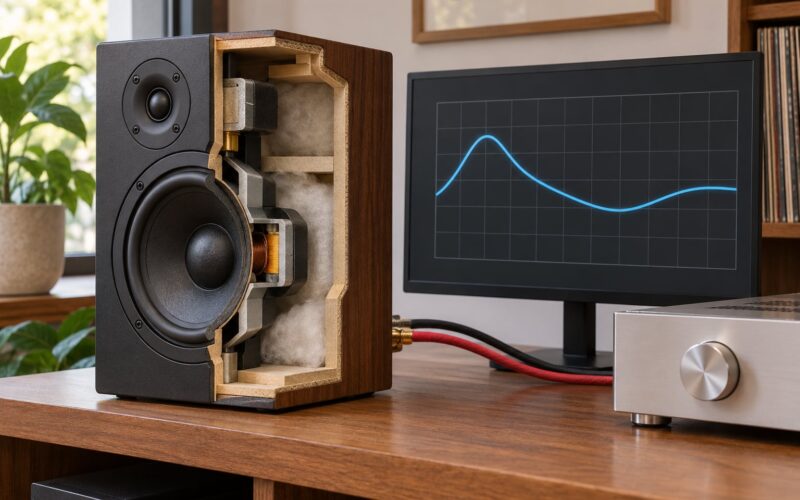
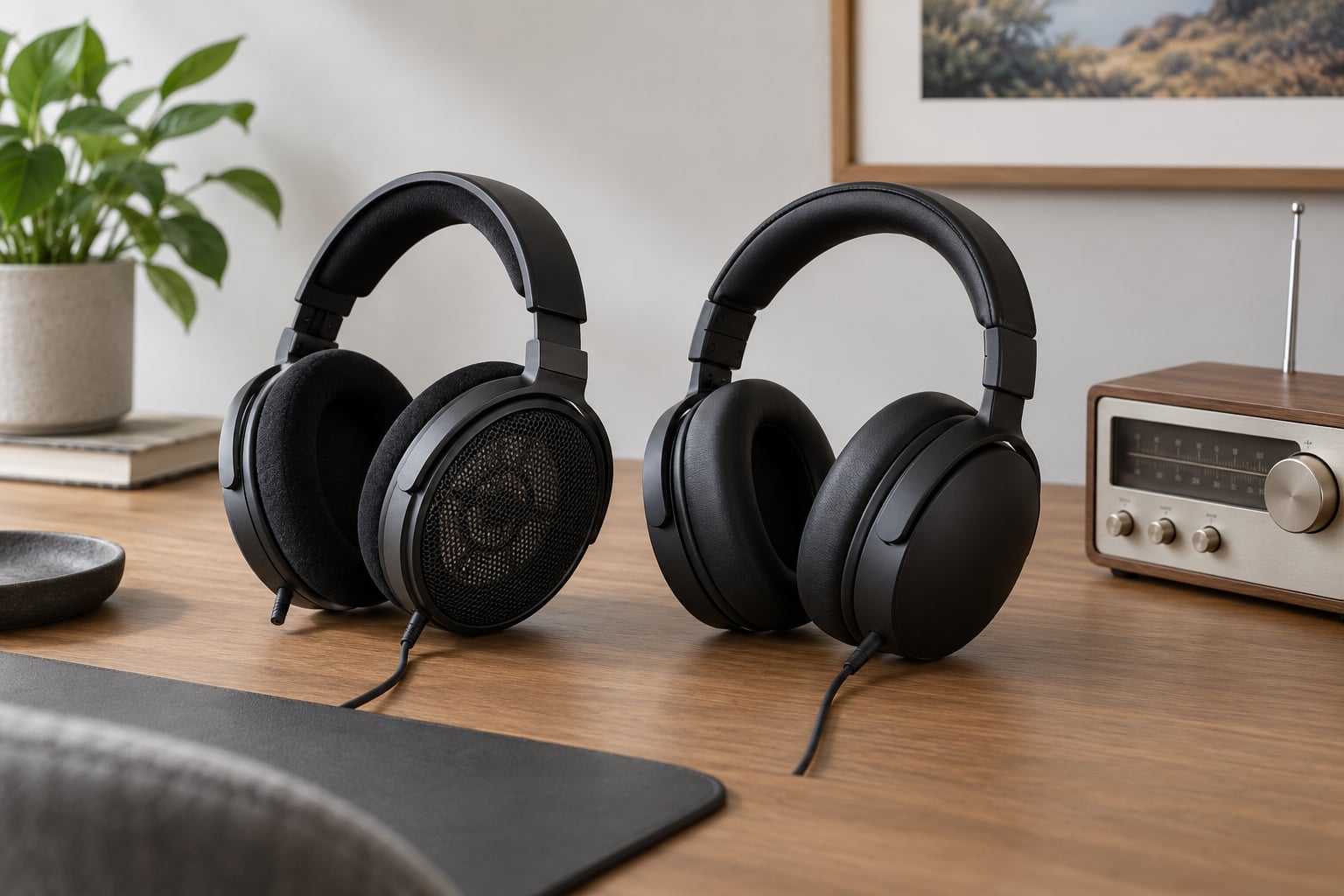
The cup is acoustically open, usually a grille or a ring of drilled holes that lets air and sound move freely through it. Airflow follows the signal, so sound leaves the cup in both directions. That gives you a roomy, uncrowded presentation and no sealed chamber to trap anything.
How a closed-back earcup is built
The cup is sealed, typically with a solid back and an ear pad that creates a physical barrier around the ear. Sound that would otherwise pass out of the driver has nowhere to go, and outside sound is partly blocked on the way in. That is passive isolation, and it needs no battery and no electronics.
A third option sits between the two. Semi-open designs use a partly perforated grille, which softens the extremes of both behaviours without beating either one at its own game.
Soundstage and Imaging for Radio Listening
Open-back headphones usually sound more spacious, and that spaciousness is the reason people buy them. There is more air around each voice and instruments, so a drum kit sounds like it is in front of you rather than inside your skull.
Where the extra space genuinely helps
Long-form music radio benefits most. If your station plays jazz, classical or an ambient block, the wider presentation makes it easier to hear the room a recording was made in, and easier to pick out a single instrument buried in a mix.
Where it helps less than people expect
Talk radio is mostly one voice in the middle, sometimes two. A soundstage has nothing to arrange when there is nothing spread across the stereo field. In practice the perceived difference between the two designs on a two-host interview is small, and any difference you do notice will come down to level and tone rather than imaging.
Spaciousness is also not accuracy. A wide soundstage can come from pad damping, driver design or system tuning rather than from a flat frequency response. Two open-back models can sound wildly different from each other, and plenty of closed-back studio monitors are flatter than either.
Noise Isolation and Sound Leakage
This is where the choice becomes practical rather than aesthetic. Sound moves both through and around headphones, and open-back designs fail in both directions.
In a quiet home office, the leakage from open-back headphones is mostly a small leak onto the desk. In a live studio it is a different problem entirely, because the microphone is live and open-back monitoring will print programme audio straight into the mix. That is the bleed every broadcast engineer is trying to avoid.
The reverse matters just as much. Household noise, air conditioning, a television in the next room and corridor chatter all reach an open-back earcup, and there is no way to turn them out. When you are trying to judge whether a cue is clean, background noise gives you a false answer.
Some specific situations worth naming:
- Live mic in the room: closed-back, no exceptions worth making.
- Shared office or studio with other presenters: closed-back, so nobody else hears the station feed.
- Night shift editing in a quiet house: either design works, and open-back is cooler over a long night.
- Train, bus or plane cabin: closed-back only, and even then expect cabin noise to get in.
- Hotel room for a live remote: closed-back, and check the wall behind you as well as the headphones.
How Open Back vs Closed Back Headphones Handle Bass and Dialogue
Perceived bass depends heavily on the cup design, and this is where closed-back models get unfairly criticised for being boomy. They do not have more bass by default, but they hold the low end inside the cup, which you hear as weight.
The closed-back bass problem
Many closed-back models are voiced with a low-end lift that was designed for fun rather than for monitoring. On a radio station that lift competes with speech, and you end up turning the cue feed down and losing the top end along with it. Models intended for tracking are usually flatter, which is exactly what you want when your only reference is your ears.
Why open-back suits dialogue
Open-back headphones tend to roll off gently at the extremes and stay out of the way in the middle, which is where every voice lives. For editing a two-hour interview and checking that each answer is clean, that is a real advantage. It is also why open-back cans have become the default choice for long mixing and mastering sessions.
Neither design rescues a badly voiced microphone or a noisy cue feed. Track level, mic technique and room treatment move the result further than the earcup decision ever will.
Comfort, Build, and Everyday Practicality
On air, comfort is not a luxury. A presenter wears the same pair for three to six hours, and a hot cup turns into a fidgeting hand, a shifting mic position and a voice that drifts off axis.
Open-back cups vent heat, so they run cooler over a long shift. Closed-back cups trap warmth, and the ear pads are the part that decides whether that is a problem. Breathable fabric pads stay cooler than leatherette, and swapping pads is cheap compared with buying a new pair of headphones.
Clamping force is the other issue. Studio-standard closed-back models built for years of daily use are often firm, and firm is fine for a short session but punishing for a full shift. Clamping force, pad swaps and headband tension are the three things worth adjusting first, and most of the time they solve the problem without changing the headphone itself.
A few practical points:
- Weight matters over a full shift, and over-ear cups spread it better than on-ear ones.
- Detachable cables with locking connectors survive daily plug and unplug far better than fixed cables.
- Replaceable ear pads are worth more than any spec sheet, because pads fail before drivers do.
- Glasses wearers should check the pad shape carefully, since a broken seal costs isolation and comfort at once.
- Wired stays the default for live monitoring, because wireless adds latency you cannot undo.
Which Should You Choose?
Pick by situation rather than by preference, then adjust the rest. Here is how the decision usually lands.
- Quiet home, music discovery and station playlists: open-back. Nothing is recording, so leakage costs you nothing and the wider soundstage is a genuine gain.
- Noisy room, shared house or open-plan office: closed-back. You need outside noise to stay out and the station feed to stay in.
- Live on-air presenting: closed-back. Bleed control is the whole job.
- Interview editing and production work: either, based on the room. Open-back if it is quiet, closed-back if it is not.
- Commuting or travelling with live voice work: closed-back, or an in-ear monitor if you need real isolation.
- Mixed radio and music use every day: closed-back as the workhorse. Add a pair of open-back headphones for production if the budget allows, and swap rather than compromise.
- Guests on a remote call: closed-back, and send them the cable type and level guidance before they connect. A leaking pair doubles the echo problem.
If you can only own one pair, buy the closed-back pair and treat the open-back upgrade as a second step for production work.
Frequently Asked Questions
Are open-back headphones better for radio listening?
Only when nothing is being recorded. Open-back headphones give you a wider, more natural soundstage, which is genuinely pleasant for long music sessions and for editing. The moment a microphone goes live they become a problem, because programme audio leaks out of the open cups and into the mic. For listening at home, yes. For on-air work, no.
Are closed-back headphones better for listening to talk radio?
In practice, yes, and mostly for reasons that have nothing to do with tone. Sealed earcups keep room noise out so you can hear whether a cue feed is clean, and they stop the station feed leaking into a live microphone or into the room. If you already own good open-back headphones, though, talk radio still sounds perfectly clear through them.
Can I use open-back headphones on a train or airplane?
You can, but you should not. Cabin noise and engine rumble pass straight through an open earcup, so you will raise the volume to compensate and arrive fatigued. The programme also leaks into a shared space, which is awkward at best on a train. Use closed-back headphones for travel, and take volume limiters with you for long flights.
Do open-back headphones have better soundstage for radio?
Usually yes, and usually it does not matter much for radio. A wider soundstage shows up most on music with instruments spread across the stereo field, such as jazz, classical or an ambient block. A two-host interview is one or two voices in the centre, so there is very little for a soundstage to arrange. Wide is not the same as accurate, either.
Should I choose wireless or wired headphones for radio?
Wired, for anything live. Wireless adds a small but real delay between the audio feed and what you hear, which makes it harder to judge timing and causes small lip-sync slips when you are back on air. Wireless is fine for listening to a station in the studio kitchen. For monitoring your own voice during a broadcast, keep the cable connected.
What headphones are best if other people are in the same room?
Closed-back, and the more nearly sealed the better. The goal is that nobody else hears the station feed, so avoid open-back and semi-open designs entirely. Padding your cushions with a towel or covering them with a headset cover helps with the small gaps many headsets leak through. Higher impedance closed-back models also tend to seal better.
Start With Your Listening Environment
Decide where you listen before you decide anything else. A microphone in the room means closed-back, every time, and no soundstage benefit is worth the bleed. A quiet room with no recording in progress means you can have the wider, cooler open-back design without downside.
After that, the trade is simple. Spaciousness or isolation. Isolation wins whenever another person, another sound source or a live mic is part of the picture. If you can only afford one pair, make it a well-sealed closed-back pair with replaceable pads, and treat the open-back upgrade as a production tool you add later.