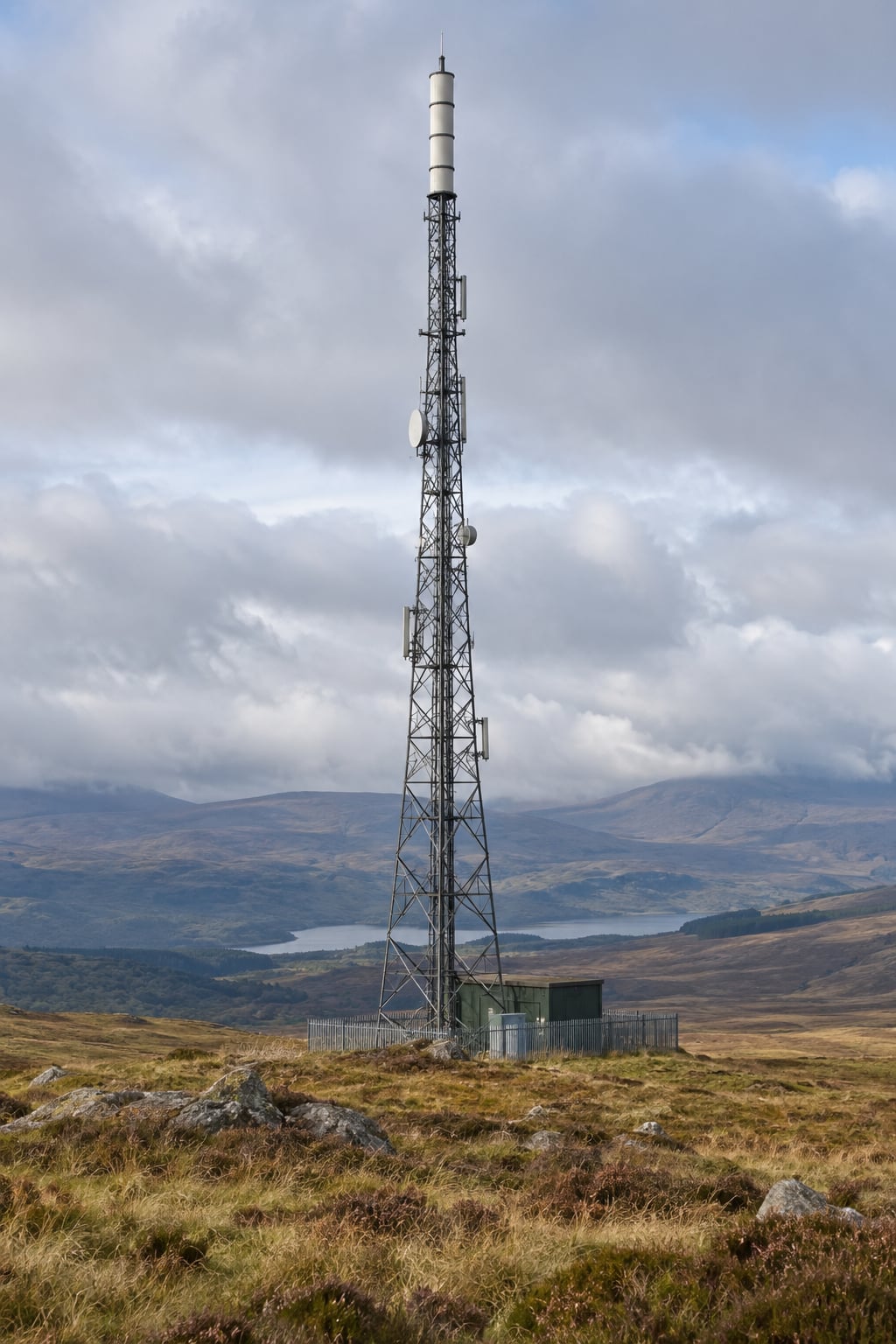
A radio tower broadcasts a signal by carrying a broadcast antenna as high above the ground as possible. Up there, audio from the studio becomes a radio-frequency carrier, is boosted to tens of kilowatts, and leaves the antenna as an electromagnetic wave that your receiver picks up and turns back into sound.
That is the whole trick. Nothing about a radio tower is mysterious, but the chain has more links than most people picture, and every link has its own weak point.
Key takeaways before we start:
- The tower is mostly steel. The radio equipment bolted to it does the actual work.
- Height buys range. A taller antenna sees over more buildings and hills.
- AM, FM and DAB signals travel by different rules, which is why they behave so differently in your car.
- Towers both send and receive, and most reception dropouts happen on the receiving end, not the transmitting end.
Table of Contents
- What Does a Radio Tower Actually Do?
- How Radio Towers Broadcast a Signal From the Studio
- What Is the Transmitter’s Job?
- How Does the Antenna Send the Signal Into the Air?
- Why Do Radio Towers Stand So High?
- What Happens When the Signal Reaches a Receiver?
- Which Radio Broadcast Technologies Carry the Signal?
- What Determines How Far a Radio Signal Travels?
- What Can Interrupt or Distort a Radio Broadcast?
- How Can Listeners Improve Radio Reception?
- Frequently Asked Questions
- How far can a radio tower broadcast its signal?
- Are radio towers always broadcasting the same kind of signal?
- Why can I hear one radio station but not another nearby?
- Does a taller radio tower always reach farther?
- What is the difference between AM, FM, DAB, and HD Radio?
- Can listeners receive a radio station through the internet?
- Conclusion
What Does a Radio Tower Actually Do?
A radio tower does one job well: it gets an antenna up high. The structure itself is steel, a lattice of bolted angles or a single tapering pole, and it carries no signal of its own.
Radio towers come in a few shapes. A lattice tower is an open steel framework, usually guyed with cables anchored to concrete blocks, and it is the classic broadcast mast. A monopole is a single pole, often tapered, that stands without guys. A mast radiator is a pole that is itself the antenna, with no separate aerial on top, and it is the classic AM arrangement.
Heights run from around 30 metres for a small local station to well over 200 metres for a regional super-sites covering several counties. Yorkshire has plenty of both, which is why you can pick up a county station from a hilltop but lose it in a dale.
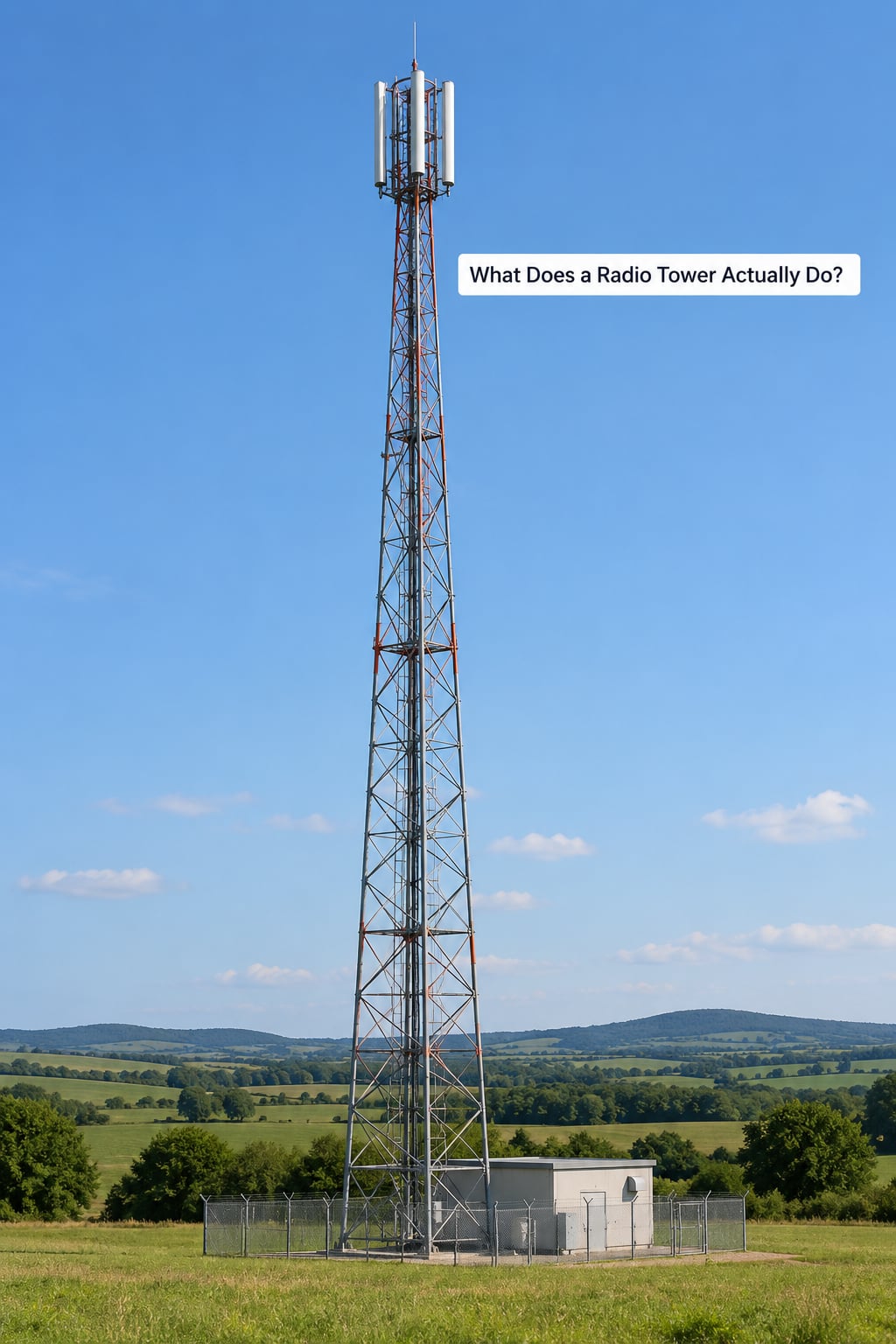
Two myths worth clearing up first. The tower is not glowing, because radio waves are invisible and harmless at that scale. And broadcast towers are not the same thing as cell towers: a broadcast mast sends one signal to everybody in range, while a cell tower handles two-way phone traffic in small sectors with far lower power per user.
Safety note: never climb a mast, never touch an antenna or feeder, and stay well clear of guy-wire anchors. The structure supports a live radio-frequency emitter, the electricity runs through it, and falls from that height are fatal. A fence and a warning sign are there for good reason.
How Radio Towers Broadcast a Signal From the Studio
The signal starts as sound in a studio, not at the tower. A presenter’s voice hits a microphone, the microphone turns it into an electrical audio signal, and a mixing desk blends that with music, adverts and the station’s other sources.
Before it leaves the building the audio is processed: levels are balanced and limited, compression keeps loud moments from swamping quiet ones, and the sound is trimmed to a target loudness so station to station you get a similar level. A stereo or surround signal is also encoded onto its own subcarrier at this stage for FM.
Getting from the studio to the transmitter site is a problem of its own. A studio-transmitter link, or STL, carries the finished audio over a microwave dish link or, more often now, over fibre. Many UK stations send audio to several transmitters and simply play the result straight from a file server, which is why a Yorkshire signal can be identical to a Plymouth one.
Radio tower diagram: studio to transmitter to antenna to receiver.
MICROPHONES + MIXING DESK
        |  audio processing
        v
   STUDIO / PLAYOUT
        |  studio-transmitter link (microwave or fibre)
        v
  EXCITER  (adds the radio-frequency carrier)
        |  low-level modulated RF
        v
  TRANSMITTER AMPLIFIER MODULES  (boost to kW)
        |  coaxial hardline feeder, up the mast
        v
  ANTENNA BAYS  (RF becomes a radio wave)
        |  free space
        v
  YOUR RECEIVER  (wave becomes sound again)
        |
     SPEAKER
At the transmitter site the audio arrives, usually as a digital stream, and an exciter does the actual conversion. It takes your audio and attaches it to a carrier wave at a fixed, precisely held frequency, for example 96.4 MHz. The exciter’s job is accuracy, not power.
On a site carrying several stations, each station’s RF output meets the others in a combiner, a passive device that merges them so a single antenna can carry all of them. The stations stay separate because each sits on its own frequency.
What Is the Transmitter’s Job?
The transmitter’s job is power. The exciter’s output is tiny, a few watts, and useless for covering a county. Amplifier modules, often solid-state cabinets the size of a large suitcase, push that output up to somewhere between 250 watts and 30 kilowatts for FM, and up to 50 kilowatts or more for a big AM station.
How the audio is attached to the carrier is the difference between AM and FM. In FM, or frequency modulation, the audio makes the carrier wobble very slightly higher and lower in frequency, and the receiver watches only that wobble. The amplitude of the carrier, which is easily wrecked by lightning and electrical noise, is thrown away.
In AM, amplitude modulation, the audio makes the carrier swell and shrink in strength while the frequency stays put. More of the signal survives, but so does more of the interference, which is why AM stations pick up hiss and buzz from car systems, kettles and pylons that FM shrugs off.
Digital services such as DAB work differently again. An exciter encodes the audio into a stream of data, and every receiver decodes that data. There is no amplitude to preserve, so the reception threshold is very sharp: either the data arrives cleanly and the sound is pristine, or it fails and you get silence or a stutter rather than gradually worsening sound.
A transmitter also watches itself. Reflected power going back down the feeder, which means a mismatch or a damaged cable, will shut the amplifier down before it destroys itself. Transmitters run continuously, so they are built in pairs, with automatic switchover to a standby unit, and the whole building sits on a diesel generator for when the mains power goes.
How Does the Antenna Send the Signal Into the Air?
Coaxial hardline feeder runs up the inside of the mast, usually a few inches across, carrying the radio-frequency power. At the top it meets the antenna, and that is where electrical energy stops being electricity in a cable and becomes an electromagnetic wave in the air.
At an FM site the antenna is normally a stack of identical antenna bays, each one a vertical arrangement of dipoles fed in phase so the whole column radiates as one. More bays means more gain, which means more signal for the same transmitter power. Eight bays is common for a regional site.
That gain is why two numbers for the same station never match. Transmitter output power is what leaves the amplifier. Effective radiated power, or ERP, is what the antenna actually pushes out in a chosen direction, and because the antenna focuses energy horizontally rather than up and down, ERP can be several times the transmitter power. Height and antenna gain, not raw kilowatts, are what decide coverage.
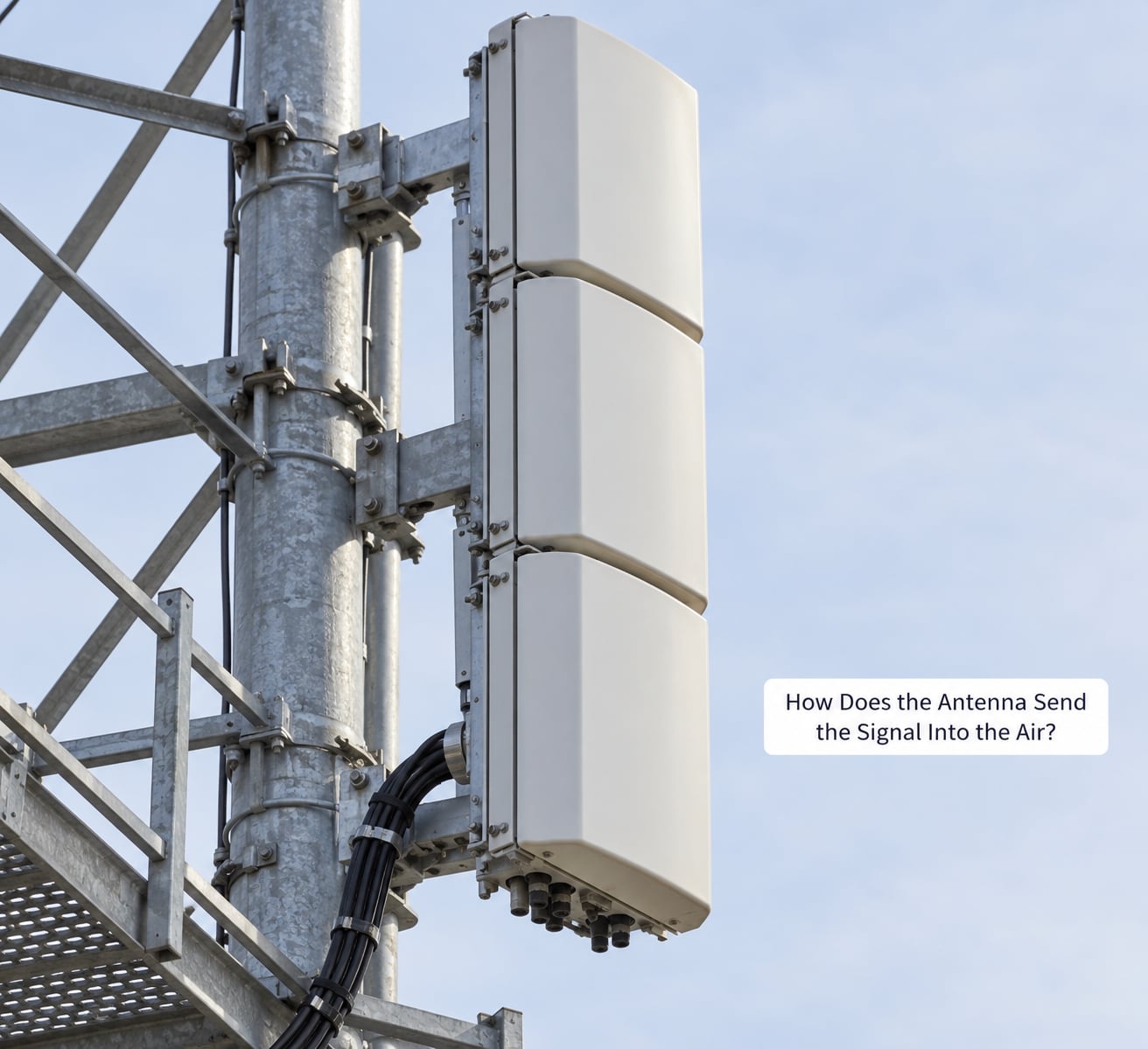
Antennas waste energy on purpose. Energy radiated straight up does you no good at ground level. The radiation pattern, a diagram of how much energy goes in each direction, is therefore deliberately squashed, and some sites add directional panels to tilt coverage toward a population rather than out to sea.
Why Do Radio Towers Stand So High?
Radio at these frequencies behaves almost like light. It goes in straight lines, it is blocked by solid things, and it does not wrap around hills. The transmitter site has to be able to see the receiver, which is why engineers talk about line of sight and the radio horizon, a line that sits slightly below the visual horizon because the radio wave bends very slightly downward as it travels.
Ten extra metres of mast height is worth an enormous amount of coverage. A site on top of a Pennine ridge at 300 metres sees far across several counties. A site on the flat floor of a city, at 40 metres, has buildings in the way almost immediately and is useful mainly to cars driving in streets around it.
Compare the two cases. A community FM station running 250 watts from a 30 metre mast may give reliable reception across a single town and fringe into the villages around it. A regional station running 30 kilowatts from 150 metres reaches across a county and 30 to 40 miles into neighbouring counties, and does it far more consistently because the horizon is further away.
Rural sites are the awkward ones. A village in a steep dale can sit inside the shadow of the hill next to it no matter how powerful the transmitter is, because the hill is between the transmitter and the village.
What Happens When the Signal Reaches a Receiver?
Your radio runs the whole chain backwards. The antenna on the set picks up a tiny electrical signal from the wave passing through it, the tuner selects one frequency from all the hundreds on offer and rejects the rest, and a filter narrows it down further.
Then the reversal happens. An FM receiver rebuilds the audio from the wobble in the carrier. An AM receiver follows the swell and shrink. A DAB receiver decodes the data stream, corrects any errors it can, and hands clean audio to the amplifier and speaker.
One effect surprises nearly everyone. A very strong nearby station does not simply make other stations easier to receive. It can overload the receiver’s front end so badly that weak stations become impossible to hear, which is why a cheap set next to a powerful transmitter can sound worse than the same set in a quiet spot. Hobbyists call it being deafened by the neighbour.
This is also the difference between broadcast radio and streaming. A broadcast signal reaches everyone in range at once, from one tower, with no subscription and no data plan. Streaming sends a private copy to each device, which is more convenient and works anywhere with a connection, but it is not the same as a tower transmitting.
Which Radio Broadcast Technologies Carry the Signal?
| Technology | Method | Typical use | Strengths | Limits |
|---|---|---|---|---|
| AM | Amplitude modulation, medium wave | Talk radio, local and national | Travels much further, especially at night, and bends around hills and buildings | Noisy, prone to interference, poorer sound, tall masts needed |
| FM | Frequency modulation, 88 to 108 MHz in the UK | Local commercial and community radio | Clean sound, stereo, strong immunity to electrical interference | Line of sight only, so coverage is limited by terrain and antenna height |
| DAB and DAB+ | Digital audio encoded onto OFDM subcarriers | National and local multiplexes across the UK and Europe | Consistent quality, no tuning between stations, extra data services | Sharp cliff-edge reception, gaps where the transmitter is blocked, fewer sets than FM had |
| HD Radio | Digital sidebands either side of an existing FM carrier | Mainly North America | Keeps FM coverage, adds digital channels and on-demand features | Not a UK service, receiver-dependent, digital layer drops away at the edge of coverage |
None of these is universally best. AM wins on reach, FM wins on sound, DAB wins on consistency where you have it, and HD Radio is largely a US story.
What Determines How Far a Radio Signal Travels?
Distance is never a single number written on a licence. It is the result of several things pulling against each other, and understanding which one is limiting explains most reception complaints.
- Transmitter power. More kilowatts means a stronger signal at the edge, though the gain flattens out as power rises.
- Antenna height and gain. In practice the biggest lever of all, because height moves the radio horizon further away.
- Frequency. Lower frequencies bend around obstacles and follow the ground further. Higher frequencies carry more data but are more line-of-sight.
- Terrain. A ridge can double your coverage for a site and blind it in the next valley.
- Buildings and obstructions. Dense city centres and thick woodland absorb and scatter signals.
- Your receiver. A decent set with a proper external antenna outperforms an expensive one with a short whip.
- Interference. Other transmitters, electrical equipment and the overload effect all cut into what you actually hear.
Power limits are set by the broadcasting regulator, Ofcom in the UK, which licenses a station’s location, frequency and power, and the coverage area a licence produces is a legal commitment as much as a technical one.
What Can Interrupt or Distort a Radio Broadcast?
Most signal problems are not the transmitter’s fault. Something is getting between the wave and the set.
Under a bridge or inside a tunnel you are in a radio shadow, a dead zone where the direct path is blocked and reflections cannot fill the gap. Valleys and deep cuttings do the same thing to a motorway, and so does a large building on the far side of a car park. A hand-held radio held up against a brick wall can perform worse than the same radio held out in the open, because the wall blocks and scatters rather than amplifies anything.
Multipath is the other big one. The wave reaches your antenna directly and also after bouncing off buildings, hills and cars. When the direct wave and a reflection arrive slightly out of step, they partly cancel each other, and the station gets quieter, distorted, or drops out for a moment. That is what makes reception worse while driving through a built-up area than in open countryside at the same distance.
Electrical noise from car systems, LED lights, motorway lighting and mains wiring mostly hurts AM, which is why AM stations sound full of hiss near a motorway and fine out in the countryside.
Weather matters mostly through temperature, since changes in the air’s density change how far radio waves bend. On a settled, warm day the radio horizon can extend well beyond the normal one, and distant stations appear in the afternoon that you never had before. At night the ionosphere changes the rules for medium wave, and AM stations from hundreds of miles away turn up.
How Can Listeners Improve Radio Reception?
Most reception problems in a car or at home are fixable without spending anything.
- Move the set, not the transmitter. A metre or two can be the difference between a station and nothing. Try a windowsill rather than a shelf in a metal cabinet.
- Turn the volume down and the squelch up. A weak station heard quietly often sounds cleaner than the same station pushed up against interference, because a strong unwanted signal is what usually overwhelms the receiver’s front end.
- Extend the antenna properly. On FM, fully extending the telescopic whip matters far more than on AM. For a home set, a proper external FM aerial on the roof is a bigger upgrade than a more expensive receiver.
- Use a wired aerial for AM. AM reception wants a large aerial relative to the wavelength, which means a long indoor wire or an external aerial, not a short whip.
- Pick the right service. Where a DAB multiplex is available and your set has a good signal, DAB avoids the electrical noise that spoils AM and will not drift off frequency like FM does.
- Check the connection. Corroded aerial sockets and loose car adapters cause more dropouts than people expect. A firm, clean connection is free.
- Compare against the stream. If the station’s own stream sounds fine on your phone, the fault is between the tower and your receiver, which tells you where to look next.
Frequently Asked Questions
How far can a radio tower broadcast its signal?
It depends on transmitter power, antenna height, terrain and frequency. A 250 watt community FM station on a 30 metre mast covers a town and its outskirts, while a 30 kilowatt regional station on a 150 metre mast can be heard 30 to 40 miles. AM goes much further, and night-time AM can travel hundreds of miles. There is no fixed number; height and line of sight decide most of it.
Are radio towers always broadcasting the same kind of signal?
No. A tower can carry FM, DAB, television, mobile phone and emergency services signals at the same time, each on its own frequency, merged by a combiner. Large shared sites can host several dozen services. AM stations usually use the mast itself as one big antenna, so their tower carries a different kind of signal from the multi-bay antennas used for FM.
Why can I hear one radio station but not another nearby?
Because frequency, direction and power all differ. A station on a different frequency may be transmitted from a different site, aimed differently, or on a much lower power. If the two are close on the dial they may be sharing a mast, but if the strong one is on 96 MHz and the weak one on 104 MHz, nothing about the strong signal helps. Strong nearby signals can also overload your receiver and hide the weak one.
Does a taller radio tower always reach farther?
Almost always, and that is why height is the single most valuable thing at a broadcast site. A taller antenna raises the radio horizon so the transmitter can see over more buildings and hills. Ten metres of extra height is often worth far more than tripling the transmitter power. The exceptions are engineering rather than physics: an antenna that wastes energy upward, or a site where licensing stops a taller mast being built.
What is the difference between AM, FM, DAB, and HD Radio?
AM varies the strength of a carrier and travels furthest, but sounds noisy. FM varies the frequency, sounds cleaner, and needs line of sight. DAB encodes audio as data on multiple subcarriers, giving consistent quality with a sharp edge where reception stops. HD Radio adds digital sidebands beside an existing FM carrier in North America. DAB is the standard digital service in the UK.
Can listeners receive a radio station through the internet?
Yes, and most stations offer it. A broadcast signal is sent from one tower to everyone in range at once, with no subscription, which is its main advantage. Streaming sends a separate copy to each device over a data connection, so it works anywhere you have signal and costs nothing to receive, but it uses your data allowance and depends on coverage rather than a transmitter. Many people use both.
Conclusion
How radio towers broadcast a signal comes down to three reversible steps. Audio from a studio is attached to a high-frequency carrier and amplified to kilowatts, the antenna radiates that energy as an electromagnetic wave from as high and as gainfully aimed as possible, and a receiver’s own antenna, tuner and demodulator reverse the process to give back sound.
Once you hold that chain in your head, everyday oddities stop being odd. A station fades under a bridge because something is blocking the line of sight. AM travels further than FM because lower frequencies bend around obstacles. A strong neighbour station can ruin a weak one because the receiver’s front end is overloaded. Height matters more than power because of where the radio horizon sits.
Start with the reception problem you actually have. Check whether the stream of the same station sounds clean on your phone; that single test tells you whether to blame the tower or your own set, and saves a lot of guessing.